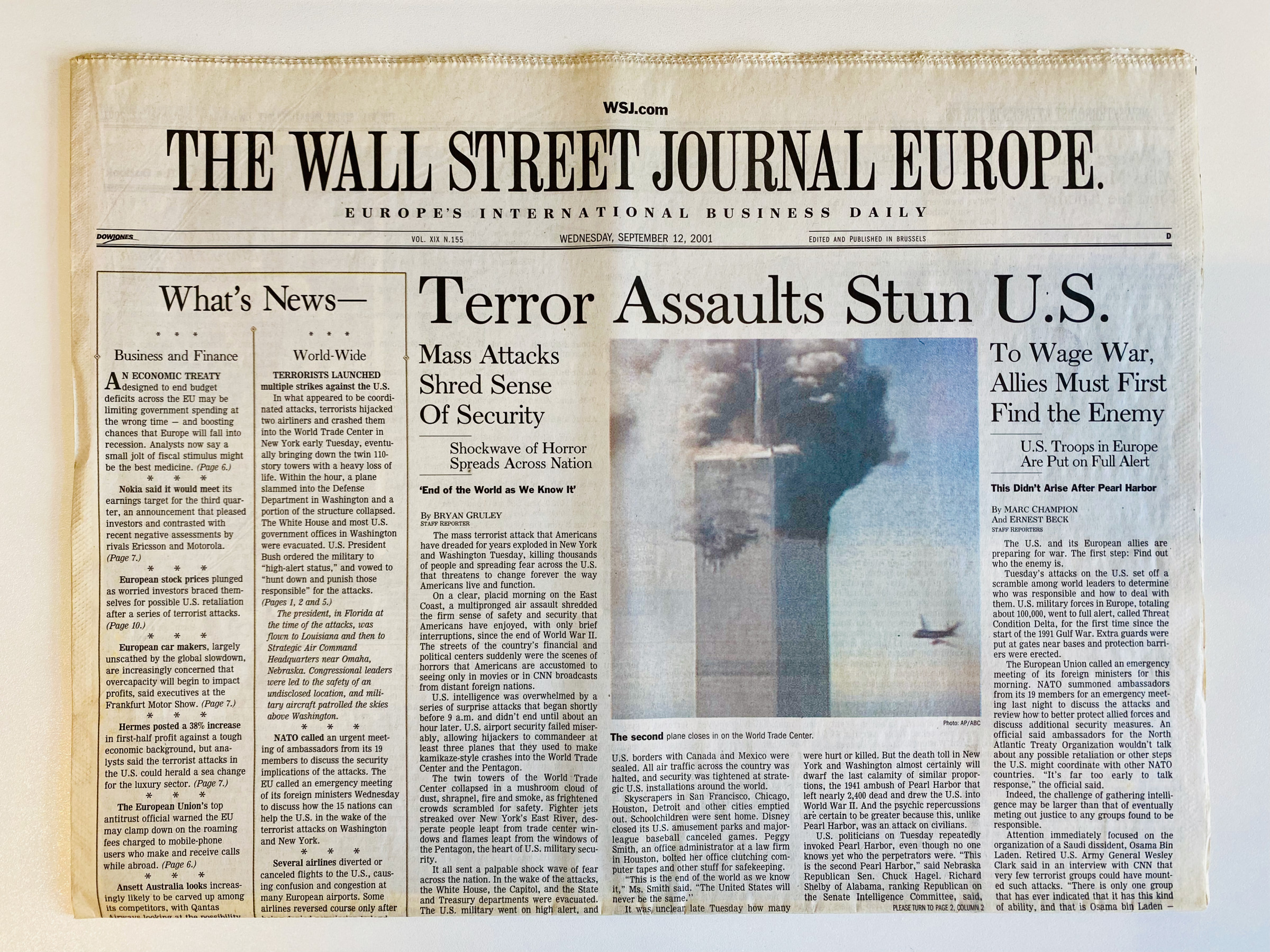
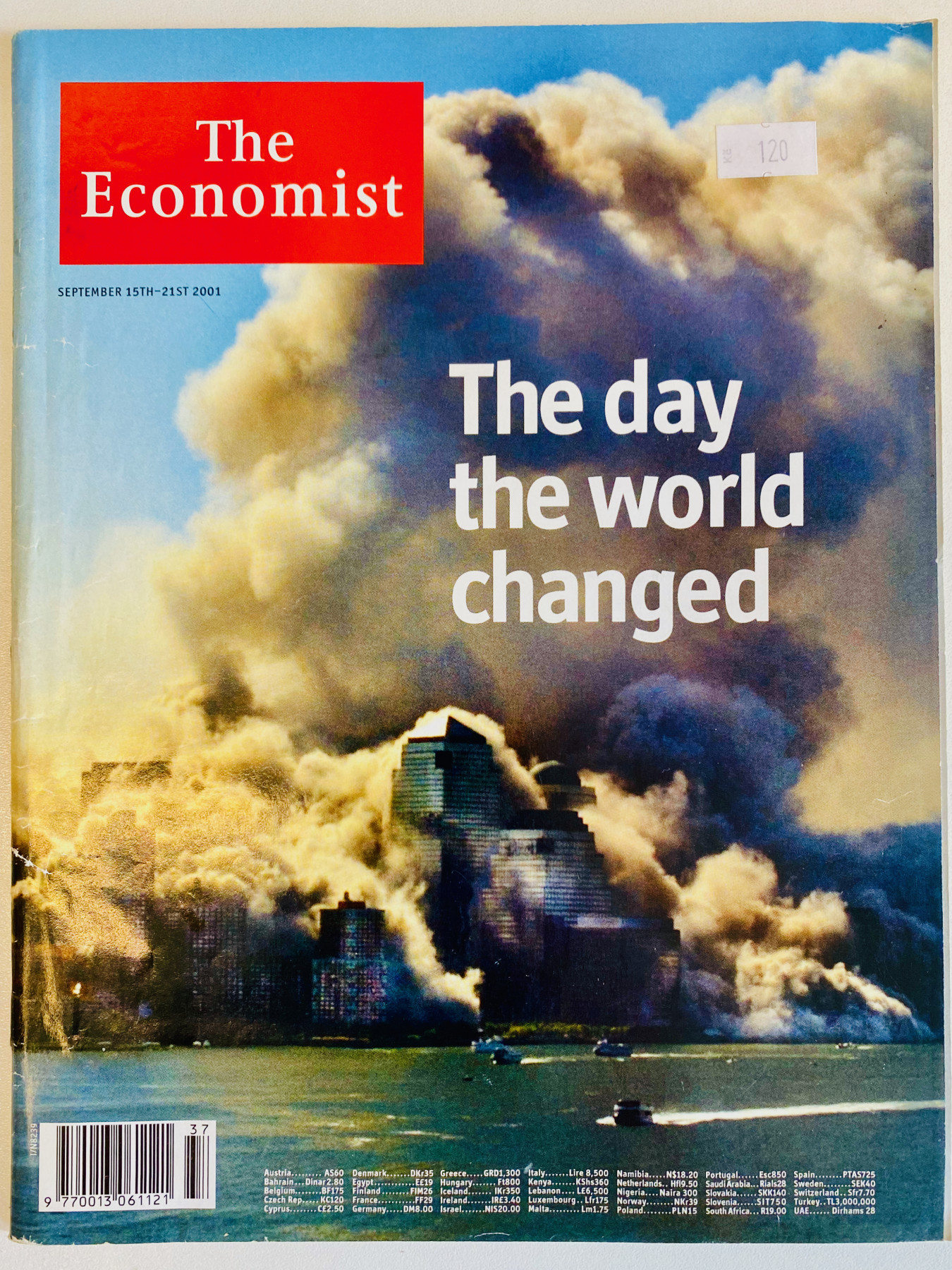

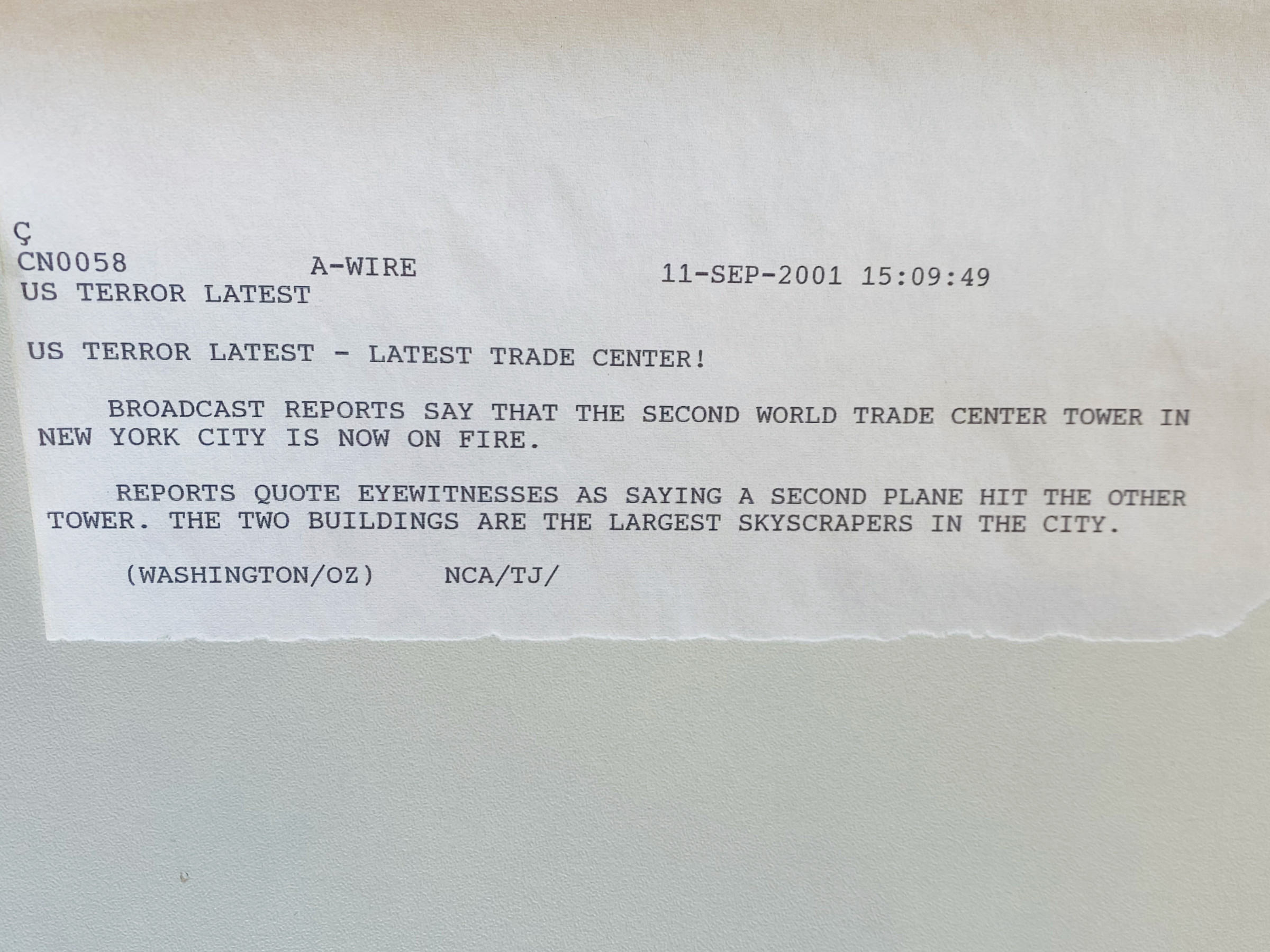
September 11, 2001, started out as just another workday for me. At the time, I was working in Prague as deputy director of the central newsroom at Radio Free Europe/Radio Liberty. It was our department’s job to monitor the major news wires – Reuters, AP and others – for stories of interest to our 30 or so broadcast language services and write them up in English as short, radio-friendly reports. We would place the stories on our internal newswire, the “A-wire,” where the language services could translate them for their own broadcasts.
It promised to be a slow-ish news day. The biggest stories were expected to be follow-up reports on two events from September 9: the Belarusian presidential election and the assassination of anti-Taliban Afghan commander Ahmad Shah Massoud by al-Qaeda operatives. That second story might, in retrospect, have offered a hint of what was coming, but nothing could have prepared us for the shocking news out of New York that arrived in mid-afternoon Prague time.
My earliest recollection of the unfolding disaster begins shortly before 3 p.m. (9 a.m. Eastern time). I remember watching CNN on one of our newsroom televisions, showing what appeared to be a small plane that had crashed into one of the twin towers of New York’s World Trade Center. The initial reports suggested a bizarre, tragic accident. We alerted our Washington, DC, bureau to the story and then, I suppose, turned our attention back to the Belarusian election.
About 15 minutes later, shortly after 3 p.m., our collective stomachs dropped. A second plane struck the other tower. It was clear in an instant that this was no accident.
After that, everything becomes a blur. Around 3:30 p.m. came news of a third attack, this one at the Pentagon. Not long afterward, another plane crashed in rural Pennsylvania. No one knew what else might be coming. Like every other news organization, we all shifted into overdrive, trying to verify the torrent of information and assemble the pieces into a coherent whole our listeners could understand. I distinctly remember the surreal, wrenching feeling of watching first one tower, then the other, crumple and collapse. Some 3,000 people would die that day, and hundreds of thousands more in the wars and attacks that followed.
I’ve posted here photos of our A-wire reports from that day. Reading them now, 25 years later, shows how the story slowly came into focus.


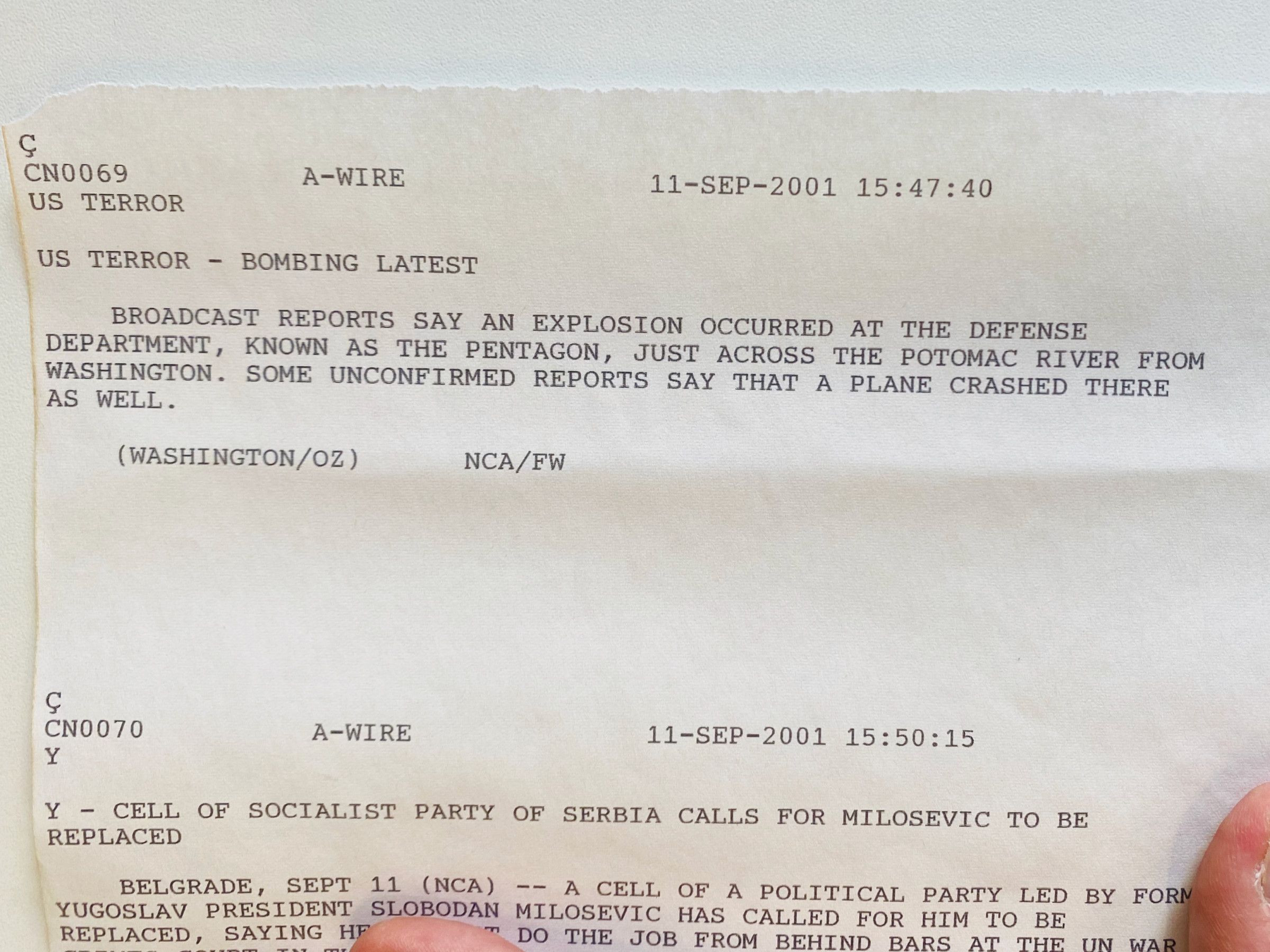
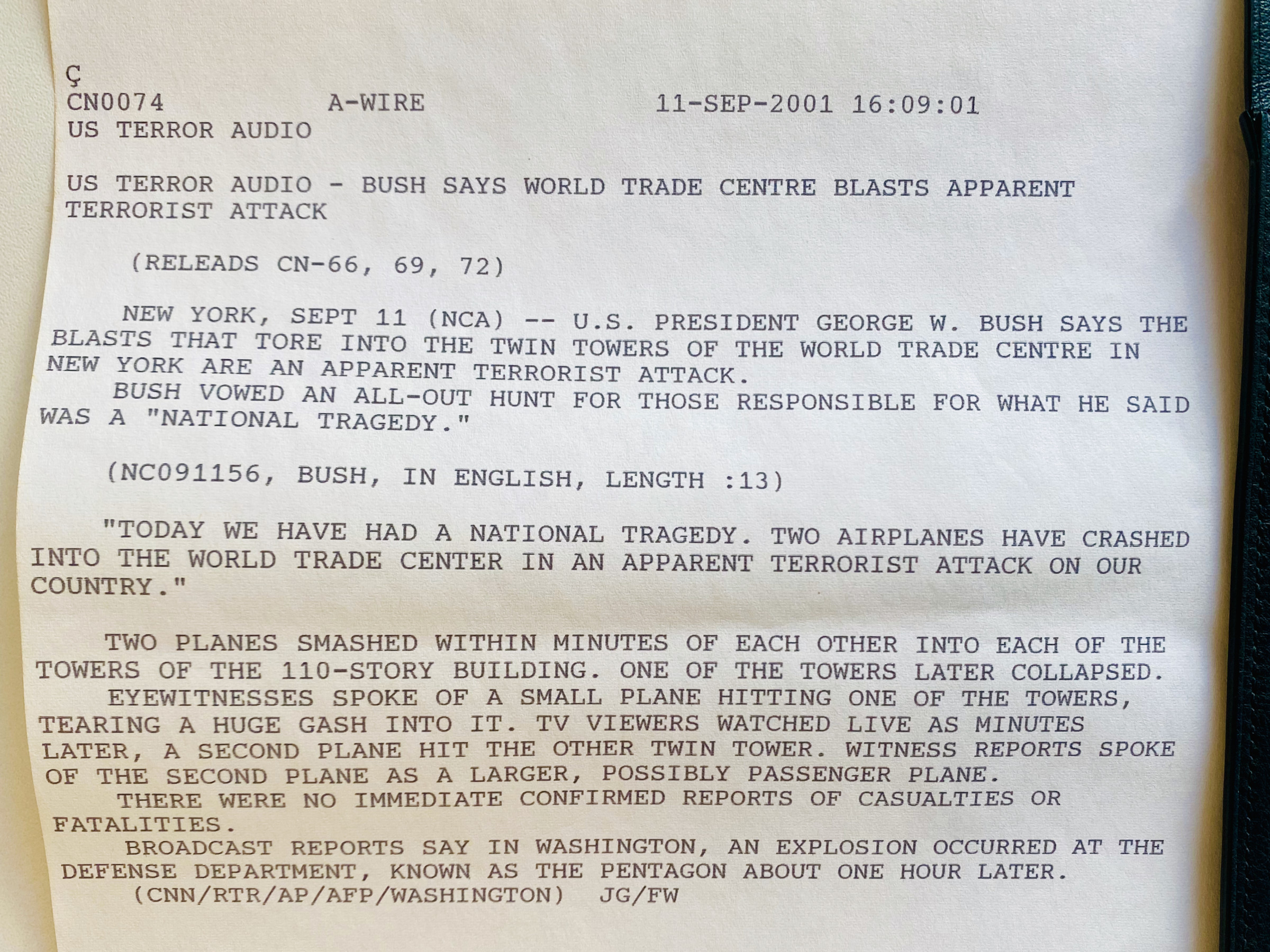
Over the next few months, the immediate consequences of the attacks began to take shape. The U.S. and its allies launched “Operation Enduring Freedom” in Afghanistan, the Taliban government collapsed, and al-Qaeda was driven from its bases and training camps there.
Almost exactly one year later, in September 2002, Radio Free Europe/Radio Liberty sent me to Afghanistan for a month-long reporting assignment. By then, most of the heavy fighting had ended and the focus was shifting toward the enormous task of rebuilding a country devastated by more than two decades of war.
What I remember most vividly from that trip is the sense of optimism. Kabul was still badly damaged, and Afghanistan remained desperately poor, but there was an unmistakable feeling the country had been given another chance. International aid organizations were arriving, refugees were returning and efforts were underway to rebuild schools, roads and government institutions. Girls, who had been barred from education under the Taliban, were going back to school. Music could be played openly again. Men could shave their beards. People -- famously -- could even fly kites.
There was also, perhaps surprisingly from today’s perspective, an enormous reservoir of goodwill toward the United States. Many Afghans I met were grateful that the Taliban had been driven from power and hopeful that, with sustained international help, their country might finally escape the seemingly endless cycle of war and poverty. I came away believing that something genuinely positive might yet emerge from the horror of September 11.
But there were warning signs even then.
During my stay, the Bush administration was already turning its attention toward Saddam Hussein and the possibility of war with Iraq. Afghans I interviewed worried that their country, once again, would simply be forgotten. In a story I filed from Kabul on September 23, 2002, I wrote about growing fears that an American invasion of Iraq would divert international attention and resources just as Afghanistan was beginning the difficult process of reconstruction. [You can read more about my 2002 Afghanistan assignment, including links to some of my original RFE/RL reporting, here.]
Looking back all these years later, what strikes me most is how plausible that early optimism felt. The eventual return of the Taliban was hardly preordained. In September 2002, Afghanistan seemed to offer at least the possibility that something constructive could emerge from the catastrophe we had watched unfold on our newsroom television screens one year earlier.
Two years later, another RFE/RL assignment would show me a different and less hopeful consequence of September 11 -- this time not on a distant battlefield, but in the heart of Europe.


That assignment came in November 2004, when RFE/RL sent me to the Netherlands following the murder of Dutch filmmaker Theo van Gogh. Van Gogh, a provocative critic of Islam, had been shot and stabbed to death on an Amsterdam street by a Dutch-born Islamic extremist of Moroccan descent. The killing stunned a country that had long prided itself on tolerance and openness. Some Dutch were already calling November 2, 2004, their own “9/11.”
I spent several days in Amsterdam and The Hague interviewing politicians, academics, immigrants and ordinary Dutch people for a five-part series on immigration, Islam and the increasingly bitter debate over multiculturalism. I began to understand that the aftershocks of September 11 extended far beyond Afghanistan, Iraq or the “war on terror.” The attacks had also changed the way Europeans started to look at one another.
One observation has stayed with me ever since. The late academic Meindert Fennema, an immigration expert at the University of Amsterdam, told me that before September 11, the presence of so many guest-workers and immigrants from the Middle East and surrounding areas had largely been regarded as a "social" problem. Afterward, it had become a "security" problem as well. Even the language had changed.
"Before [9/11]," Fennema told me, "they were [simply] ‘Moroccans’ or ‘Turks’ … but then suddenly they all became ‘Muslims.'"
That sentence crystallized a transformation I was only beginning to comprehend. Questions of immigration, Islam and national identity were becoming intertwined with fears about security and terrorism. Van Gogh’s murder brought those tensions explosively to the surface.
I had another encounter on the trip, the significance of which I didn’t fully appreciate at the time. In The Hague, I interviewed a relatively new, rapidly rising right-wing politician named Geert Wilders. Wilders had recently broken with the country's center-right VVD party and was attracting lots of attention and support with calls to halt immigration and crack down on radical Islam. Wilders was under a death threat at the time (or at least claimed to be), and we met at a hidden location. I considered him fringe, though he was quickly moving to the country's mainstream.
What I didn't fully grasp back then was that I was witnessing the early stages of a political transformation that would extend far beyond the Netherlands. September 11 didn’t create Europe’s tensions over immigration, integration or national identity, but it fundamentally altered the terms of that debate.


And that, perhaps, is why an anniversary like this one is so difficult to make sense of.
September 11 must first and foremost be a day of remembrance. Nearly 3,000 people died in the horrific attacks. We should remember the firefighters, police officers and other first responders who ran toward danger as thousands desperately tried to escape. And we should remember the servicemen and women from the U.S. and many other countries who were sent into harm’s way -- as well as the innocent people caught up in the bombings and wars that followed. It was an awful time. My stomach still churns when I think about it.
But the legacy of September 11 extends beyond the attacks and the wars in Afghanistan, Iraq and elsewhere. The events of that day changed how people traveled, how governments monitored their citizens and how countries thought about borders and security. They also transformed debates over immigration and integration, increasingly linking them, in ways both understandable and potentially corrosive, to questions of terrorism, religion and national identity.
Those tensions did not disappear as the immediate shock receded. Here in Europe, the migration crisis of 2015-16 brought them dramatically back to the surface. The arrival of large numbers of refugees, combined with economic insecurity and growing distrust of established political parties, energized populist movements and exposed political fault lines that the continent’s adversaries, including the Kremlin, could exploit.
And the consequences are still playing out. Just this past weekend, as I was considering what to write for this anniversary, Germany’s far-right Alternative für Deutschland (AfD) won nearly 44 percent of the vote in the state election in Saxony-Anhalt. The path from September 11 to that result was neither straight nor inevitable, yet the attacks profoundly reshaped the political terrain on which parties like AfD could later flourish.
Sitting in our Prague newsroom 25 years ago, watching what we initially thought was a small plane burning inside one of the towers of the World Trade Center, none of us could have imagined how profoundly those events would change the world -- or how long the political aftershocks would last.
(Did you like the post and want to add your own experiences, or maybe correct something I got wrong? Please write me at bakermark@fastmail.fm).