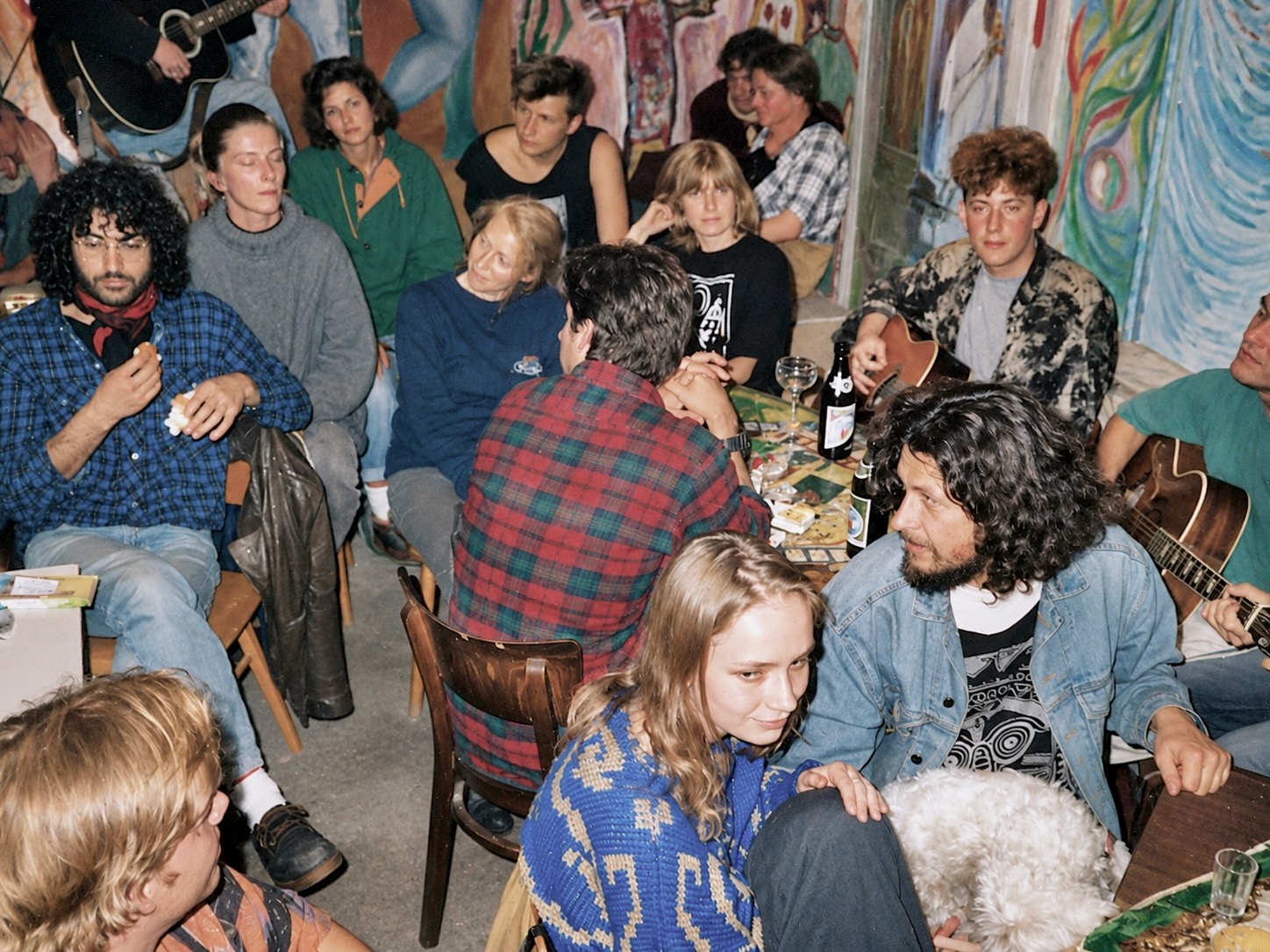
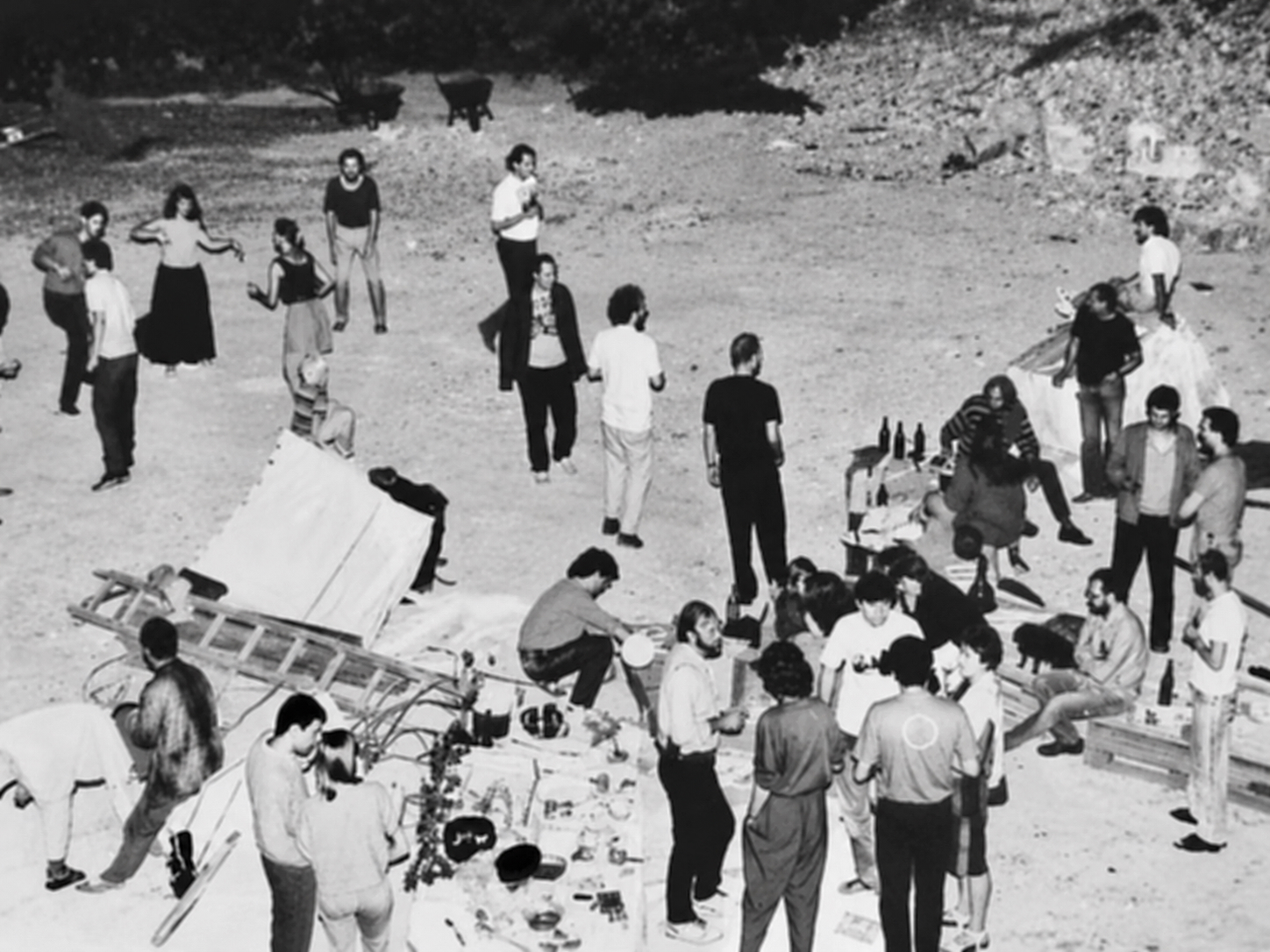
From the exhibition Dialogue/Prague/Los Angeles, at Galerie mladých (“U Řečických”), Prague, summer 1989. Co-organized by American artist Barbara Benish and Czech curator Zdenka Gabalová, the exhibition brought Czech and American artists together several months before the Velvet Revolution. The same gallery would host the landmark exhibition of foreign artists living in Prague, “…next door,” five years later. Image courtesy of Barbara Benish.
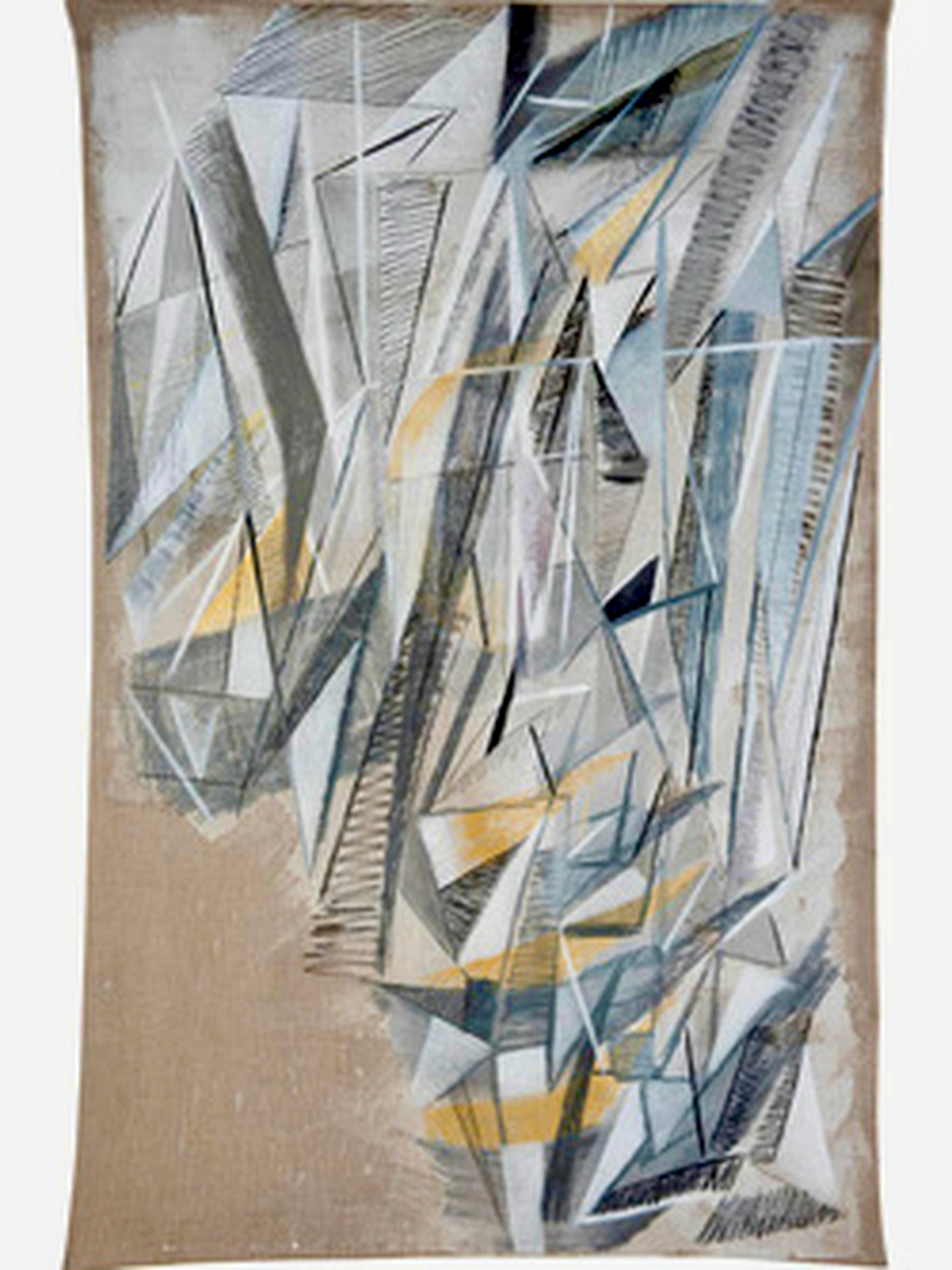
Gail Sagman, Line to Plane (1996). Paint and charcoal on fabric, 180 × 130 cm. Sagman first came to Prague in the mid-1980s, giving her a rare perspective among expatriate artists on the city’s artistic life both before and after the Velvet Revolution. She participated in the experimental art activities beneath the former Stalin Monument and exhibited at Galerie mladých. Image courtesy of the artist.

Fedele (Fred) Spadafora, late 1990s. One of a series of sketches for the “Kaiser Jazz Festival,” held at the Marquis de Sade bar at Templová 8 in Prague’s Old Town. Spadafora was a versatile contributor to the visual culture of expatriate Prague, producing everything from illustrations for Prognosis to drawings for literary works published by Twisted Spoon Press. Image courtesy of the artist.
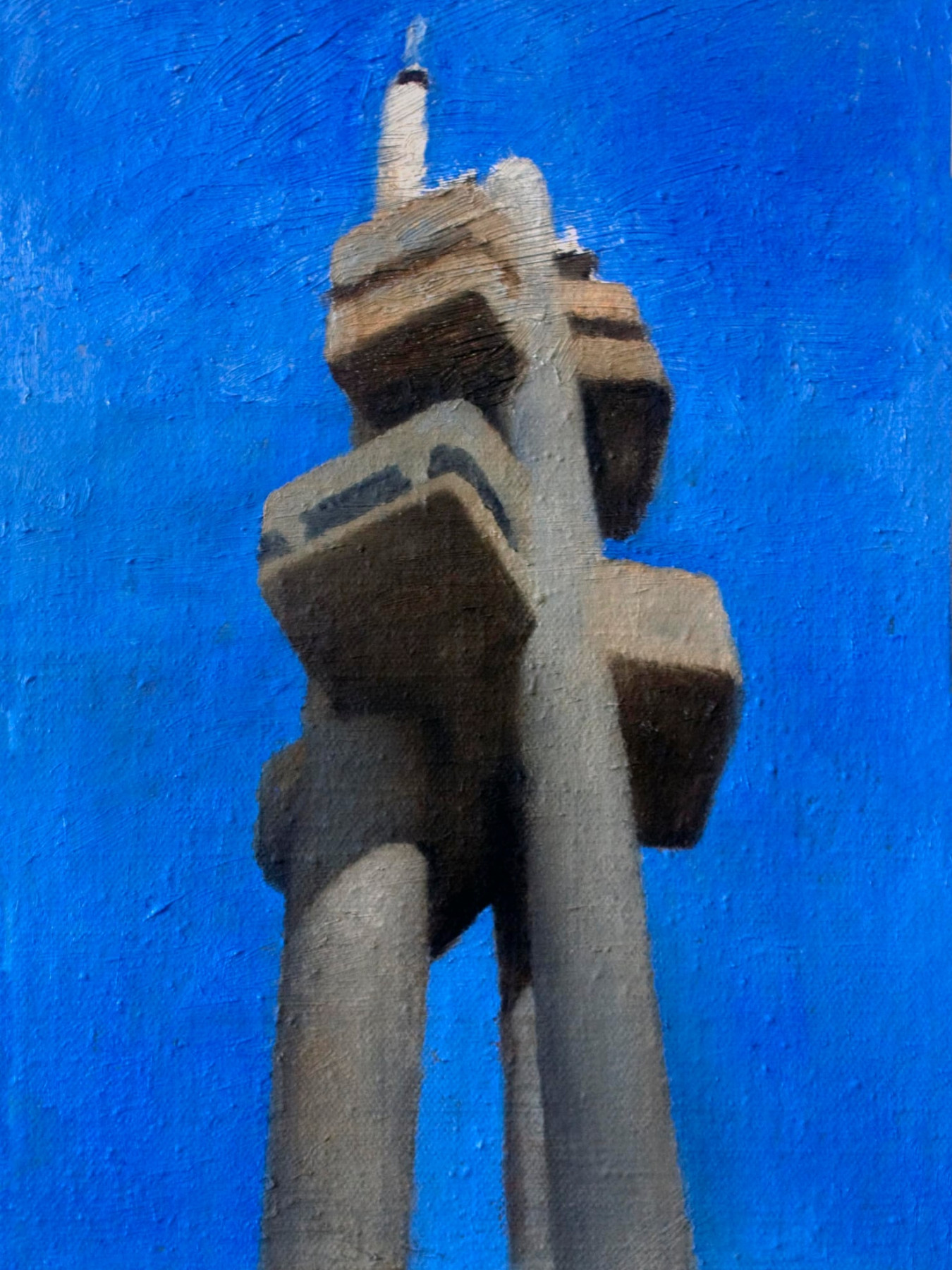
A more recent depiction of the Žižkov TV Tower by Fedele (Fred) Spadafora. Readers of Prognosis in the 1990s might remember Spadafora’s wonderfully exaggerated portrait of President Bill Clinton, which appeared on the paper’s cover in advance of Clinton’s January 1994 visit to Prague. Fred now lives in New York and is represented by Galerie Leuenroth in Frankfurt, Germany. Image courtesy of the artist.
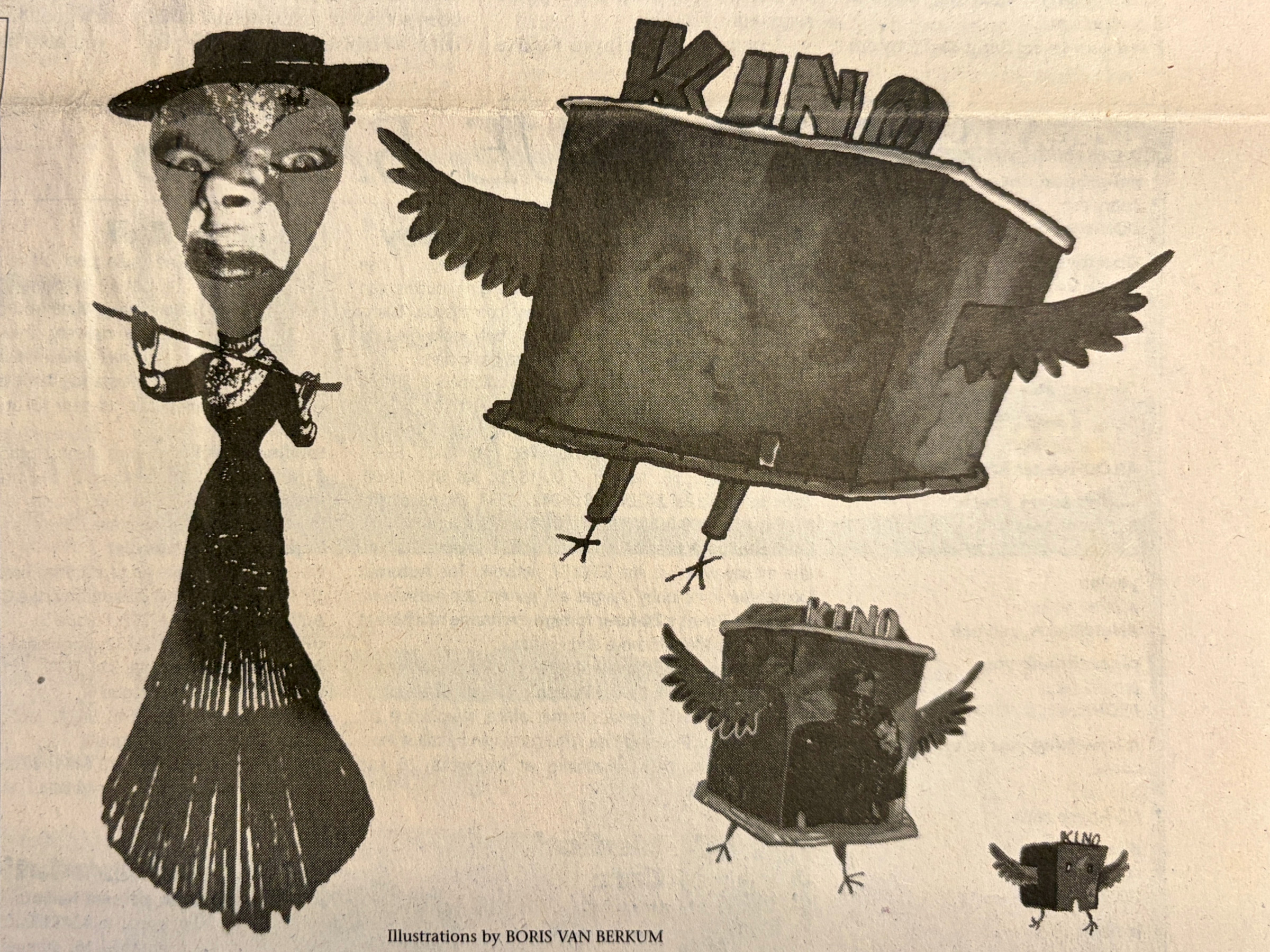
Boris Van Berkum, 1995. One of the illustrations the Dutch artist produced while working for Prognosis. The newspaper gave its artists considerable freedom to exercise their imaginations, even in such routine assignments as illustrating the restaurant listings in its weekly entertainment supplement. Van Berkum’s drawings were among the most distinctive features of those pages. Image courtesy of the artist.
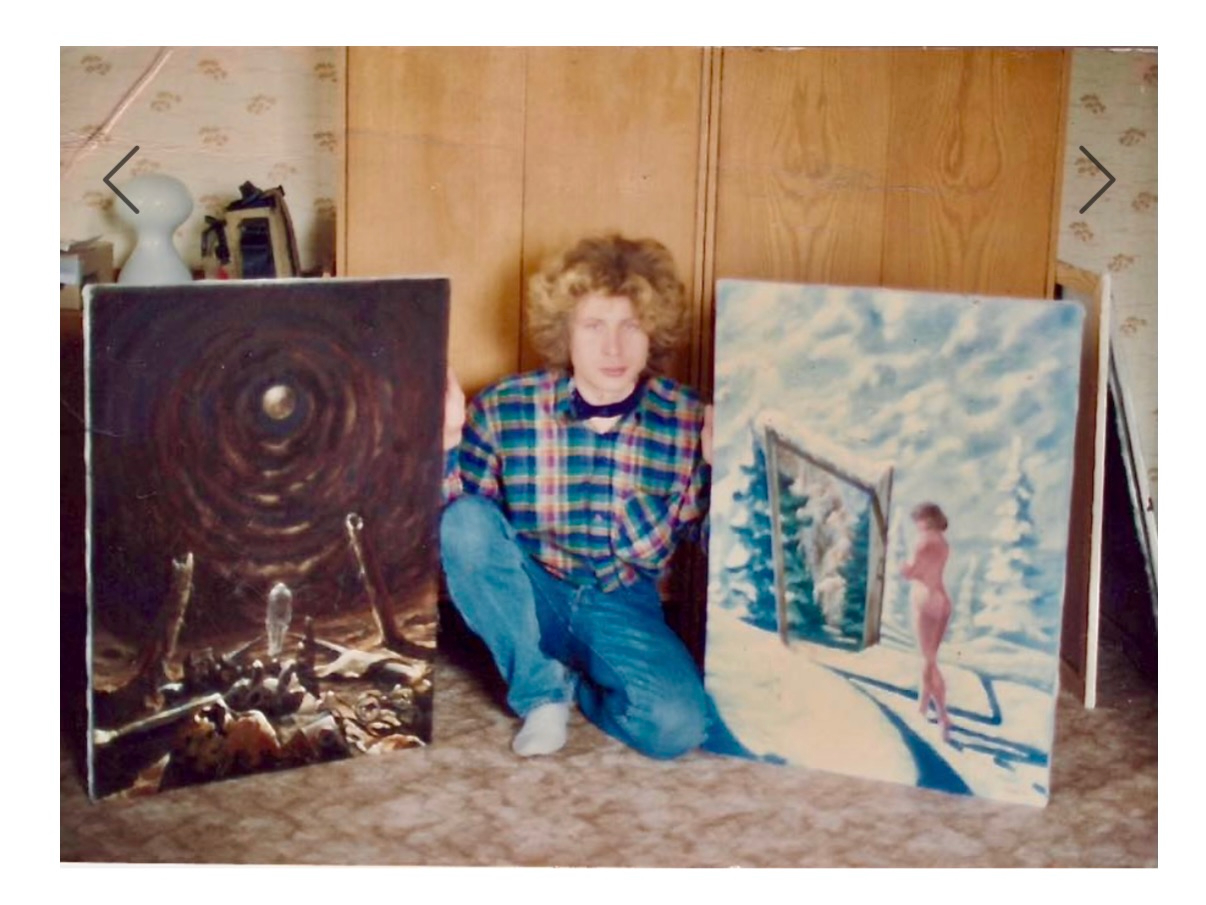
The Russian artist Valerij Narbekov in Prague, summer 1995. Though Narbekov’s paintings were familiar to many expatriates, particularly those who frequented Jáma, relatively little documentation of his Prague years has survived. Narbekov later returned to Russia, and I was unable to find any current information about him while researching this series. Photo courtesy of Ivy Allen.
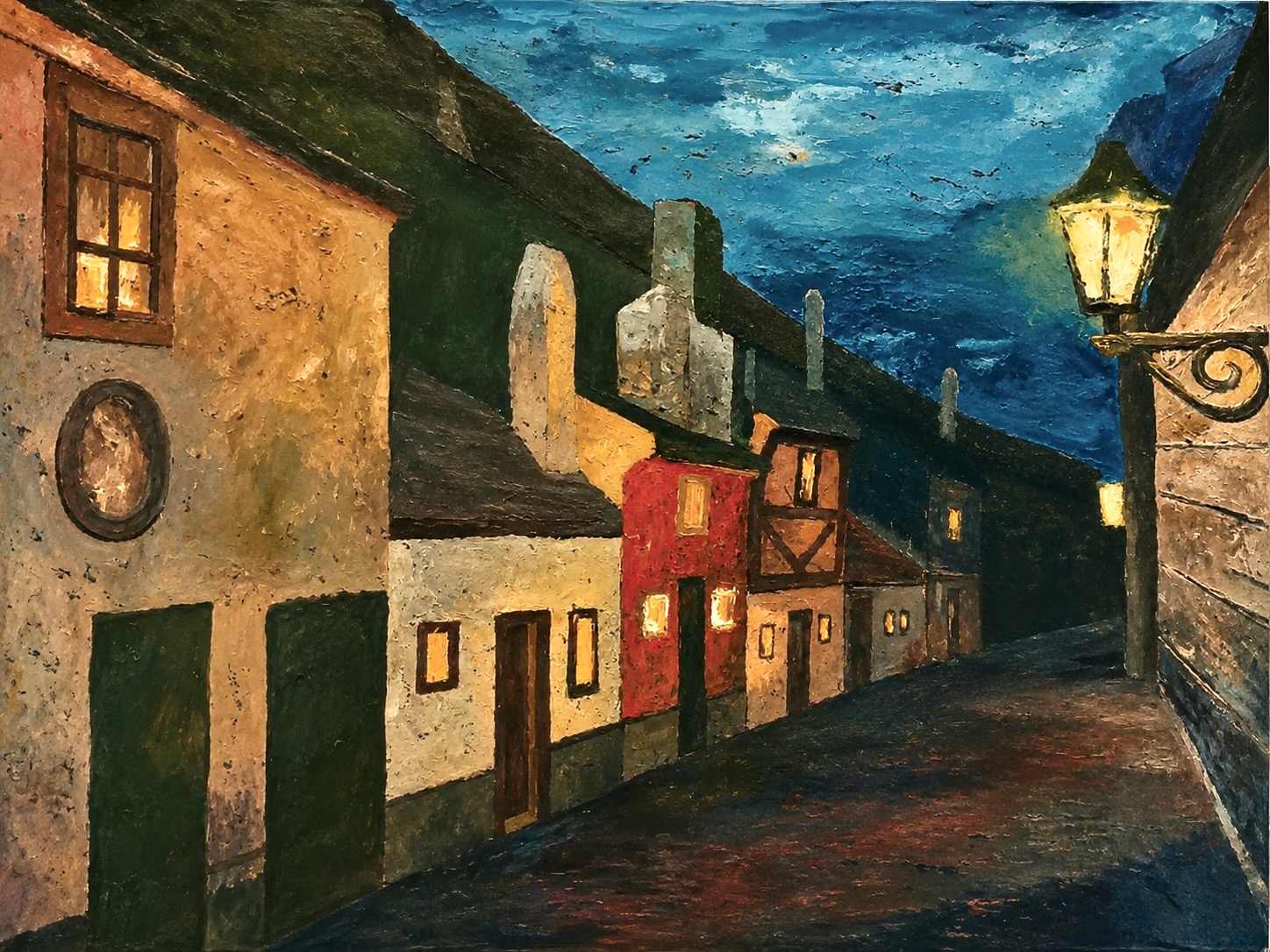
Valerij Narbekov, Untitled (mid-1990s). An atmospheric painting of what looks like Prague’s Golden Lane, with illuminated windows and streetlamps beneath a deep-blue sky. The quiet streetscape reveals another side of an artist whose more exuberant figurative paintings adorned the walls of expatriate establishments and private apartments. Image courtesy of Kristine Zamastil.
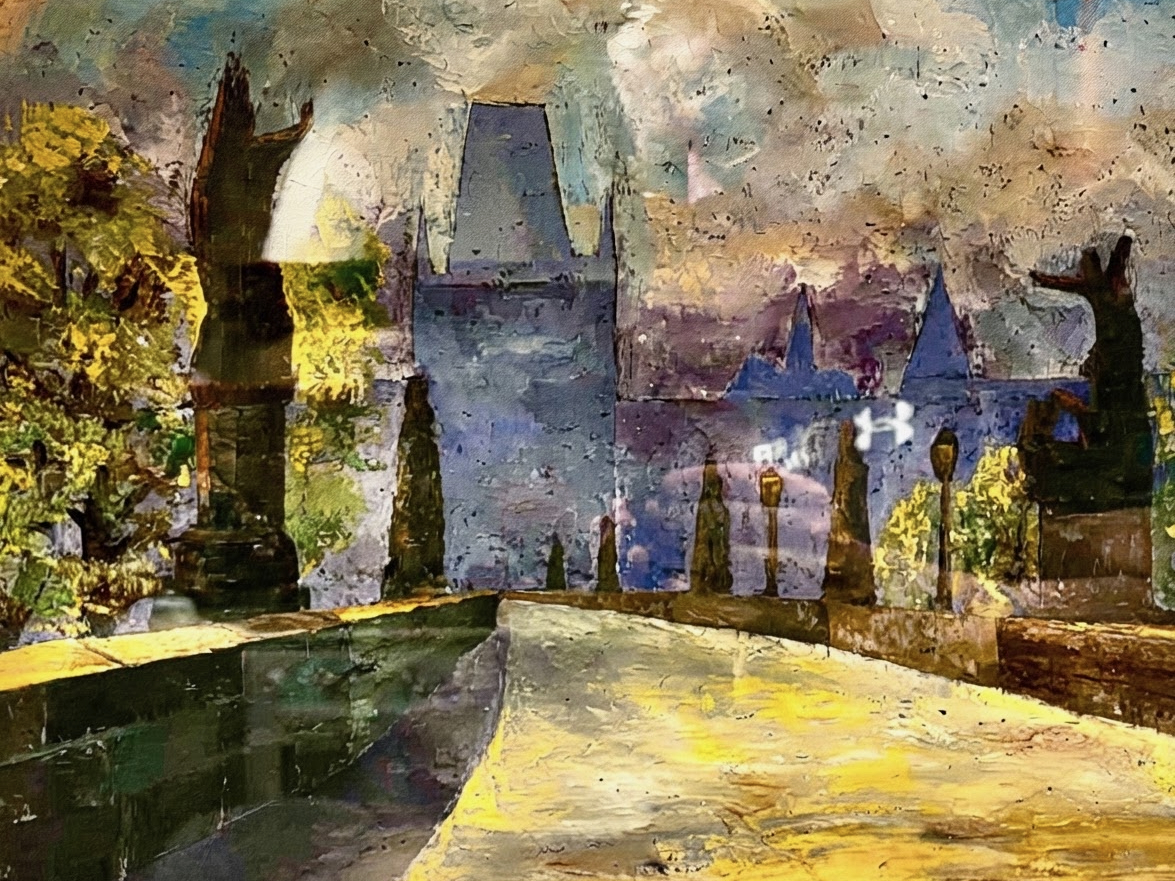
Valerij Narbekov, Charles Bridge (mid-1990s). Narbekov’s depictions of Prague’s streets and landmarks complement his mural and cover art work from the period. With the disappearance of his mural at Jáma and the difficulty of tracing the artist today, paintings preserved in private collections offer some of the best surviving evidence of his Prague years. Image courtesy of Kristine Zamastil.
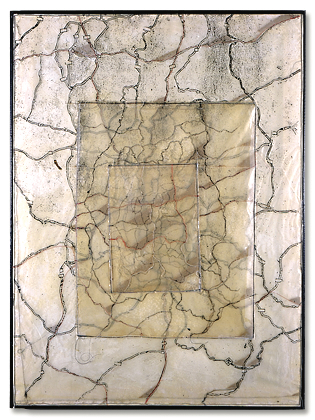
Beth Zonderman, Cardinal Know (1994). An abstract mixed-media composition combining overlapping geometric forms, translucent layers and delicate, branching lines. Zonderman was among the 12 artists featured in the March 1994 exhibition “…next door” at Galerie mladých, an early acknowledgment by the Czech art establishment of the work being produced by foreign artists living in Prague. Image courtesy of the artist.
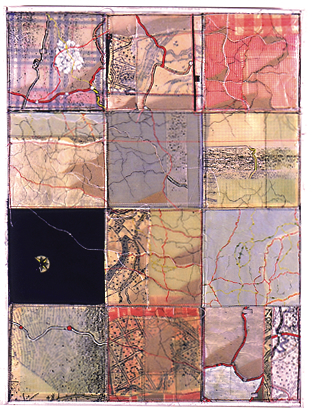
Beth Zonderman, Mapestry (mid-1990s). A mixed-media composition incorporating stitched and bound materials, reflecting the artist’s interest in texture and the physical construction of an artwork. For Zonderman, one of the great attractions of living in Prague in the early 1990s was having sufficient time to devote to artistic exploration. Image courtesy of the artist.
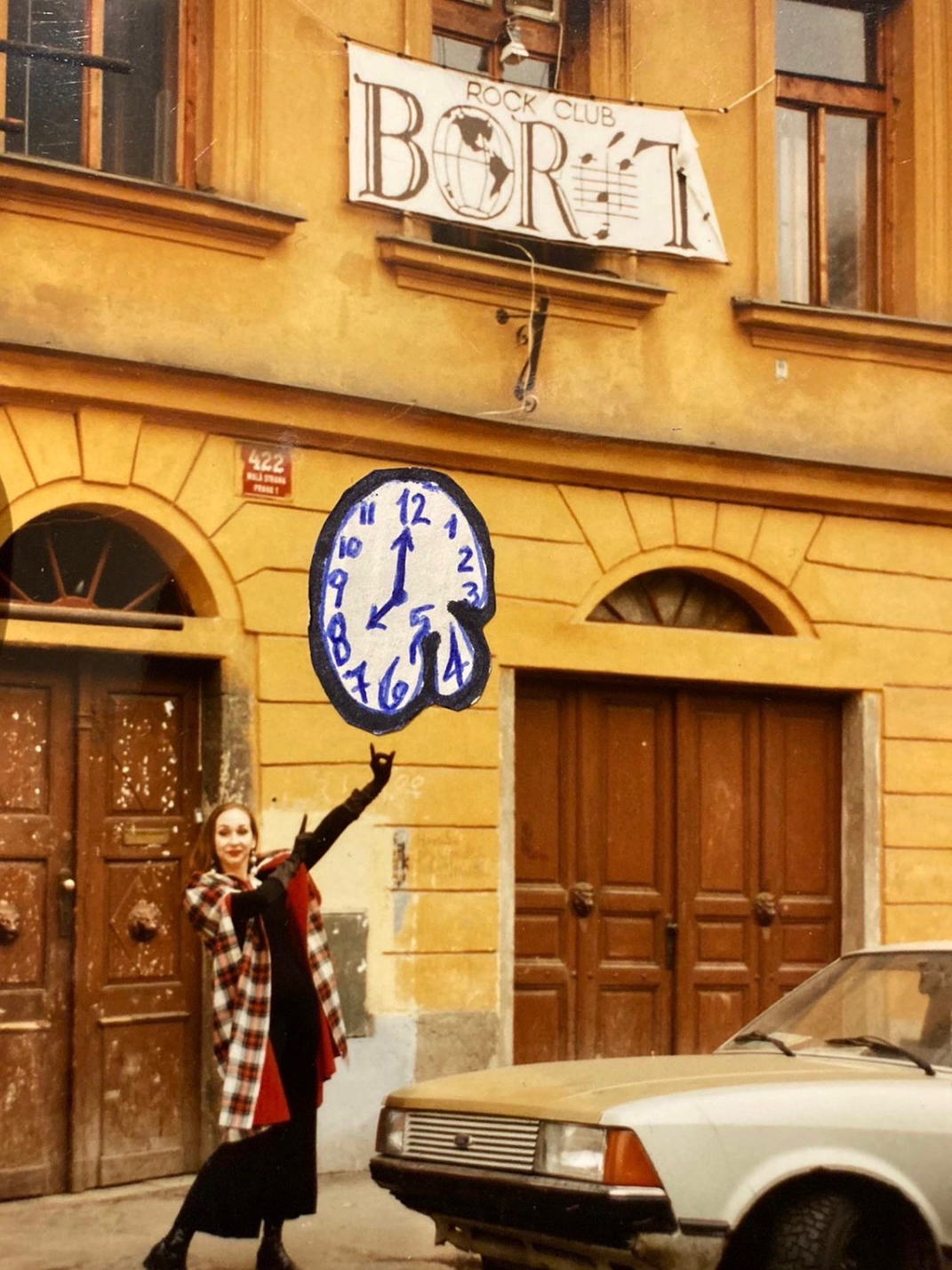
The “Surrealist Art Party” at Klub Borát, Prague, fall 1992. The exhibition included a photo collage by Amanda Bouquet (pictured), whom artist Anne Hars remembers as an important figure for many newly arriving expatriate artists. Bouquet and her partner, Michael Sprague, hosted memorable parties at their large apartment on Na Zderaze in Prague’s New Town, helping bring together members of the emerging artistic community. Photo courtesy of Anne Hars.
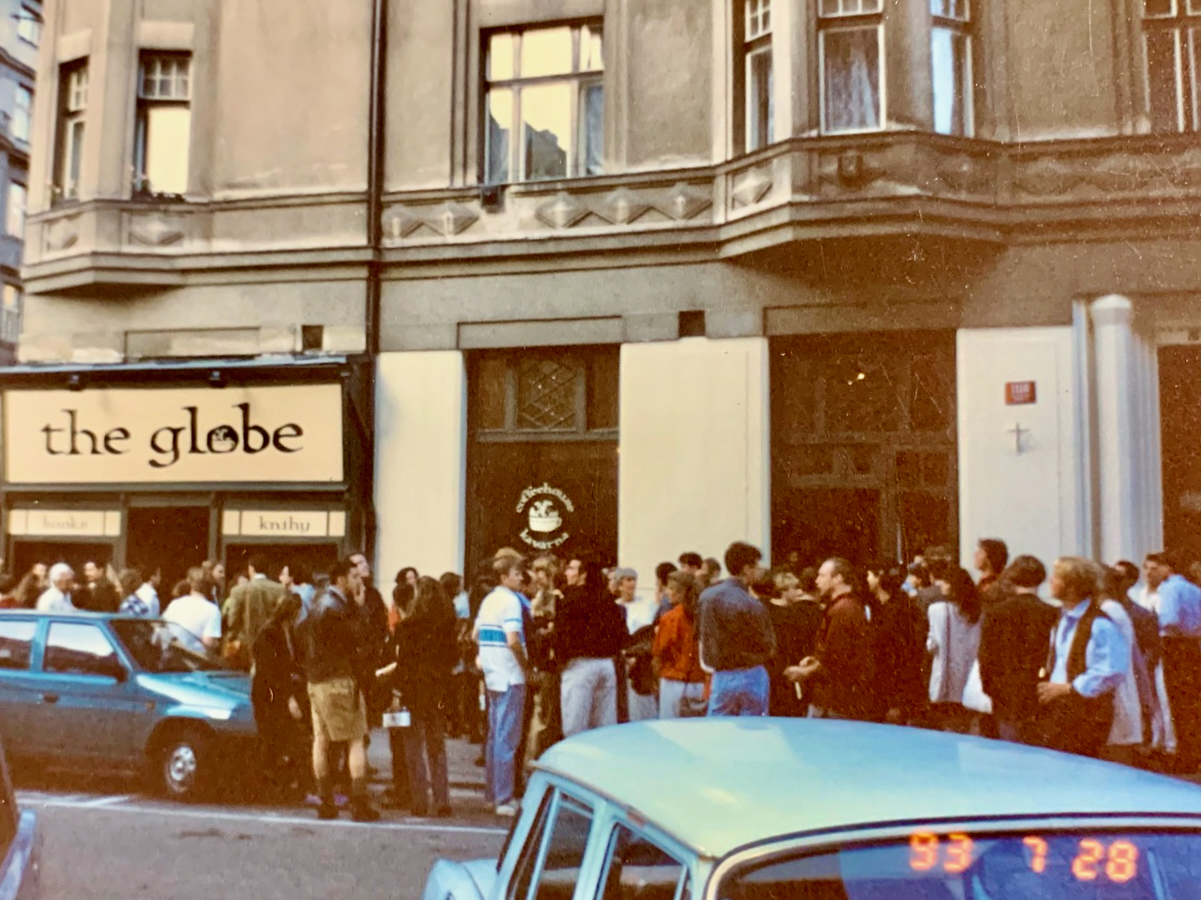
Crowds gather outside the original Globe Bookstore & Coffeehouse, near Strossmayerovo náměstí in Prague’s Holešovice district, for its opening party on July 28, 1993. From the outset, we intended the Globe to be a place for visual artists as well as readers and writers. The opening featured an exhibition of paintings by Anne Hars, inaugurating a succession of monthly art exhibitions. Photo courtesy of Anne Hars.
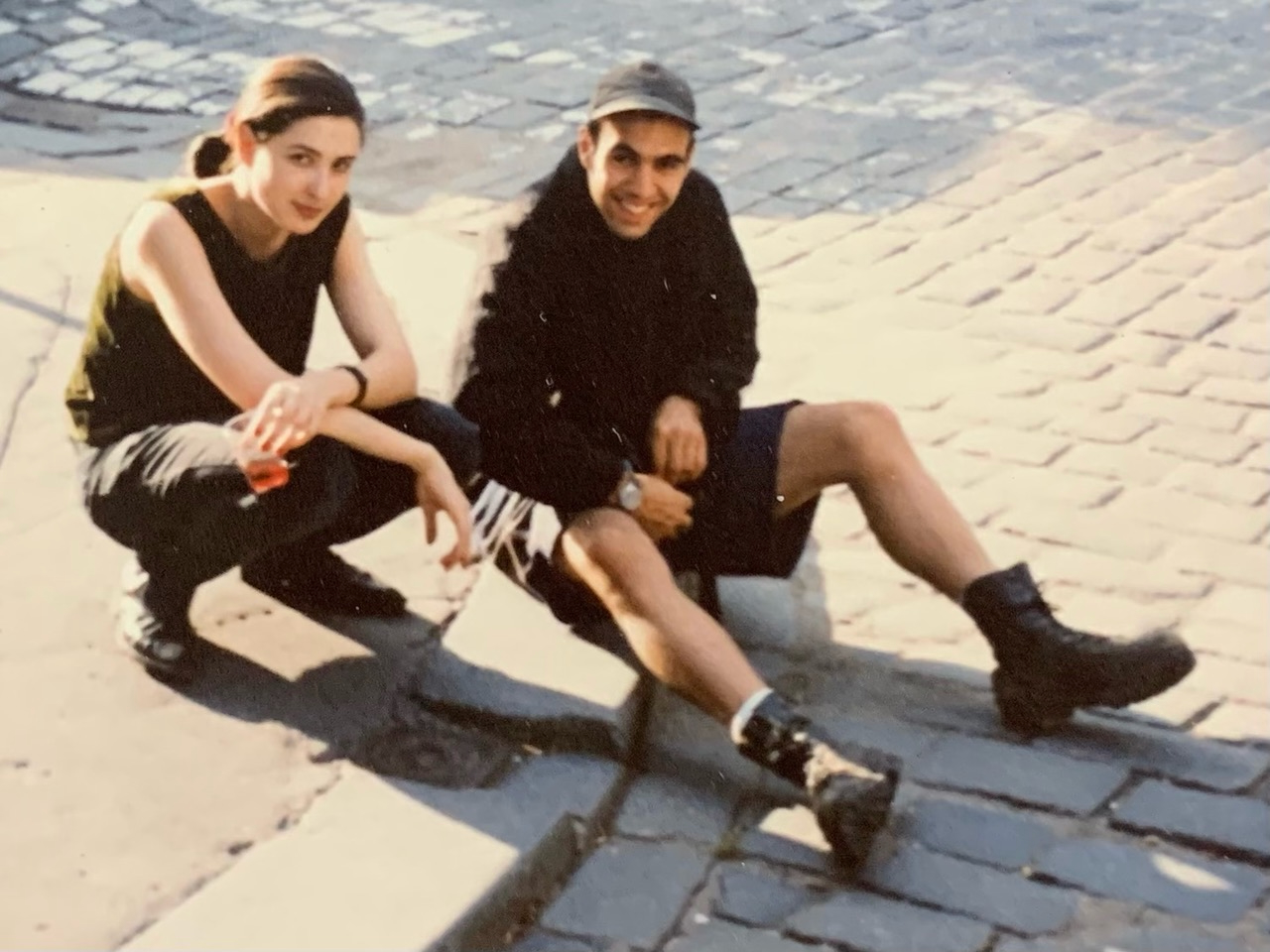
Artist Anne Hars (left) and photographer Matt Pollitz preparing artwork for the Globe Bookstore & Coffeehouse’s opening party in July 1993. Hars’s exhibition featured a series of oil studies on paper exploring ordinary objects, including bones, fruit and knives. Hars also worked with fellow artist Kirsten Kempfer to decorate the interior of Radost FX. Photo courtesy of Anne Hars.
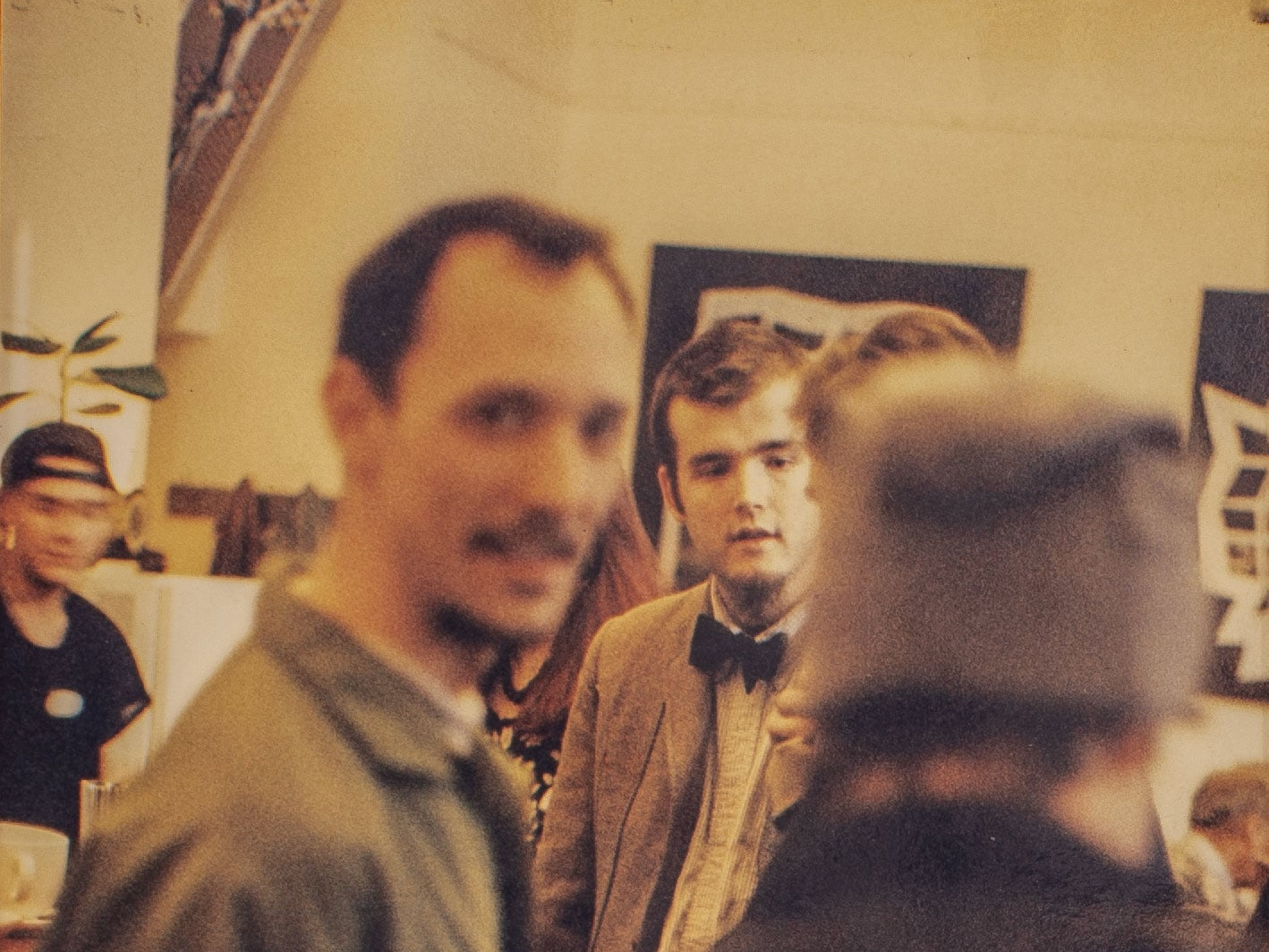
Artist Peter Bill (center) and Dan Kenney (left) at Bill’s exhibition at the original Globe Bookstore & Coffeehouse, Prague, 1995. Bill frequently drew inspiration from the streets and architecture of Prague, particularly Žižkov. Photo courtesy of Peter Bill.
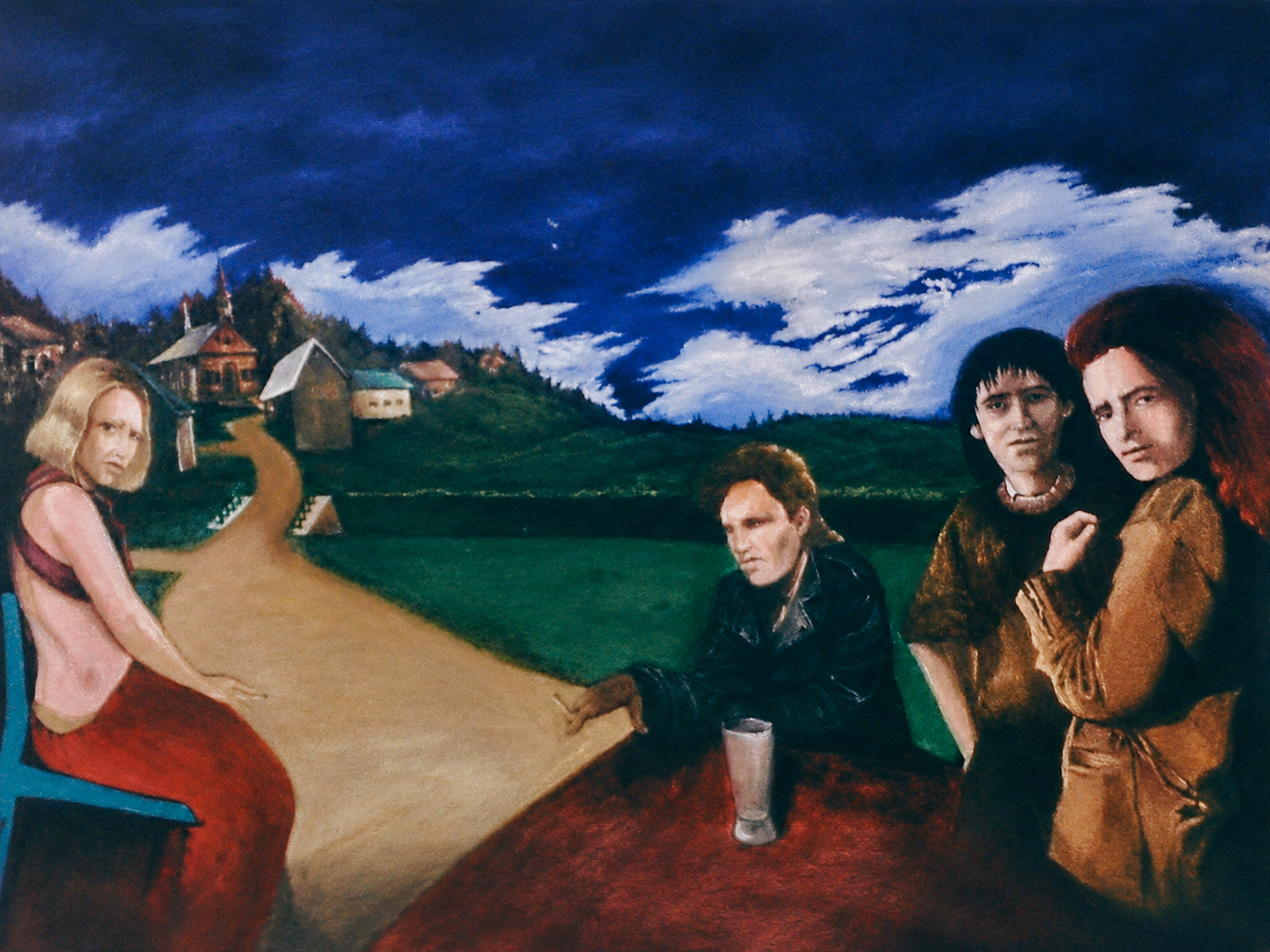
Adam Trachtman, Příbor (1994). Acrylic on wood. The painting grew out of an excursion the artist took to Příbor, Moravia, with staff from the Globe Bookstore & Coffeehouse. Though many expatriates remember Trachtman for his cartoons and illustrations in Think magazine, paintings such as this one reveal another aspect of his artistic activities in the Czech Republic. Private collection. Image courtesy of the artist.
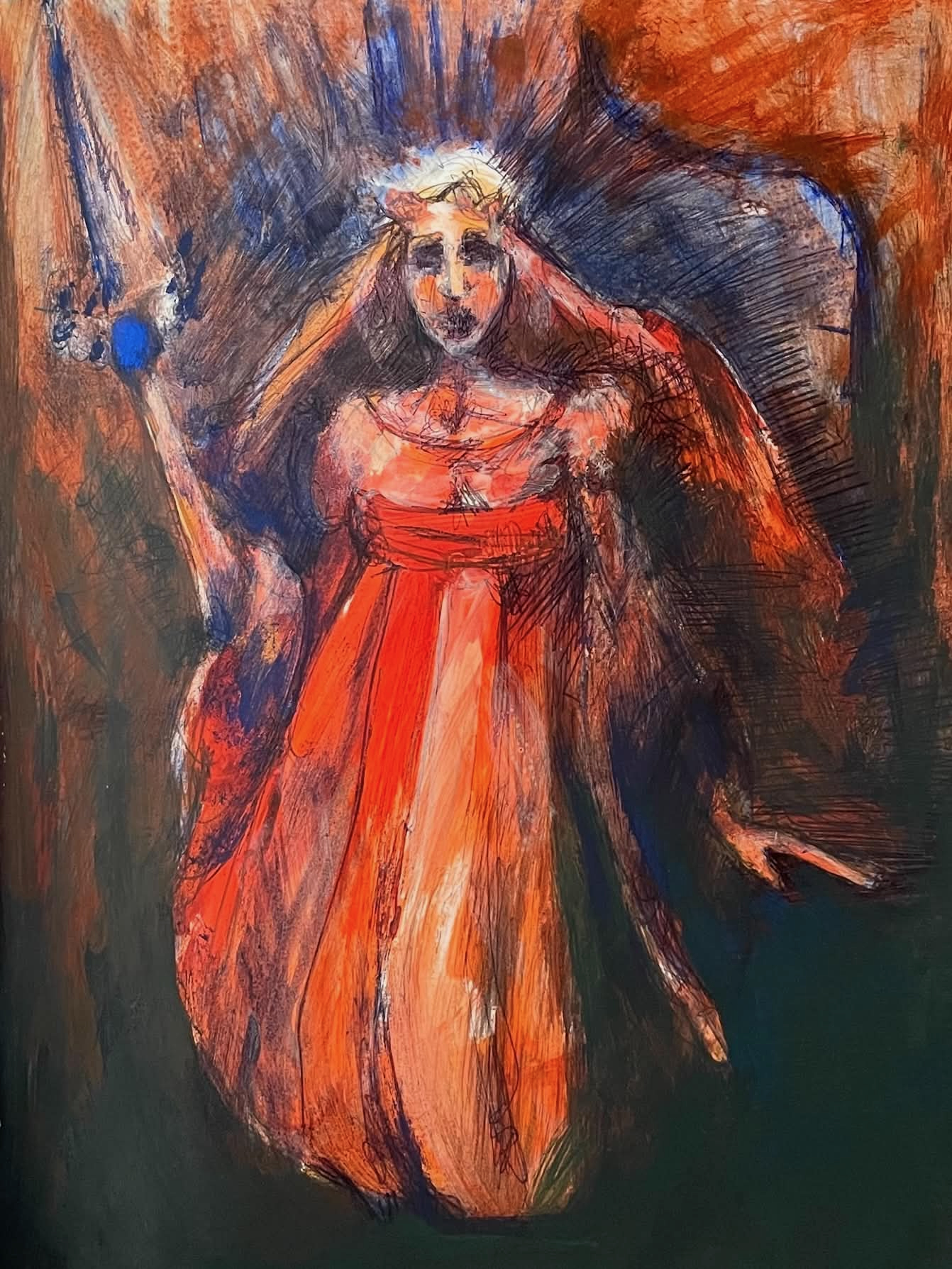
Sandra Dillon, Untitled (mid-1990s). A colorful composition from the artist’s Prague years. Like Dillon’s painting Petřín (1994), reproduced in Part 3 of this series, the work illustrates her use of strong colors and expressive forms during this period. Image courtesy of the artist.
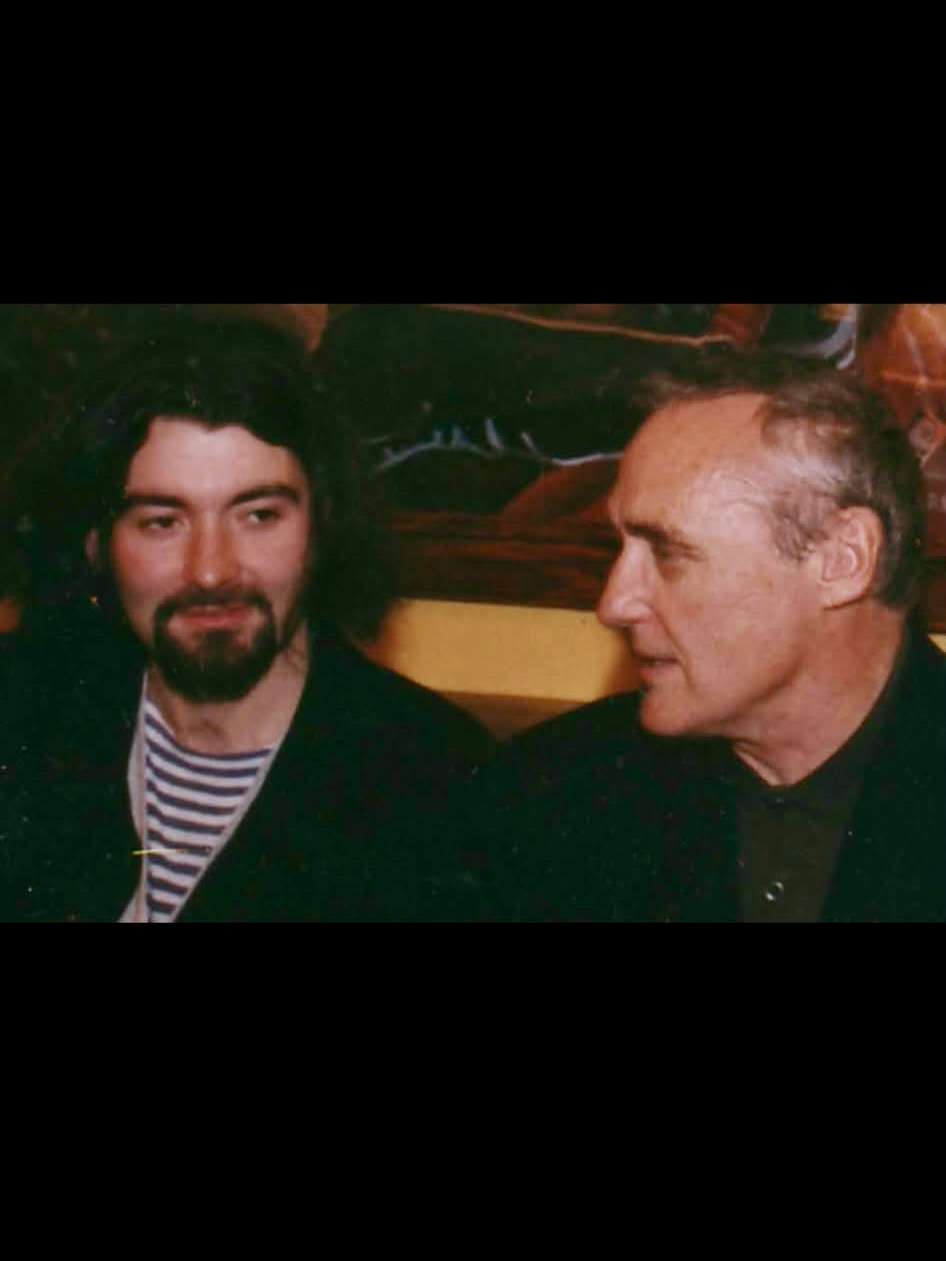
Artist Stewart K. Moore (left) with American actor Dennis Hopper at the original James Joyce Pub in Prague's Old Town in 1995, marking the completion of Moore's painting Bloomsday in Bohemia (reproduced in Part 3). Moore's commissions for Prague's Irish pubs were among his more visible artistic undertakings during a period when he was also painting, drawing and producing illustrations for publications as disparate as the Wall Street Journal, Esquire and The Prague Post. Photo by Ivan Malý.
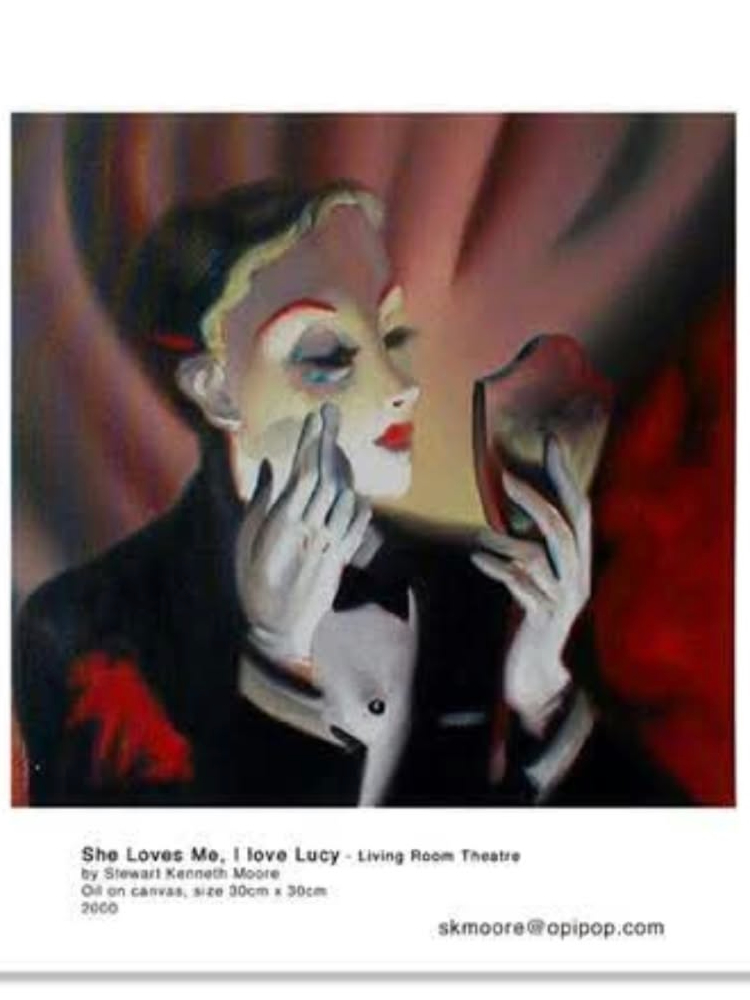
Stewart K. Moore, She Loves Me, I Love Lucy – Living Room Theatre (2000). Oil on canvas, 30 × 30 cm. The painting was exhibited in 2001 at Galerie Gambit, at Mikulandská 6, founded and run by Iva Nesvadbová. Moore continued to pursue his painting after the 1990s, alongside the comic-book art for which he would later become increasingly well known. Image courtesy of the artist.

Stewart K. Moore, The Woman with the Red Book (circa 2000). One of Moore’s character studies inspired by chance encounters. “I saw her in a cafe somewhere,” he recalls. Moore was an inveterate observer of people, as evidenced by the numerous sketches he made of customers at Café Medúza, a popular expatriate hangout in the 1990s. Image courtesy of the artist.

Stewart K. Moore, early 2000s. A miniature study of a fantastical figure. I acquired several examples of Moore's artwork during his Prague years, including some of his café sketches. This little painting now hangs in my kitchen in Prague. Photo by Mark Baker.
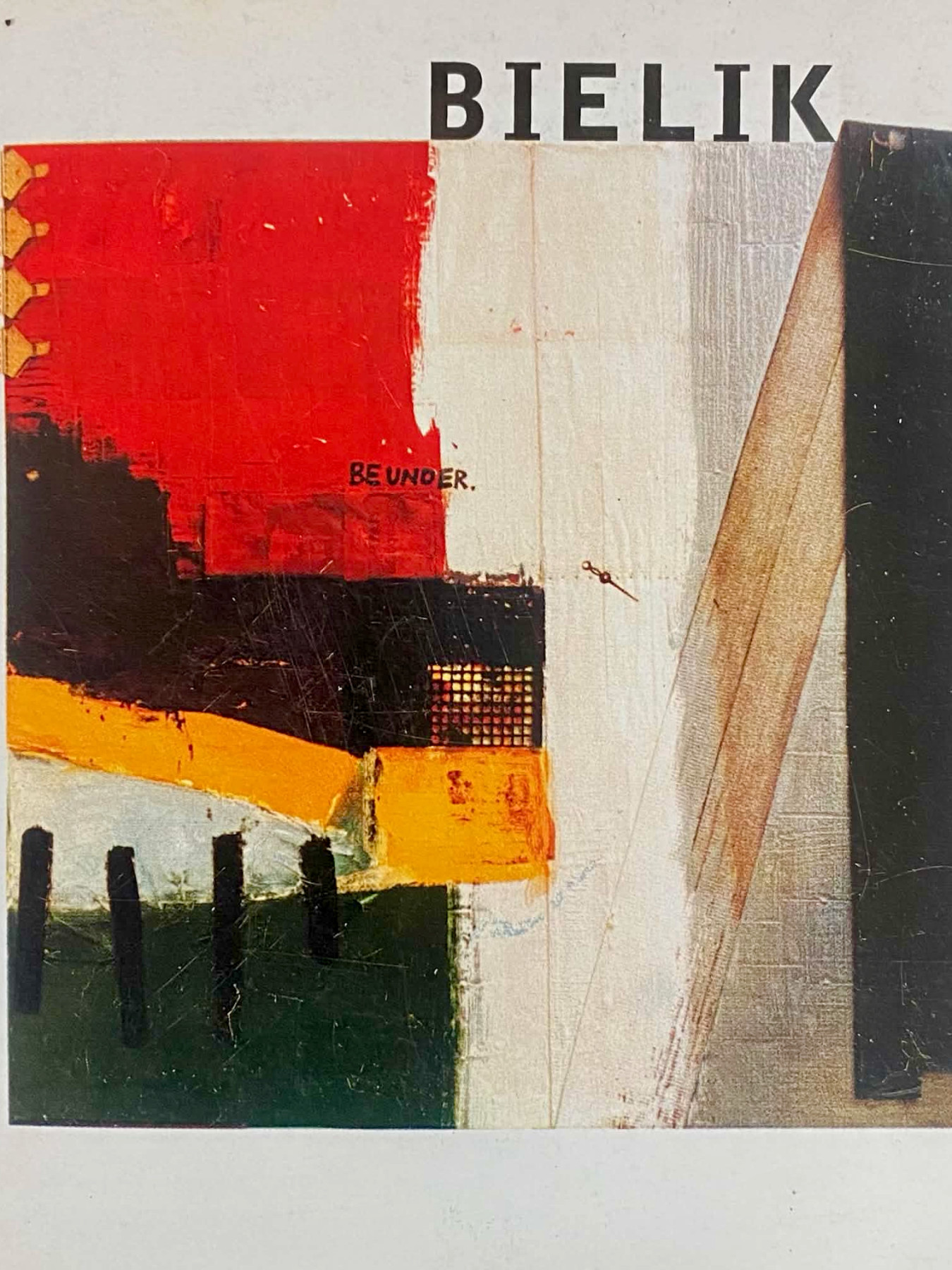
The cover of the catalog for Karl Bielik's solo exhibition at Galerie bratří Čapků (Čapek Brothers Gallery), Prague, 1997. Bielik experimented with unconventional materials and found objects during his Prague years, at one point building a work around a medical cabinet door (see Part 3). His abstract compositions stood apart from much of the figurative painting being produced by expatriate artists at the time. Image courtesy of the artist.
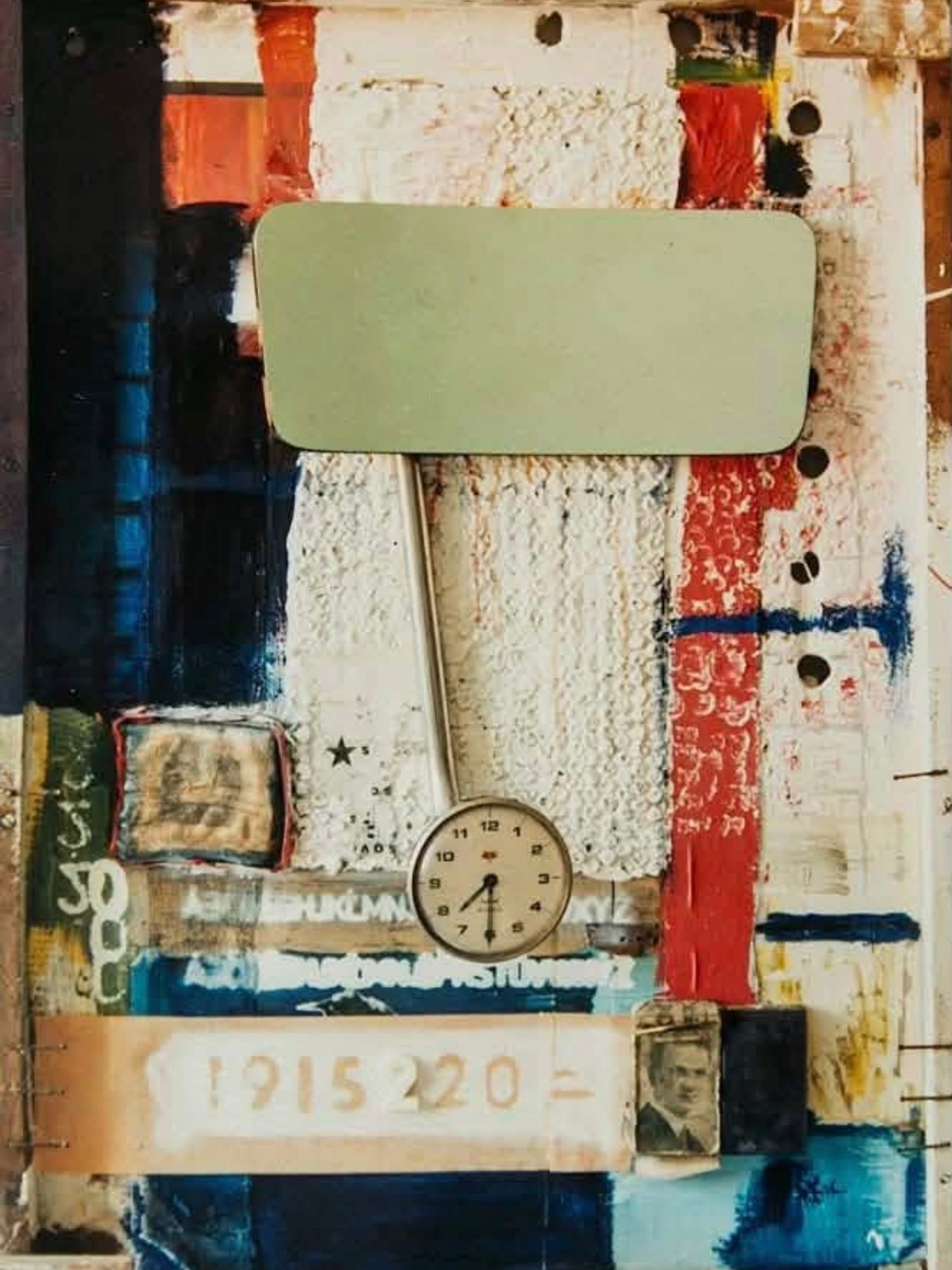
Karl Bielik, 1999. This work was exhibited at a gallery in Prague and later used as the cover of a book of poems by Vincent Farnsworth. Bielik’s independent artwork often found its way onto the printed page during his Prague years, including covers of Pozor, the English-language magazine featuring developments across the former Eastern Bloc. Image courtesy of the artist.
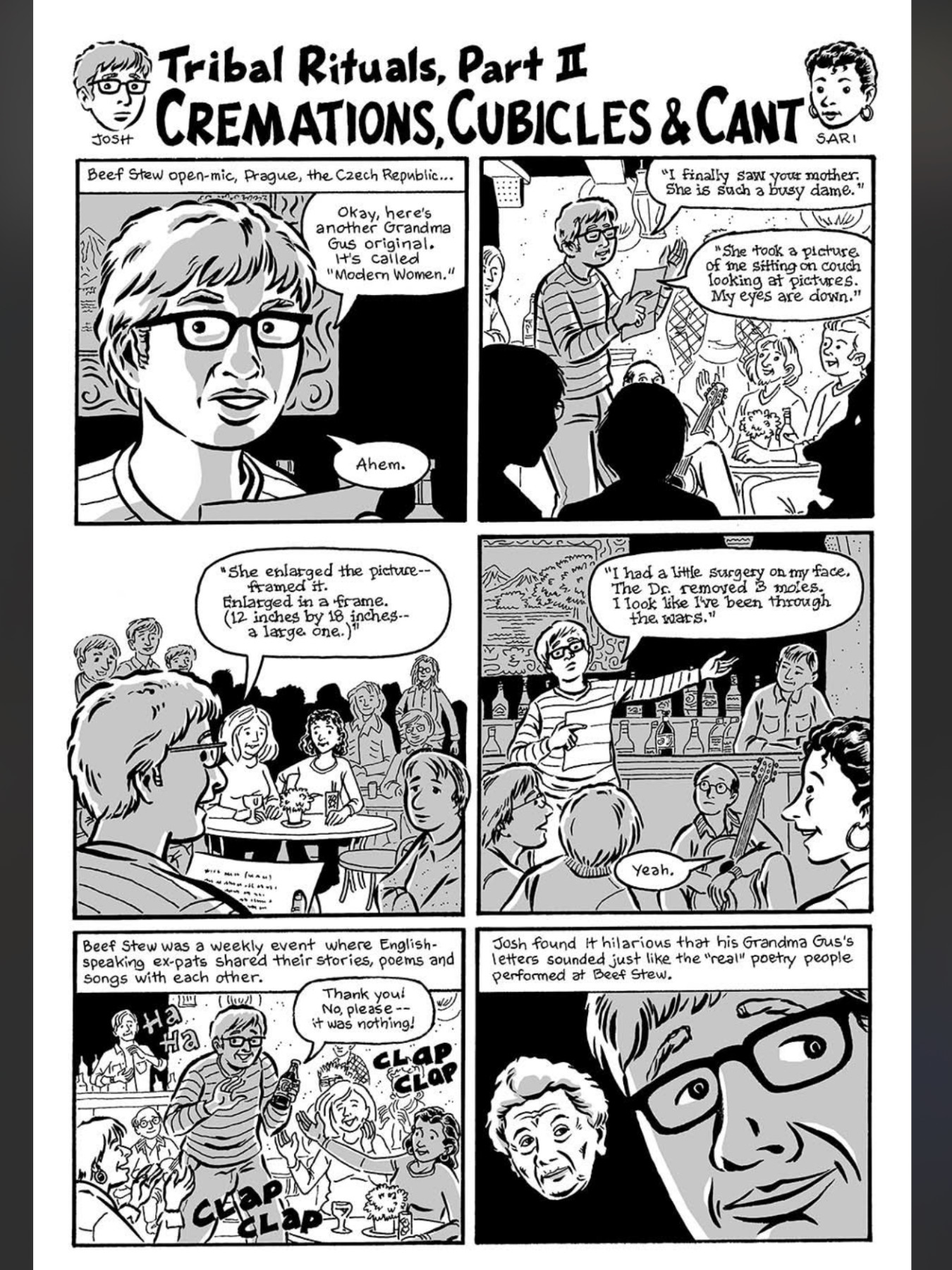
Josh Neufeld, Tribal Rituals, Part II: Cremations, Cubicles & Cant. A retrospective comics page depicting an evening at Beef Stew, the Sunday night open-mic readings held in the basement of Radost FX. Neufeld imagines an appearance by himself and his wife, Sari, featuring a poem written by his grandmother. The intimate, autobiographical approach contrasts nicely with the outrageous parody of his 1993 Prognosis comic strip, “Giant Drunk Guy.” Image courtesy of the artist.
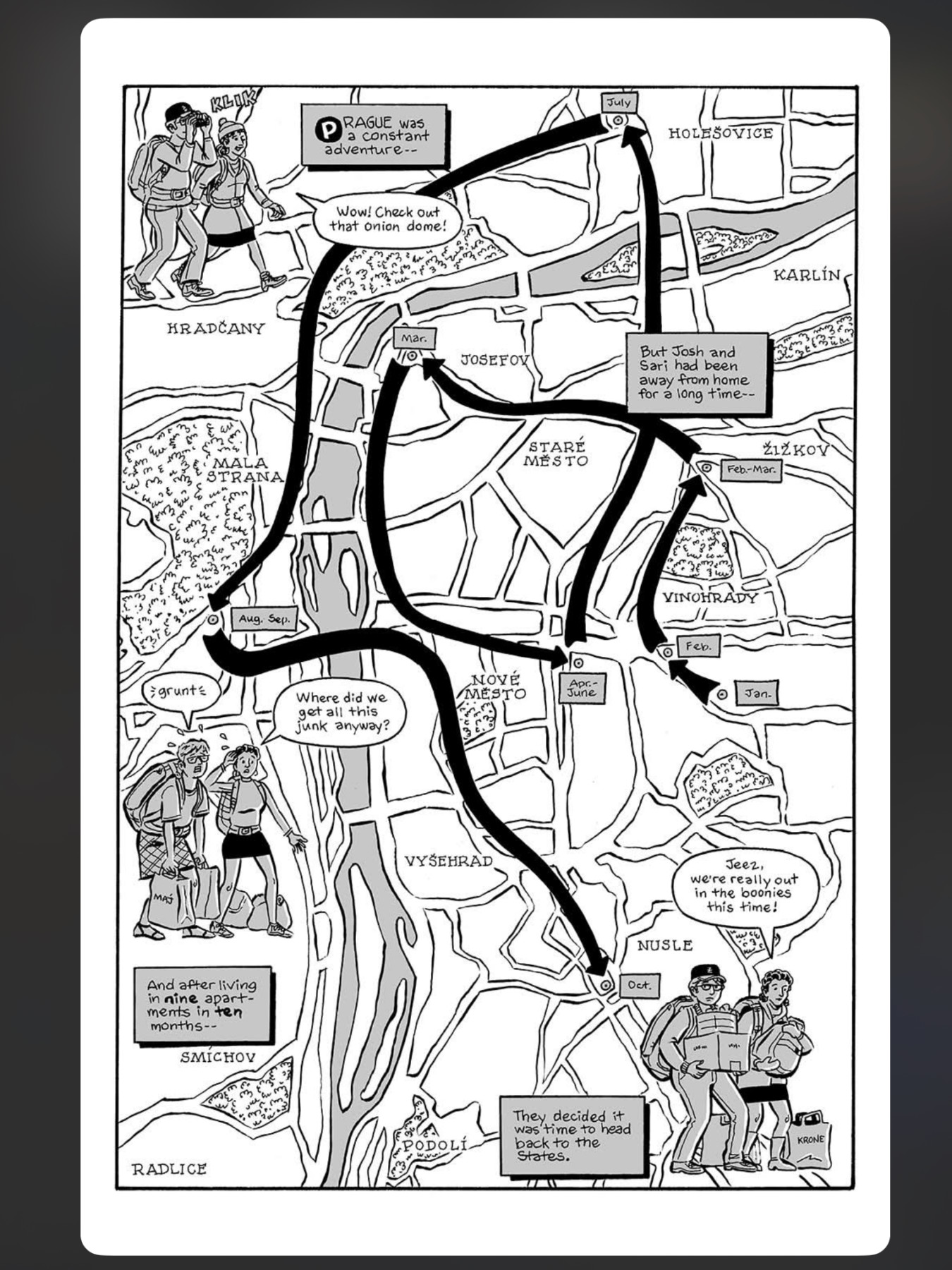
Josh Neufeld, Prague neighborhood map. A retrospective comics page charting the remarkable succession of nine apartments in which Josh and Sari lived over ten months in Prague. The map offers a reminder that, while the low cost of living attracted artists to Prague, finding a permanent place to live was not necessarily straightforward. Neufeld’s experiences in the city provided material for his autobiographical comics well after his years drawing for Prognosis. Image courtesy of the artist.
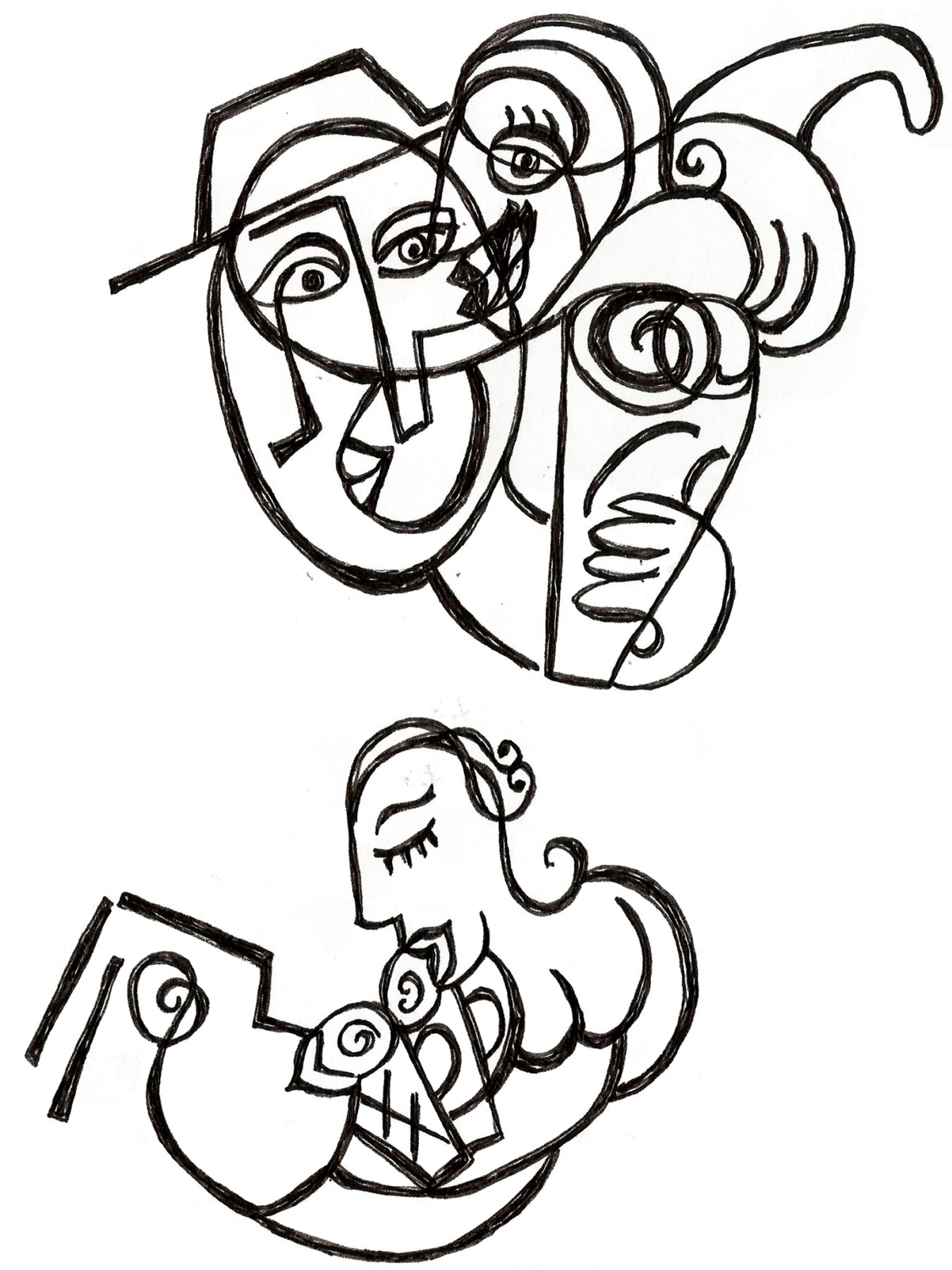
Georgia Schaller, mid-1990s. A whimsical take on lovers in Jo’s Bar. Glen Emery's sister, Jo-Anne, says the subjects are simply customers: “nobody specific.” Jo’s was closely associated with Schaller, whose paintings of the bar and its regulars helped preserve a visual record of the personalities who populated expatriate Prague in the 1990s. Image courtesy of Jo-Anne Emery.
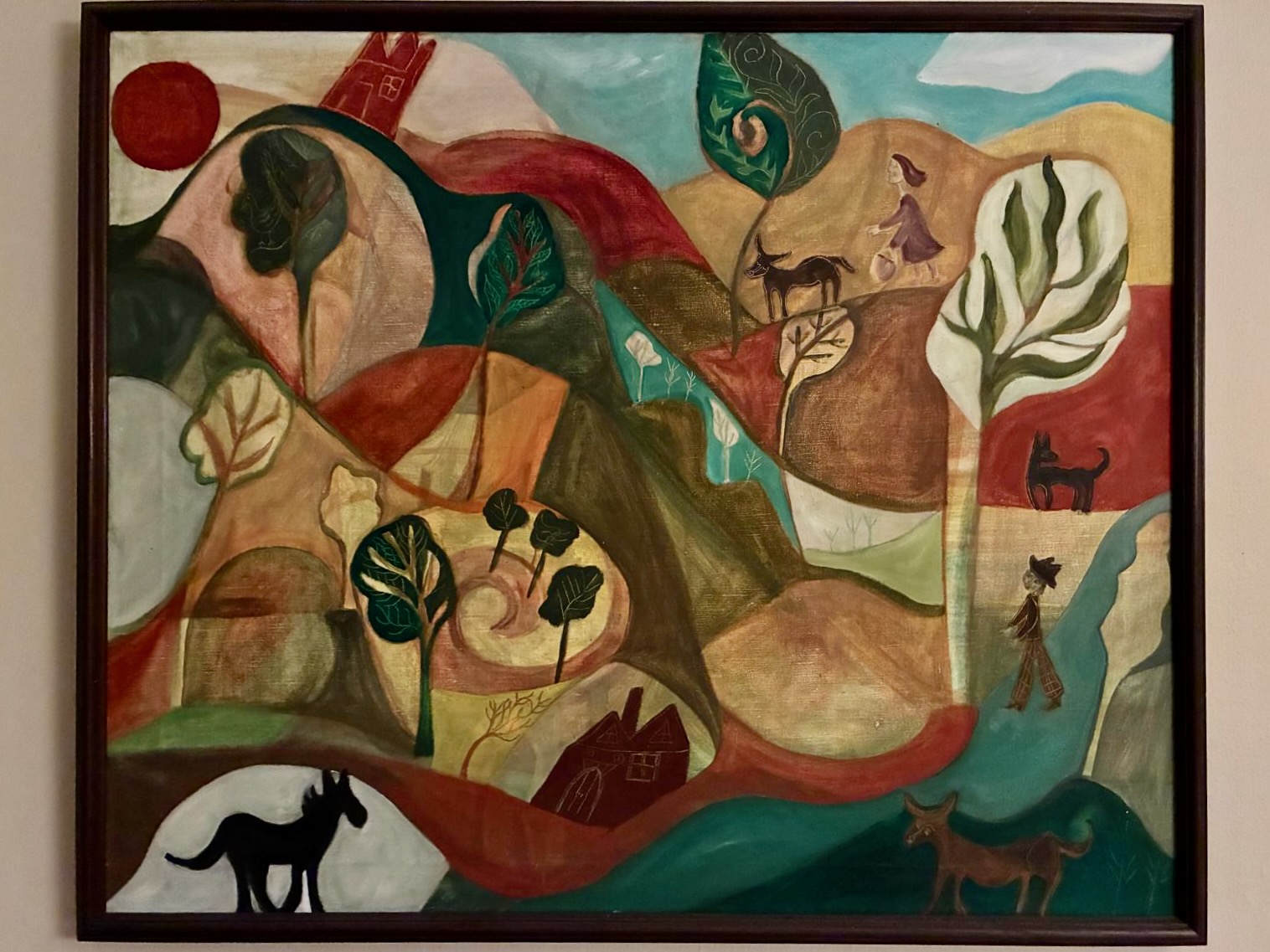
Georgia Schaller, 1992. Globe Bookstore & Coffeehouse co-founders Scott and Marketa Rogers purchased this painting in Prague and it now hangs in their home in the United States. Schaller’s artwork was once a familiar sight in several expatriate establishments, including Jo’s Bar and the original Thirsty Dog at the Municipal House. With the loss of much of her mural work, paintings like this one have taken on additional significance. Image courtesy of Marketa Rogers.
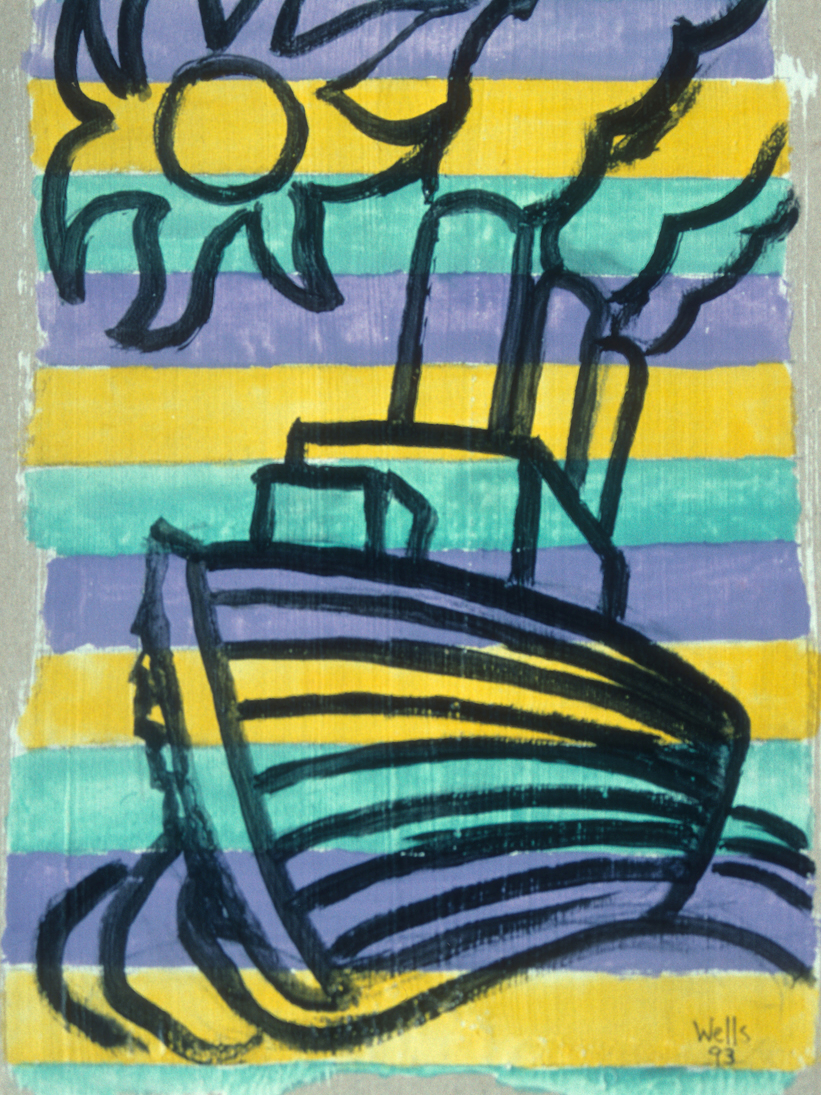
Lawrence Wells, Boat (1993). A boldly outlined vessel set against horizontal bands of yellow, turquoise and lavender. Wells arrived in Prague in 1992 after completing an MFA at the University of Mississippi. These early Prague works are notable for their strong outlines, simplified forms and unusual combinations of colors. Image courtesy of the artist.
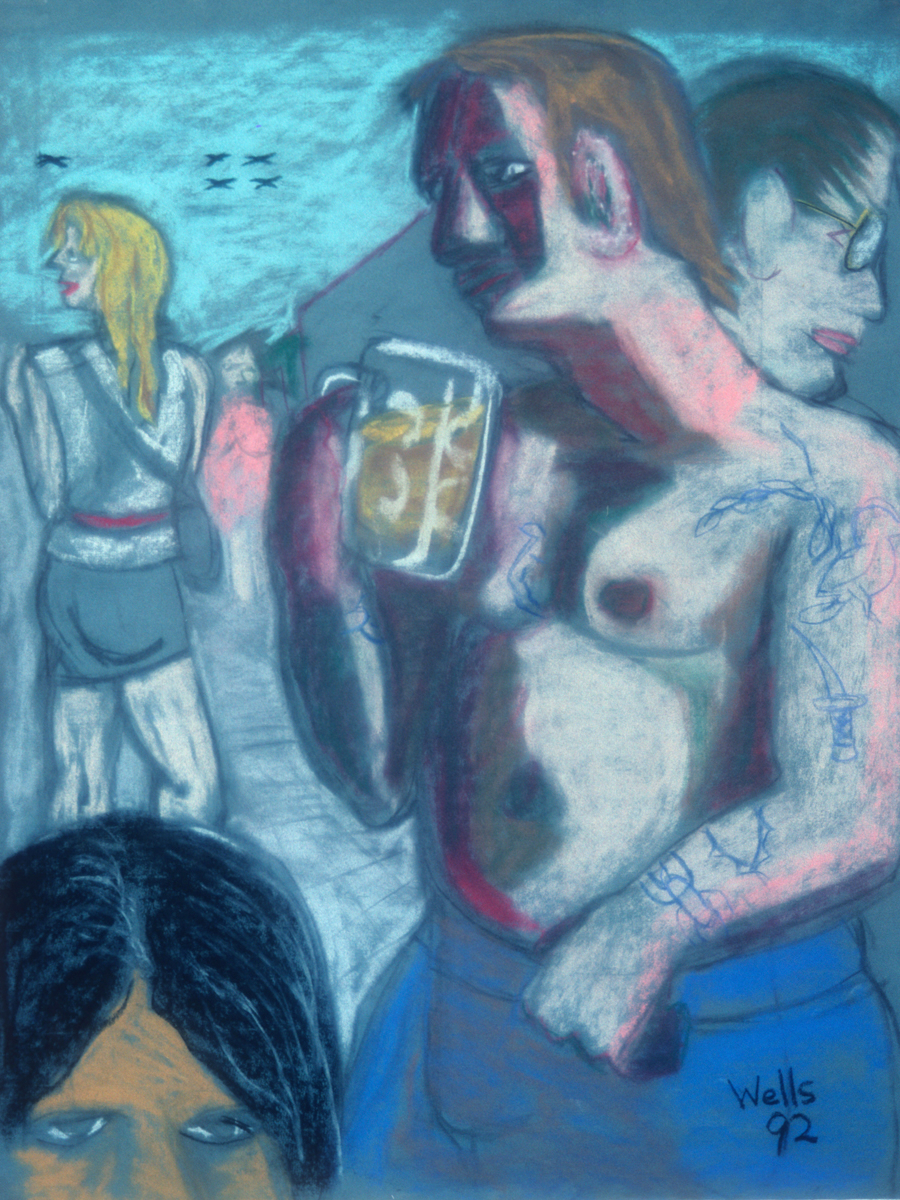
Lawrence Wells, Man with Beer (1992). An expressionistic depiction of Prague nightlife, featuring a muscular, tattooed man holding a glass of beer amid a crowd of figures. Like his painting Rock Concert, from the same year, the work offers a glimpse of the social world Wells encountered shortly after his arrival. Image courtesy of the artist.
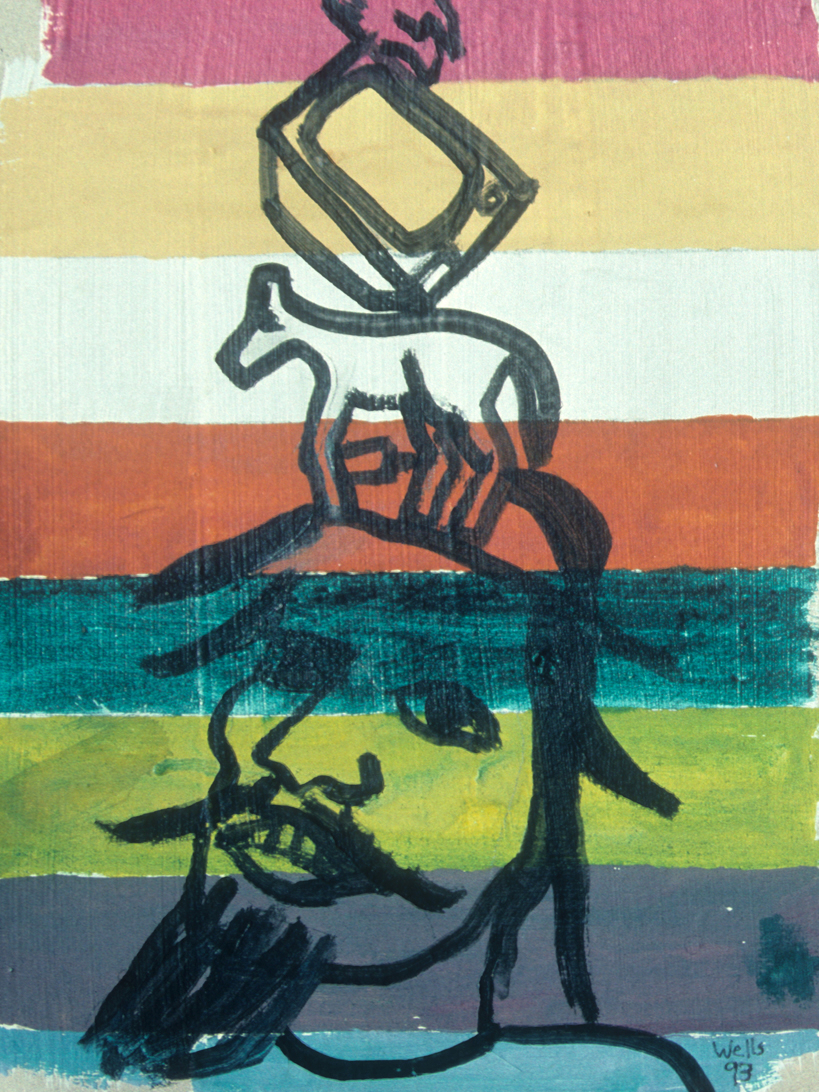
Lawrence Wells, Gypsy (1993). An unconventional arrangement of overlapping human and animal figures set against broad horizontal stripes of color. In the same year, Wells helped organize exhibitions at Asylum on Betlémská Street, including the experimental "Tape Show," for which artists were invited to attach their own work to the walls using tape. Image courtesy of the artist.

Lawrence Wells, Siren (1992). A surreal urban composition juxtaposing a reclining female figure with parked cars, a traffic sign and a dollar symbol. The work dates from Wells’s first year in Prague, when he was also discovering contemporary Czech culture through publications such as Revolver Revue. Image courtesy of the artist.
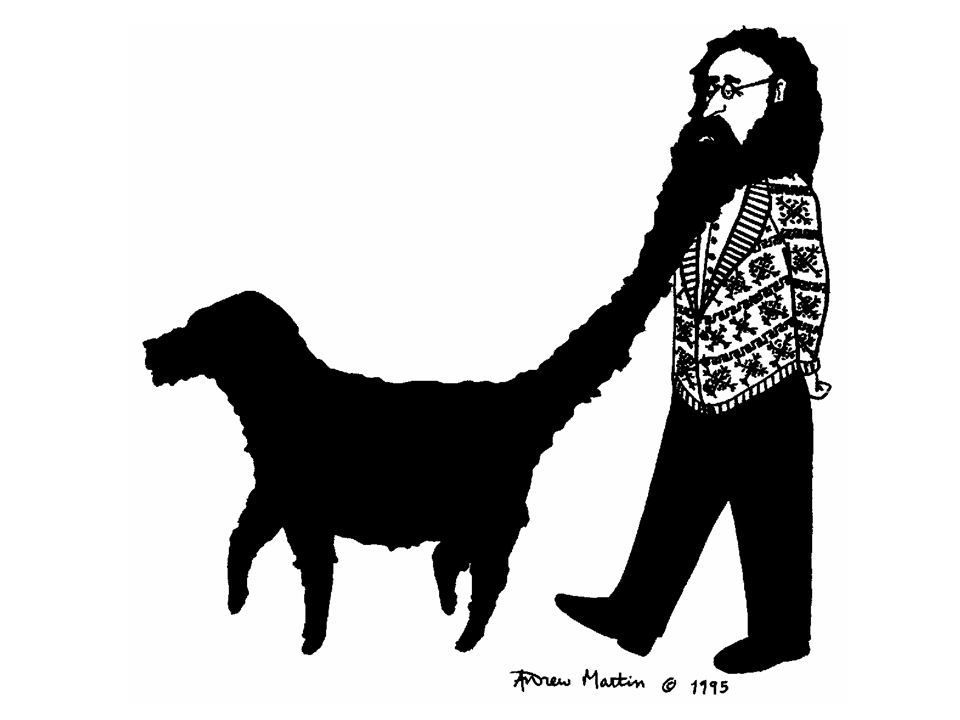
Drew Martin, Dog Walking (1995). A surreal take on the familiar sight of a Prague resident walking his dog: the man's extraordinarily long beard appears to merge with the animal. Martin had discovered the possibilities of the wordless, single-panel cartoon through the work of Czech cartoonist Jiří Slíva, whose drawings he encountered at a library in Dejvice in 1992. Image courtesy of the artist.
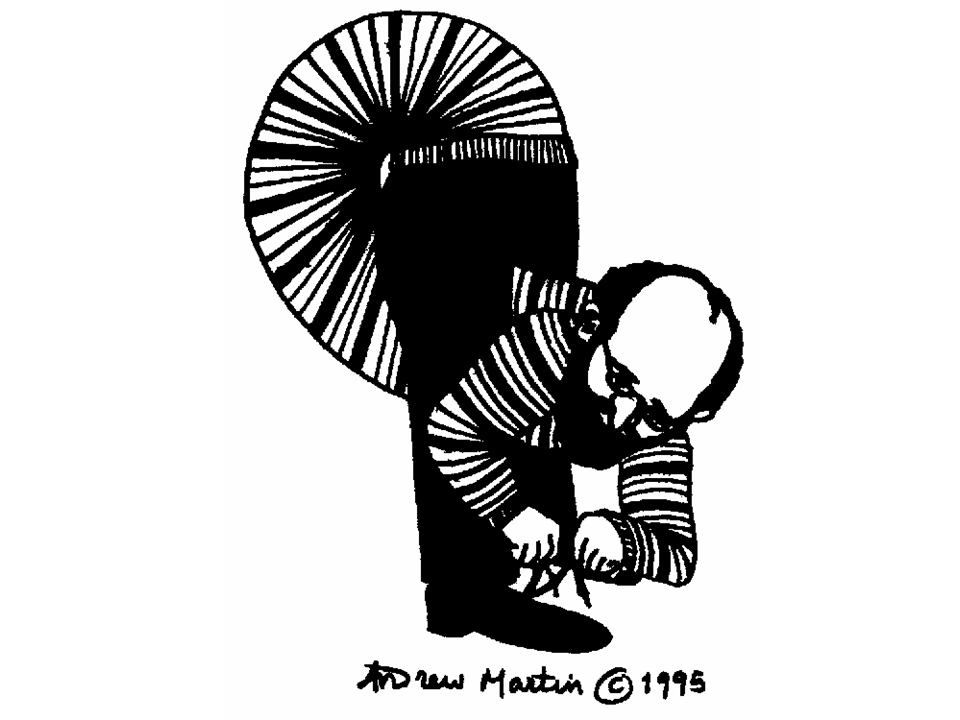
Drew Martin, Complicated (1995). A minimalist drawing in which the relationship between a human figure and a simple black circle provides the basis for an absurd visual predicament. Unlike many of the expatriate newspaper cartoons of the period, Martin’s drawings needed neither dialogue nor punch lines, allowing their humor to travel easily across linguistic boundaries. Image courtesy of the artist.
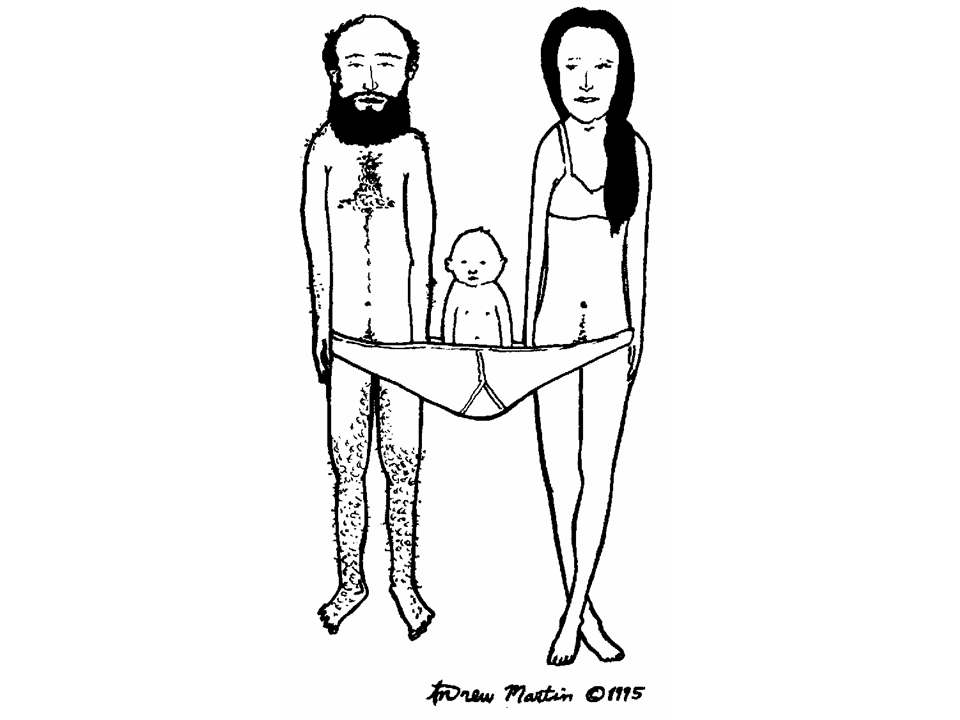
Drew Martin, Czech Family (1995). A deadpan portrait of a family of three, conveyed through an economical arrangement of lines and shapes. Martin’s drawings are interesting for the extent to which they focus on Czechs themselves, rather than on the cultural misunderstandings and tribulations of foreign residents that preoccupied some expatriate cartoonists. Image courtesy of the artist.
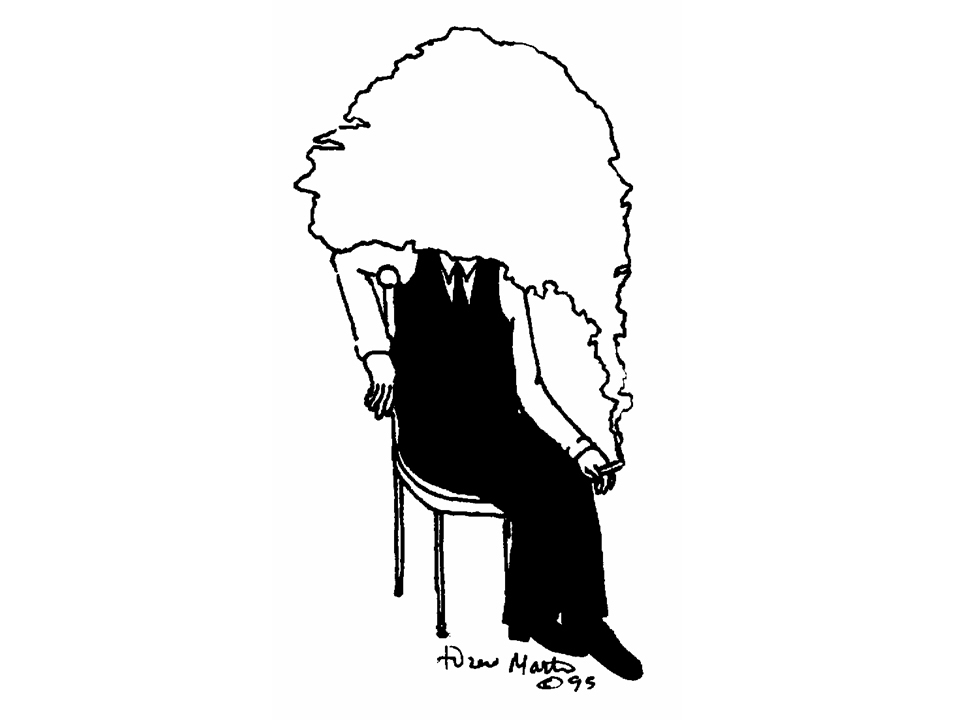
Drew Martin, Smoking (1995). One of Martin’s wordless observations of everyday Czech life. Smoking was a conspicuous feature of social life in 1990s Prague, particularly in its pubs and cafés, and its ubiquity offered another source of material for Martin’s visual humor. Image courtesy of the artist.
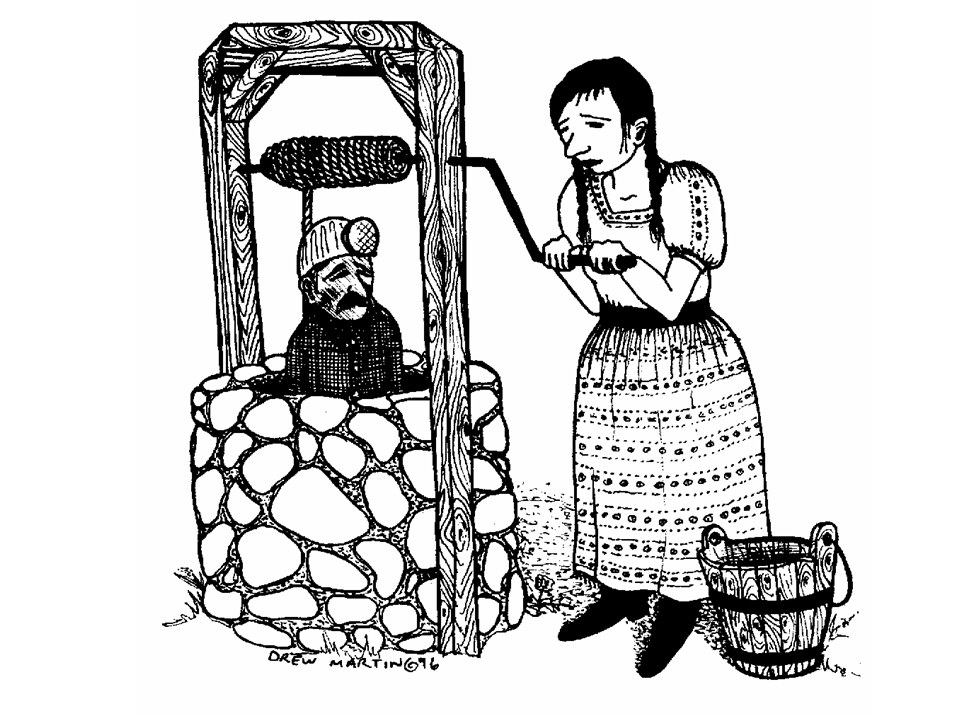
Drew Martin, Coal Miner (1996). A woman operates the winding mechanism of a well as a miner emerges from below. The drawing shows Martin's fondness for visual absurdity, turning two familiar elements of everyday life into an entirely unexpected situation. Image courtesy of the artist.
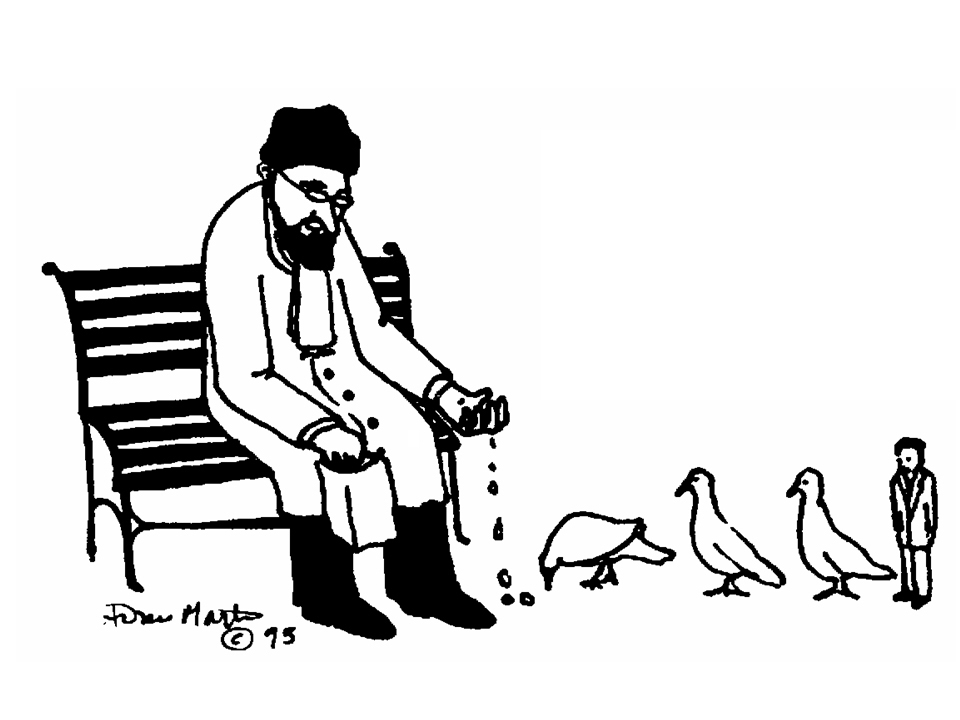
Drew Martin, Breadline (1995). A man seated on a park bench feeds a line of birds, at the end of which stands a tiny human figure awaiting a crumb. The English title adds another layer to the joke, invoking the familiar image of people queuing for food. Image courtesy of the artist.
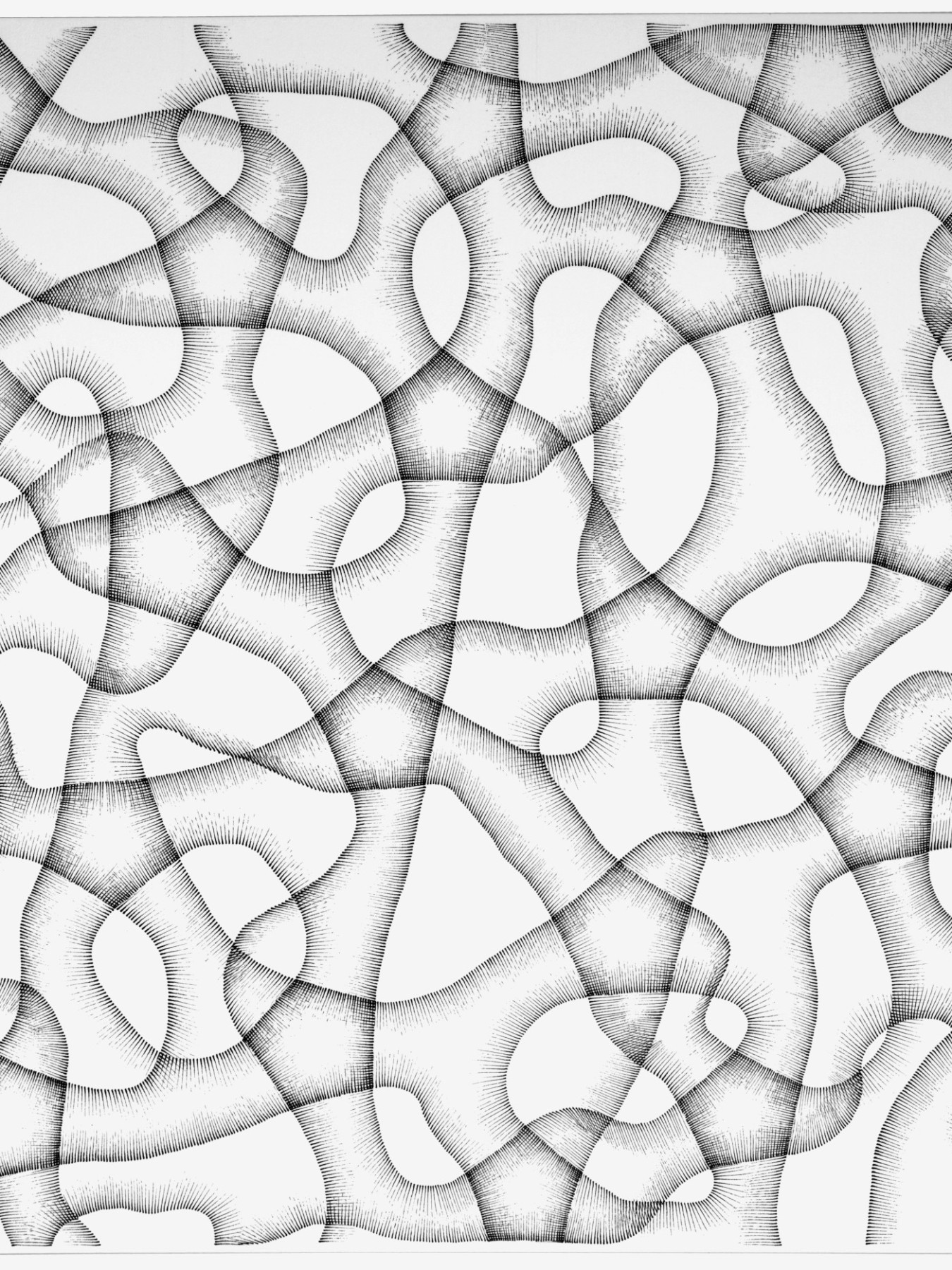
Robert Horvitz, from the series A History of Ideas (1999). An intricate abstract drawing constructed from interlocking, curving forms and thousands of fine black lines. The work was included in a retrospective exhibition of 135 of Horvitz’s drawings at Mánes in December 1999, curated by Vlasta Čiháková-Noshiro. The exhibition was a particularly substantial showcase for the work of a foreign artist in Prague at the close of the decade. Image courtesy of the artist.
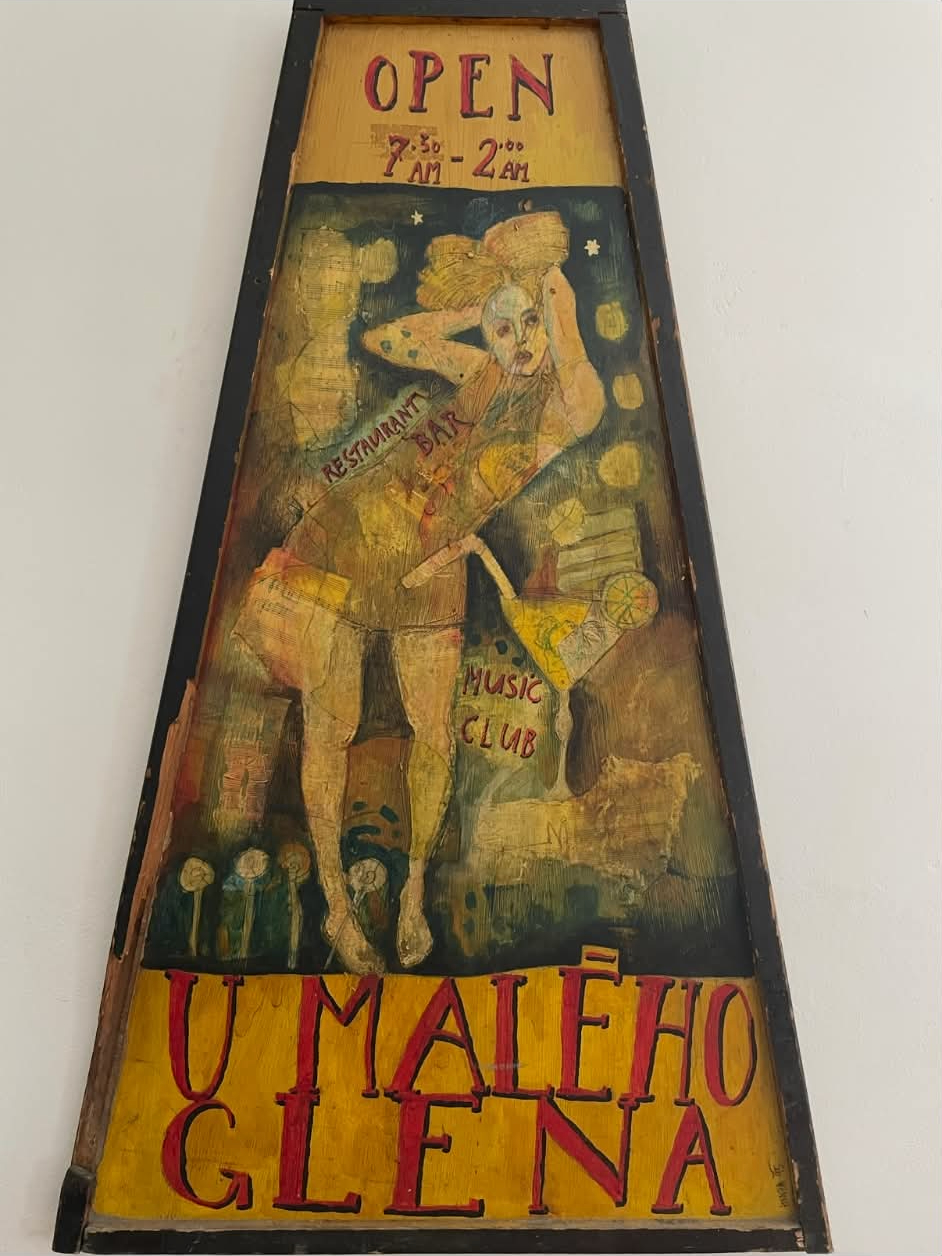
The original hand-painted sign for U Malého Glena, circa 1994. Designed by Czech artist Honza Blažíček, the sign is a reminder that the distinctive visual identity of Prague’s expatriate establishments was not exclusively the work of foreign artists. Inside, original paintings by expatriate artists, including Jesse Littell’s The Game, adorned the walls of the popular Malá Strana bar and music club. Image courtesy of Glenn Spicker.
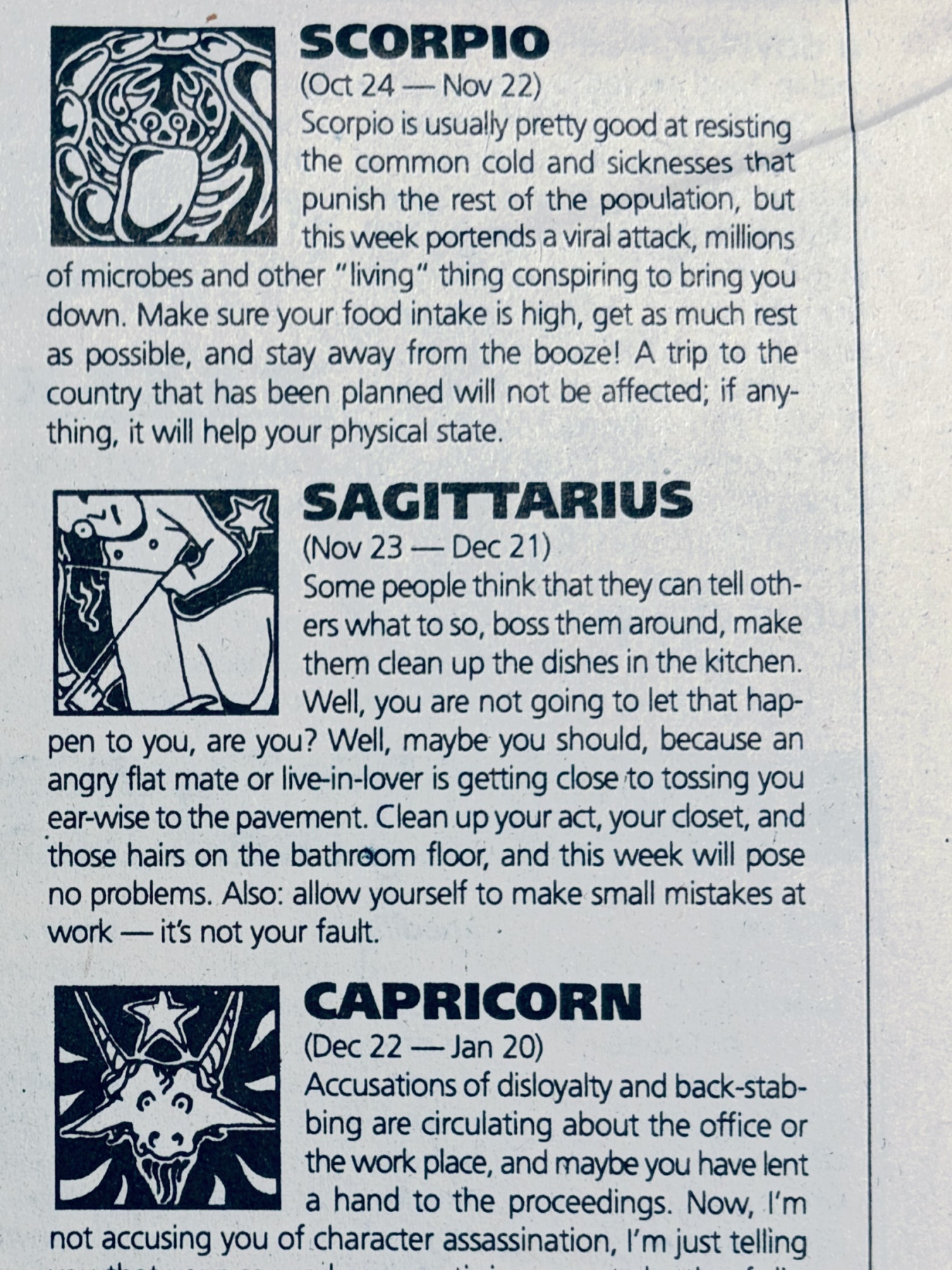
Tony Mullen’s fantastical astrological illustrations for the weekly cultural insert of Prognosis, 1995. Mullen was also the creator of “The Stranger,” a continuing, loosely autobiographical comic strip that explored the sometimes surreal experience of being a foreigner in Prague. His horoscope illustrations demonstrate how the newspaper’s artists could exercise their imaginations even in conventional recurring features. Photo by Mark Baker.
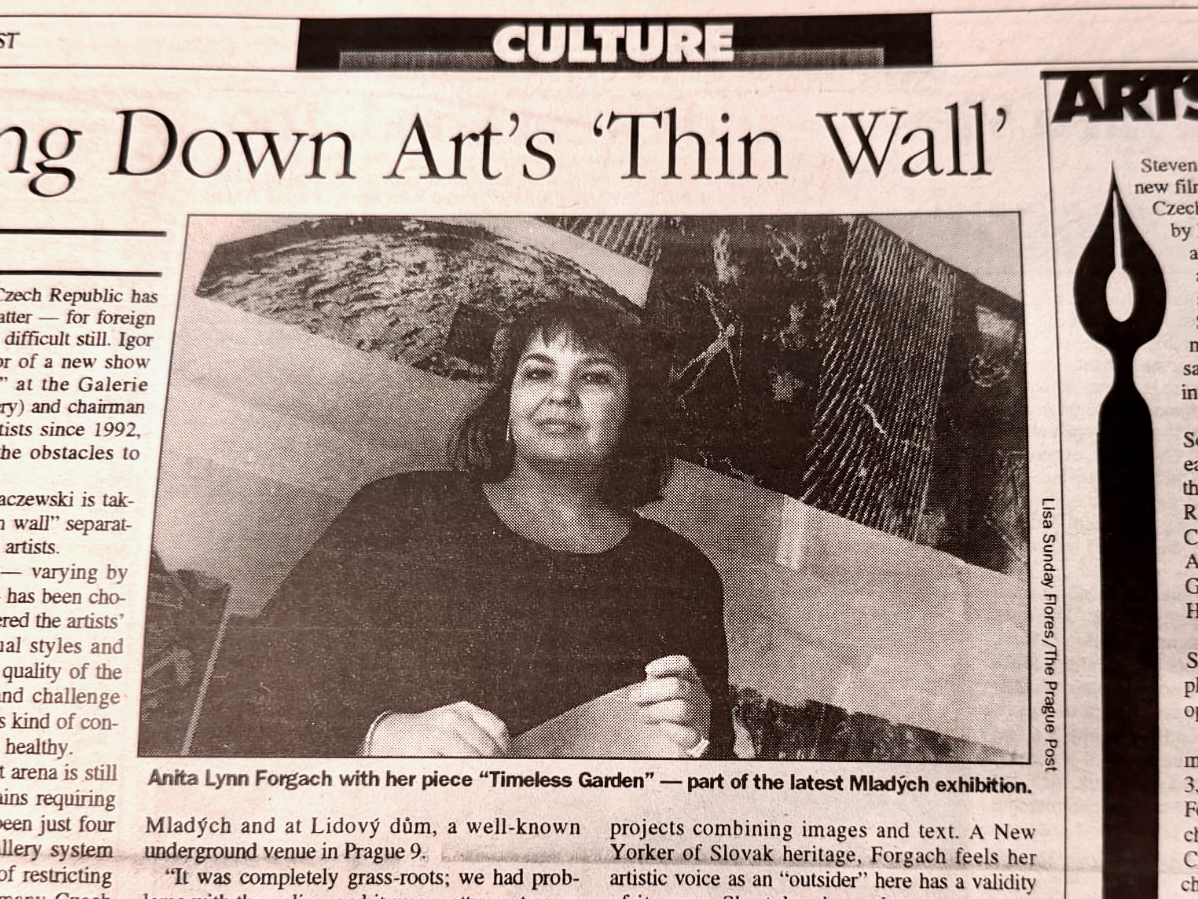
The late artist Anita Lynn Forgach with her work Timeless Garden (1994), photographed by Lisa Sunday Flores for the March 2–8, 1994, edition of The Prague Post. Forgach was one of 12 artists featured in “…next door” at Galerie mladých. Flores’s accompanying article explored the growing professional interest in foreign artists’ work and the debate within the Czech art community over access to gallery space. Image courtesy of Beth Zonderman.
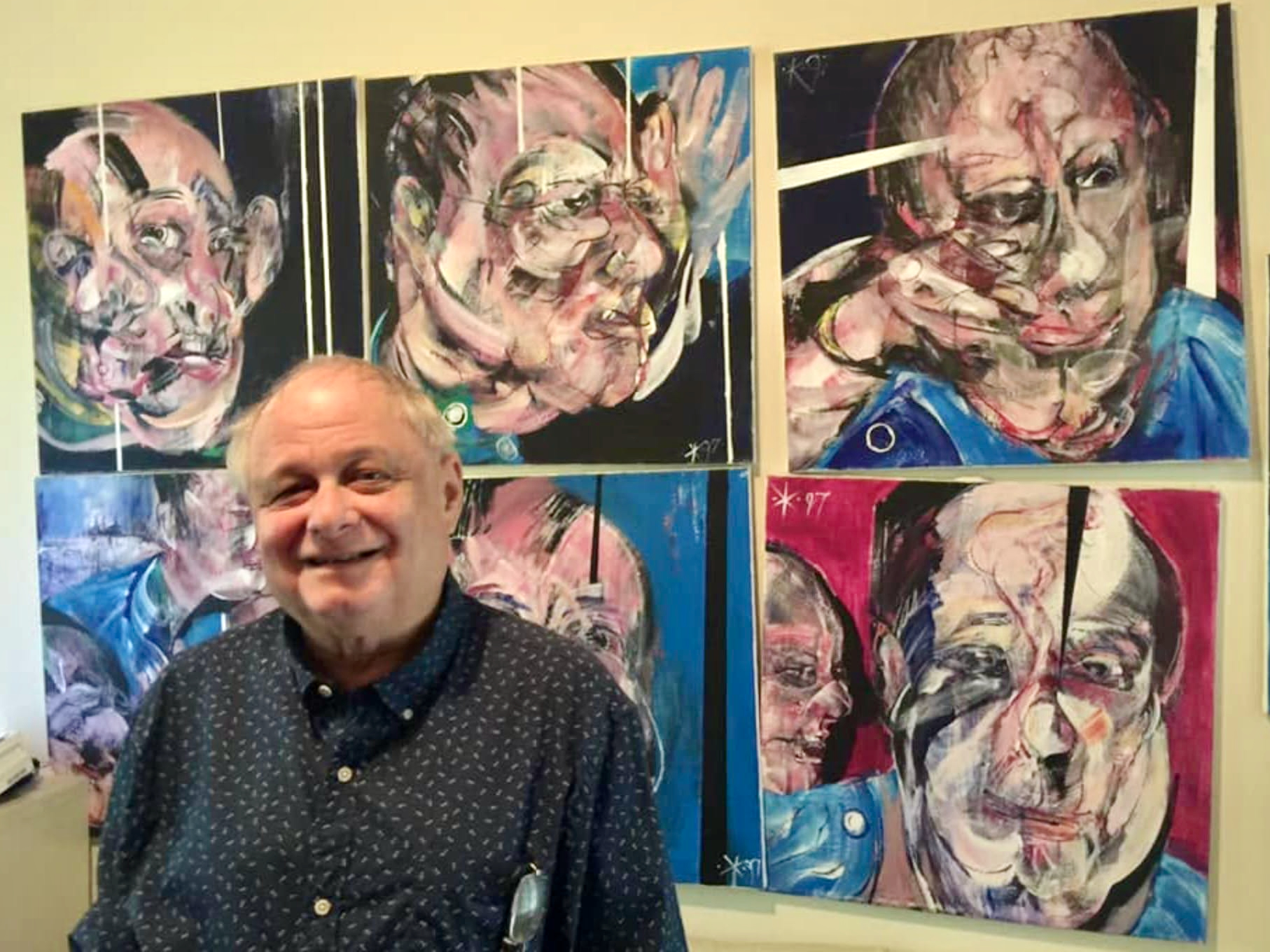
Radio Free Europe/Radio Liberty journalist and collector Frank Csongos in front of a series of portraits by “Klaus von Shit,” an elusive German artist who lived and worked in Prague in the early 2000s, and possibly in the 1990s. I was unable to find much information about the artist while researching this series. Photographs preserved by collectors and former residents are sometimes the only readily available visual record of artists who passed through Prague during those years. Photo courtesy of Grant Podelco.
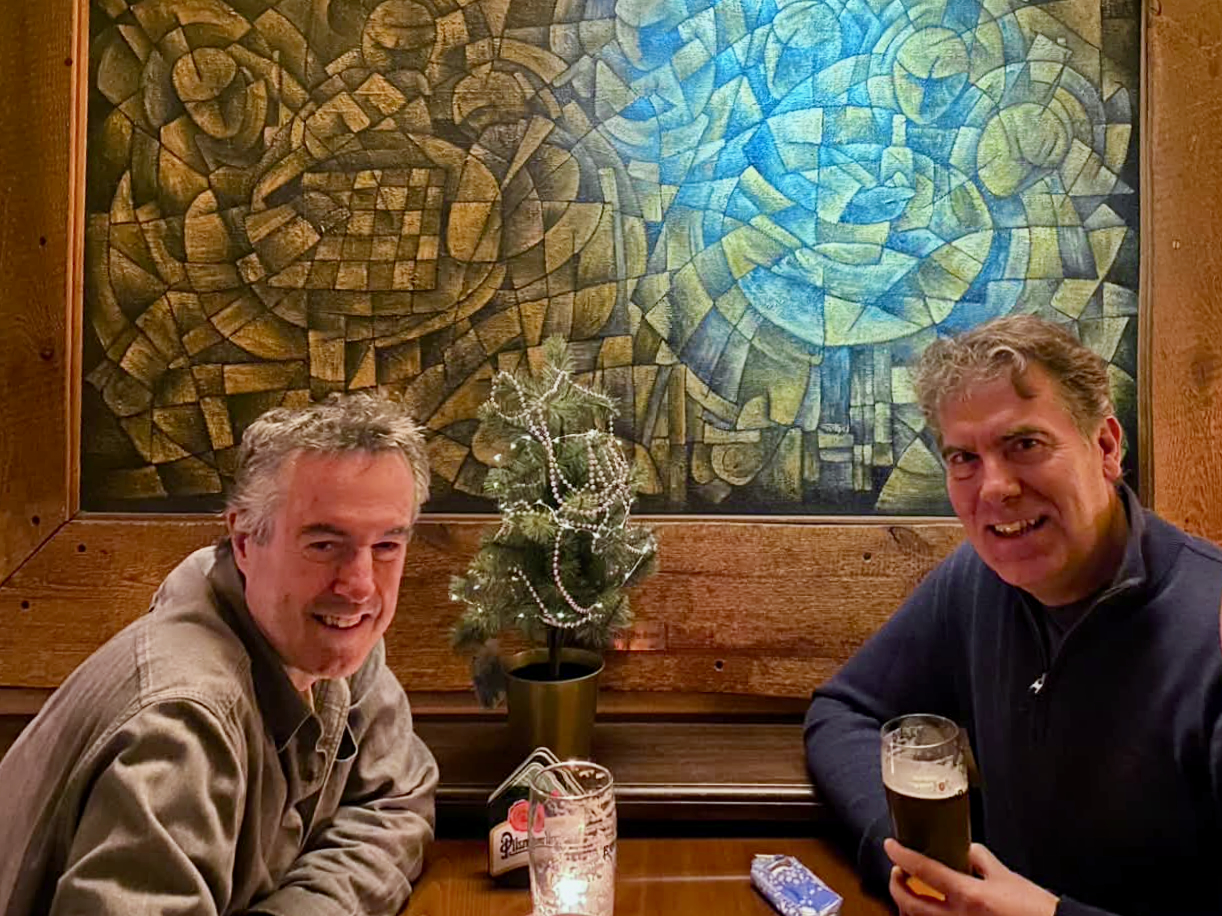
Two patrons seated beneath Jesse Littell's painting The Game at U Malého Glena, where the work hung for several years. Littell and his former college roommate, American artist Stuart Jackson, came to Prague specifically to pursue their art. Littell's expressive, fragmented approach to painting was particularly distinctive, prompting fellow artist Holly Spruck to write about his unconventional way of perceiving the world in Think magazine. Photo courtesy of Glenn Spicker.