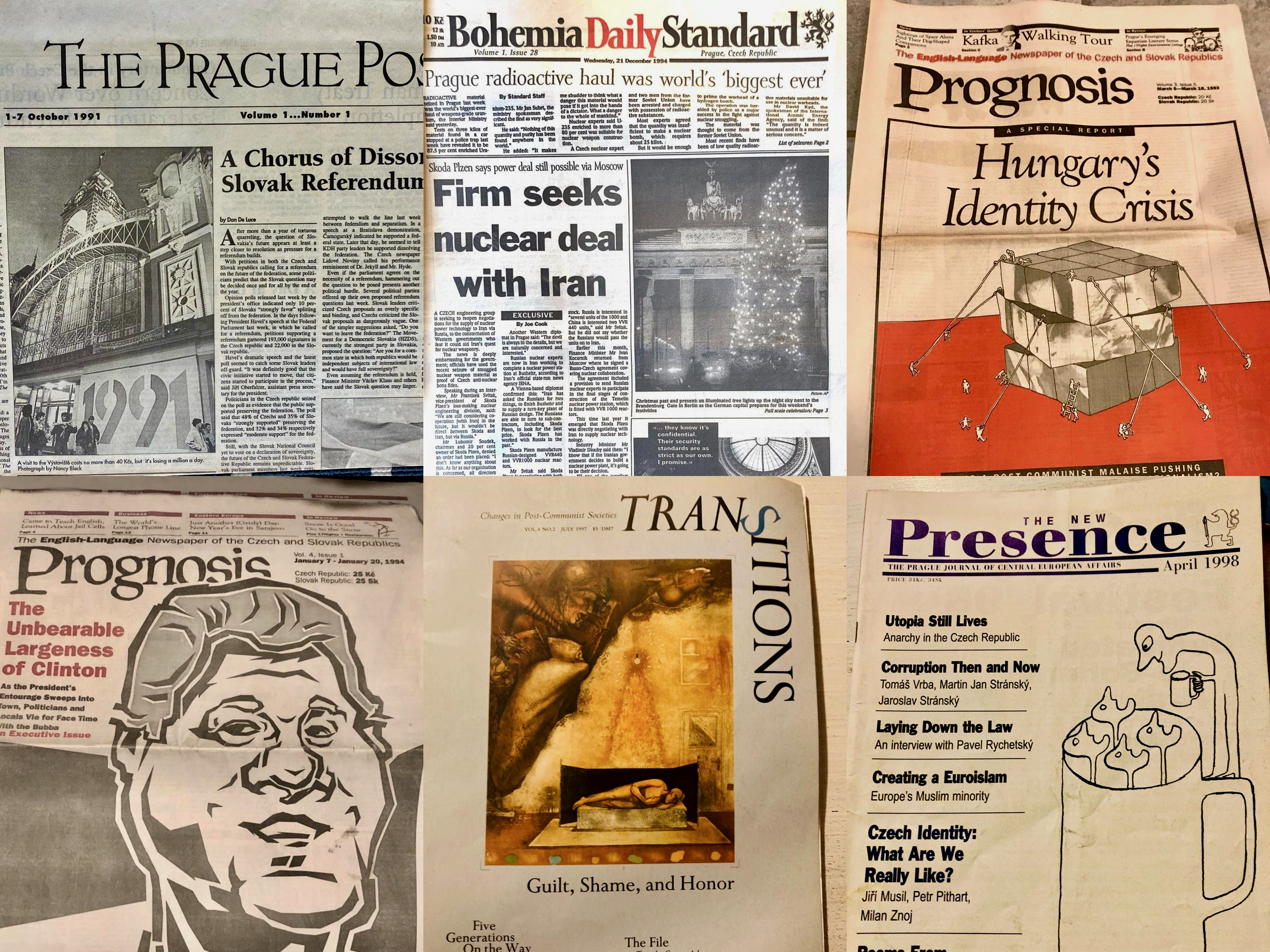
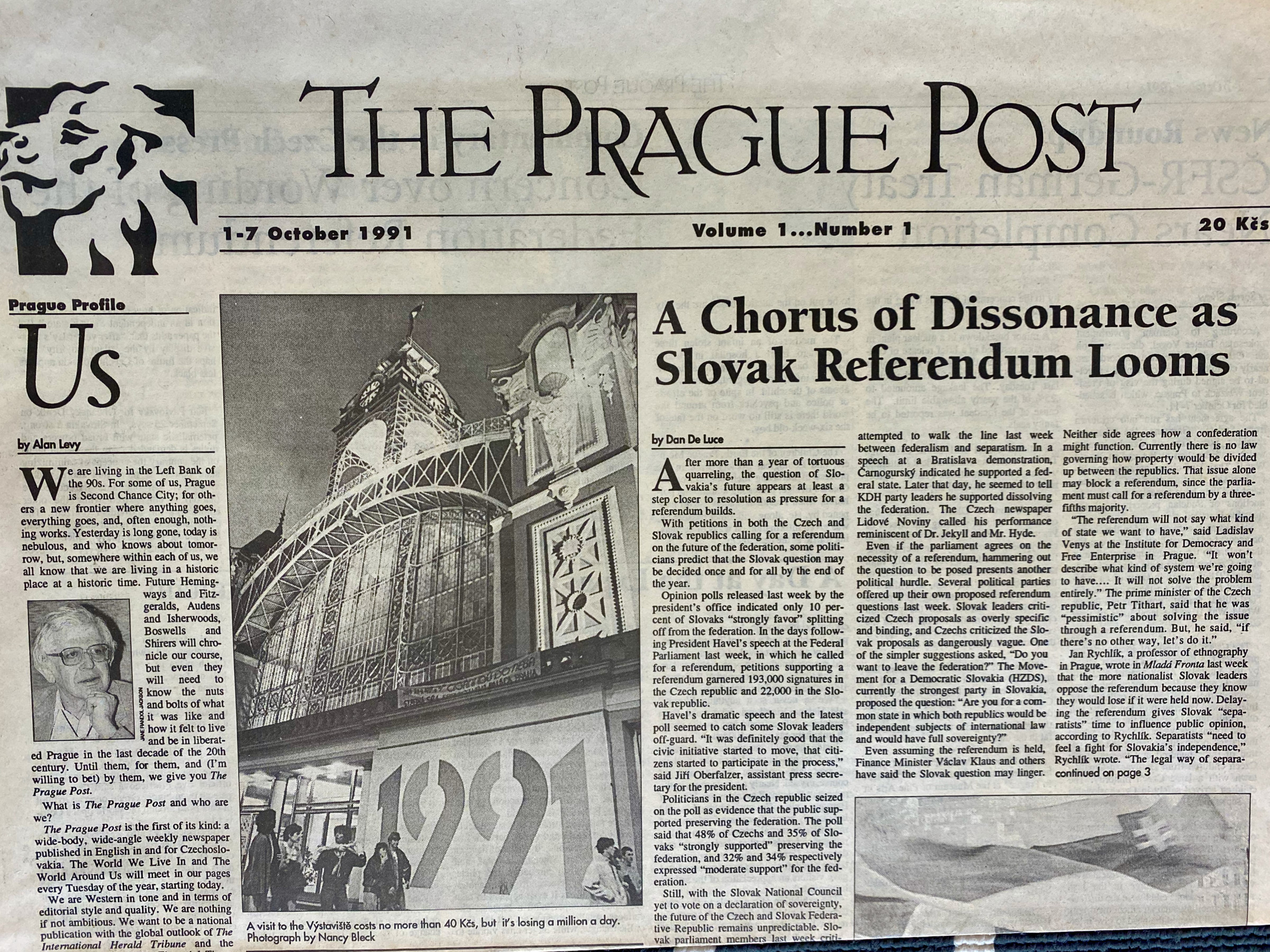
In a world where many new arrivals to Prague couldn’t even pronounce the name “Václav” correctly—whether referring to President Havel or Prime Minister Klaus—serious news coverage in English of the Czech and Slovak political scene filled an obvious market gap. Several newspapers and news magazines stepped in over the decade to meet this demand. During the first half of the ’90s, the scene was dominated by two someimes-bitter rivals: Prognosis, which began as a monthly in March 1991, and The Prague Post, a weekly that first appeared in October that same year.
In subsequent years, additional investors occasionally tested the waters with serious news publications—often with a focus on business—though most did not last long. Politically oriented news magazines, sometimes supported by international or institutional funding, also helped fill the information gap for hardcore political junkies.
NEWSPAPERS
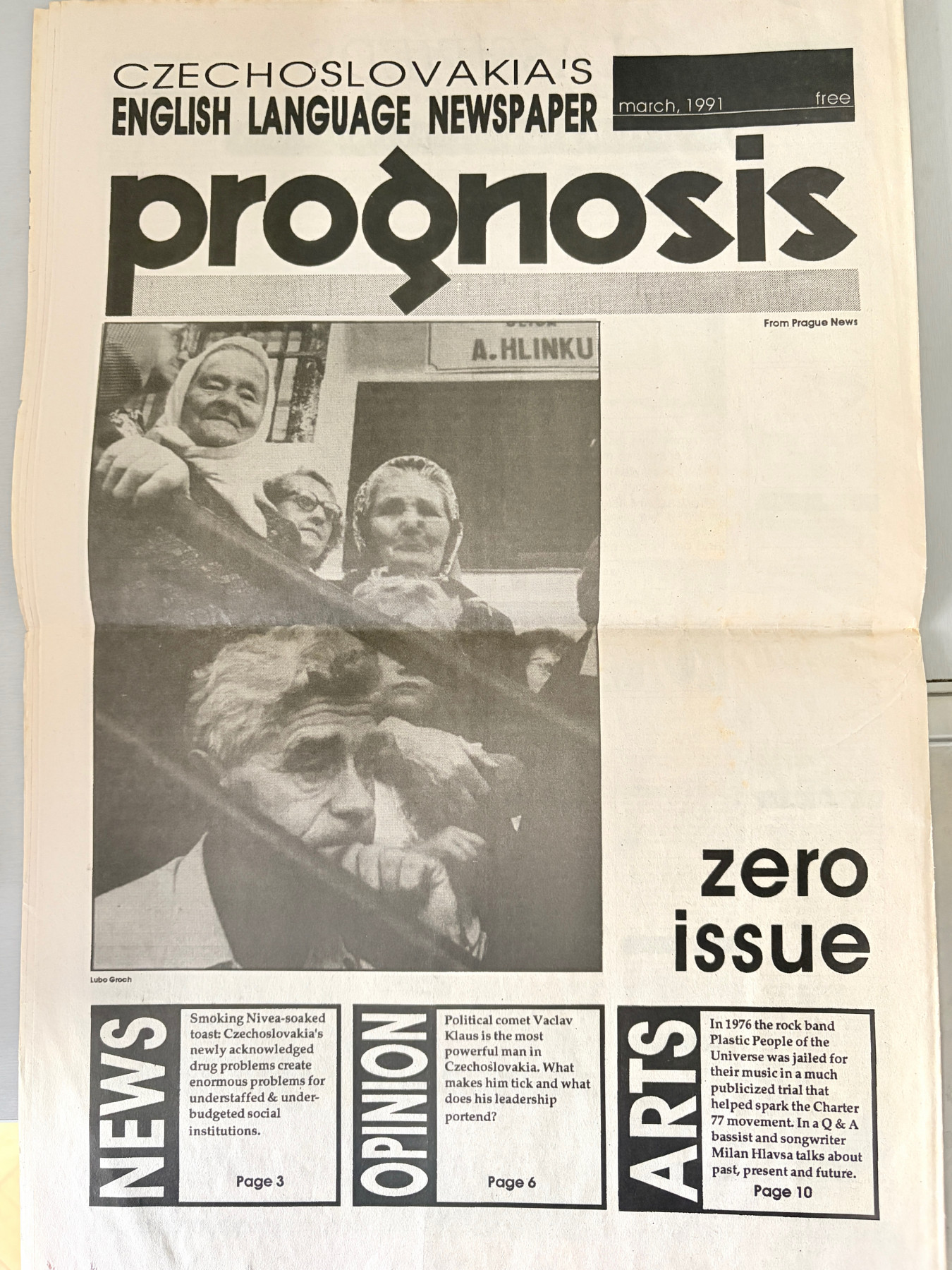
Prognosis (1991-1995)
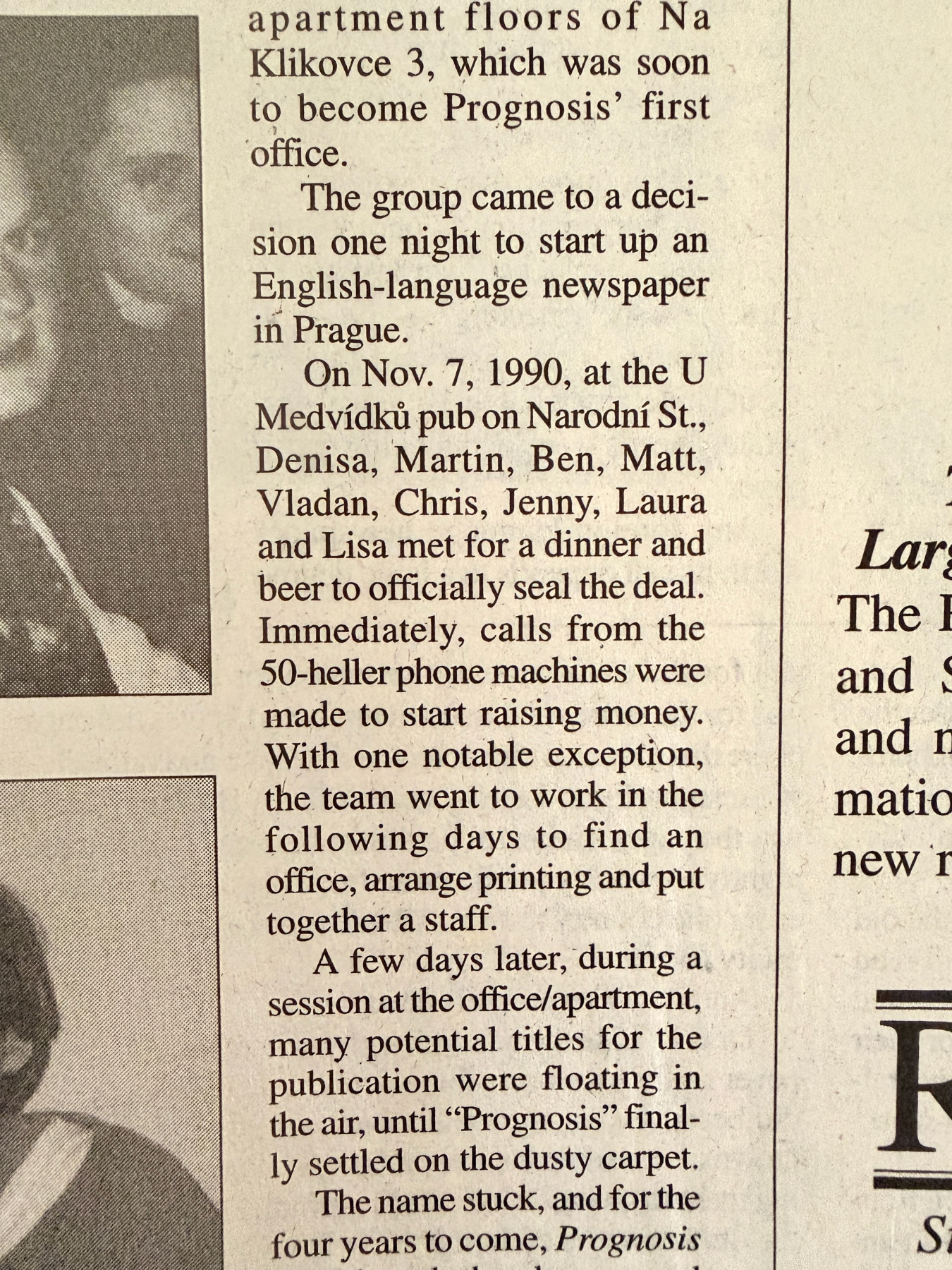
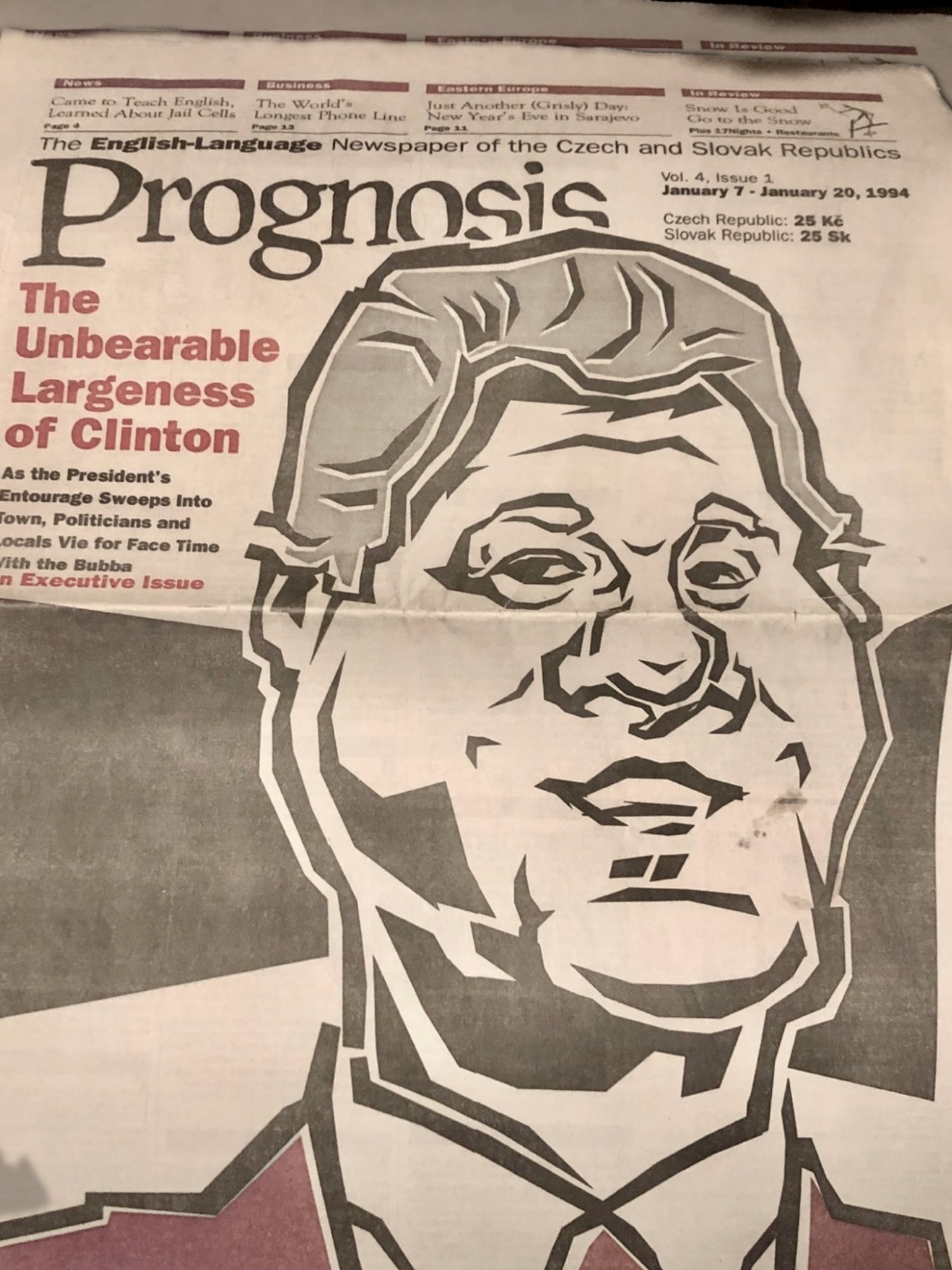
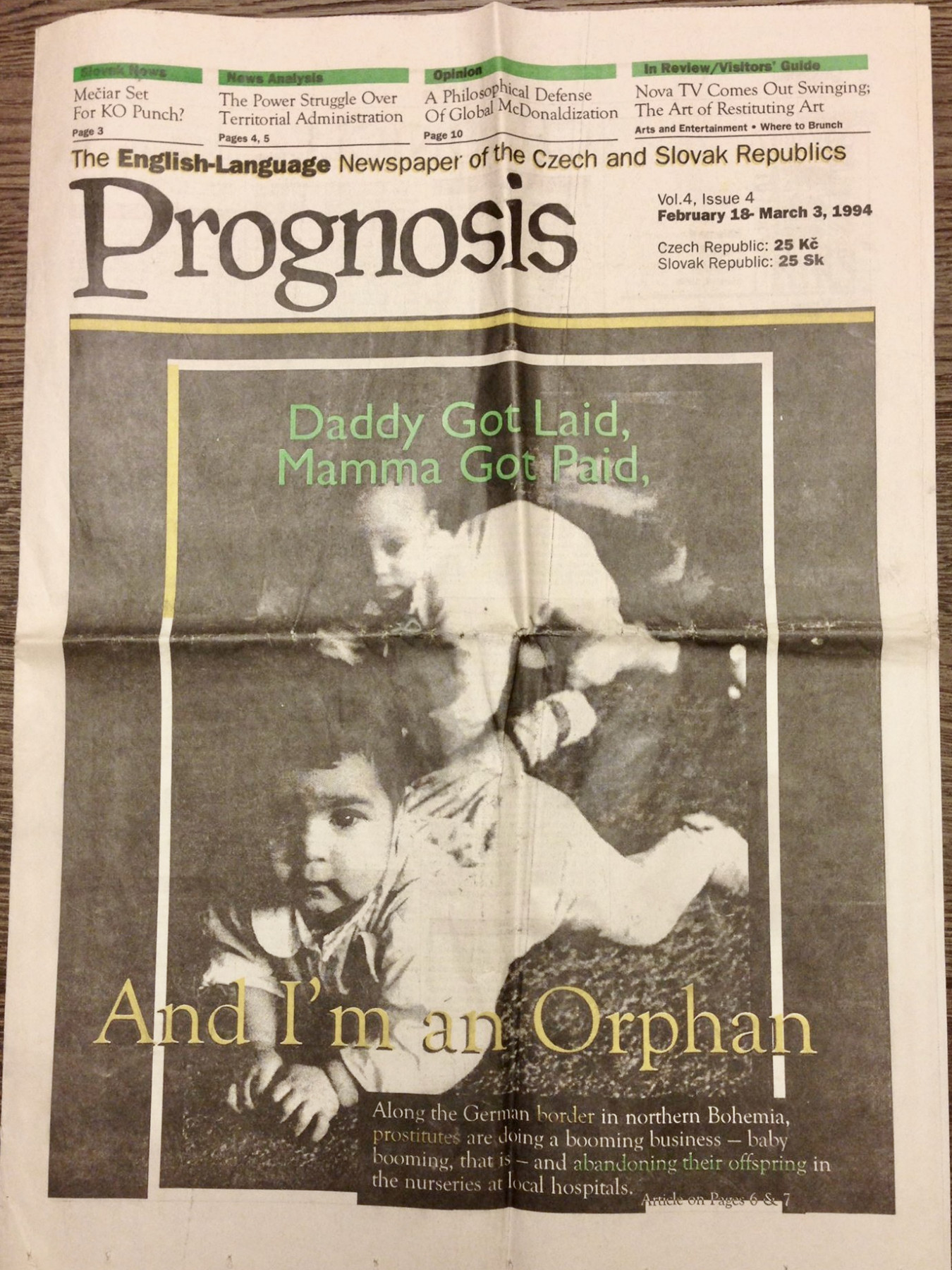
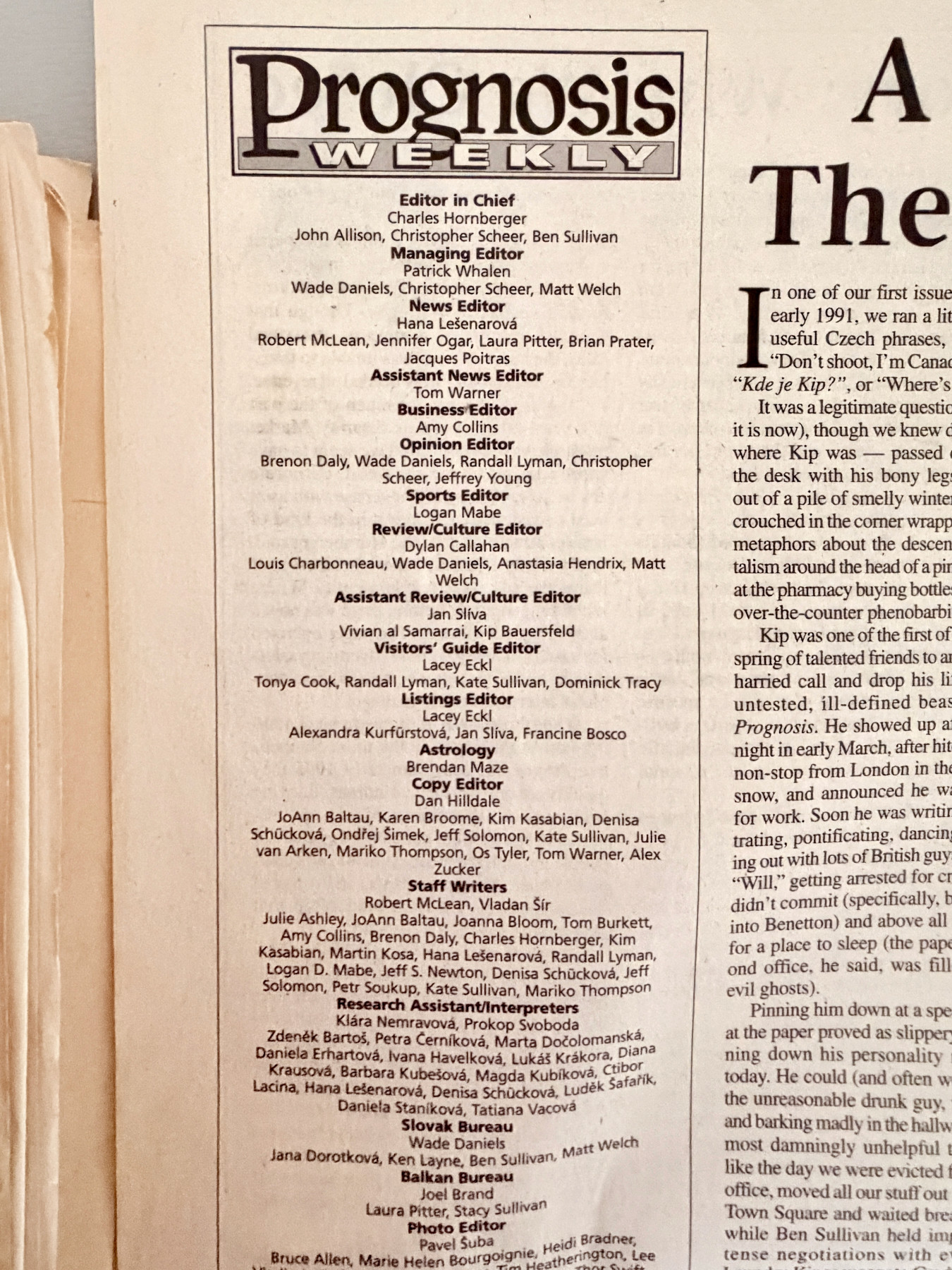
Any discussion of Prague’s expat press inevitably begins with Prognosis. This eight-page paper—initially a monthly before moving to a fortnightly and eventually a weekly—was the first English-language publication out of the gate, launching in March 1991. With its fresh-faced staff, drawn largely from a circle of college friends at the University of California, Santa Barbara, the paper truly met the moment, vibing with both the youthful energy unleashed by the Velvet Revolution itself and the backpacker crowd just then pouring in from abroad. Its tone—witty, opinionated, slightly detached, and socially aware—also set a template for the many ’zines and alternative publications that would emerge over the course of the decade.
Although I was the business editor at the rival Prague Post during Prognosis’s early days, I was a longtime admirer of the paper, dating back to when it operated out of a tiny office on Malé náměstí next to the old American Hospitality Center.
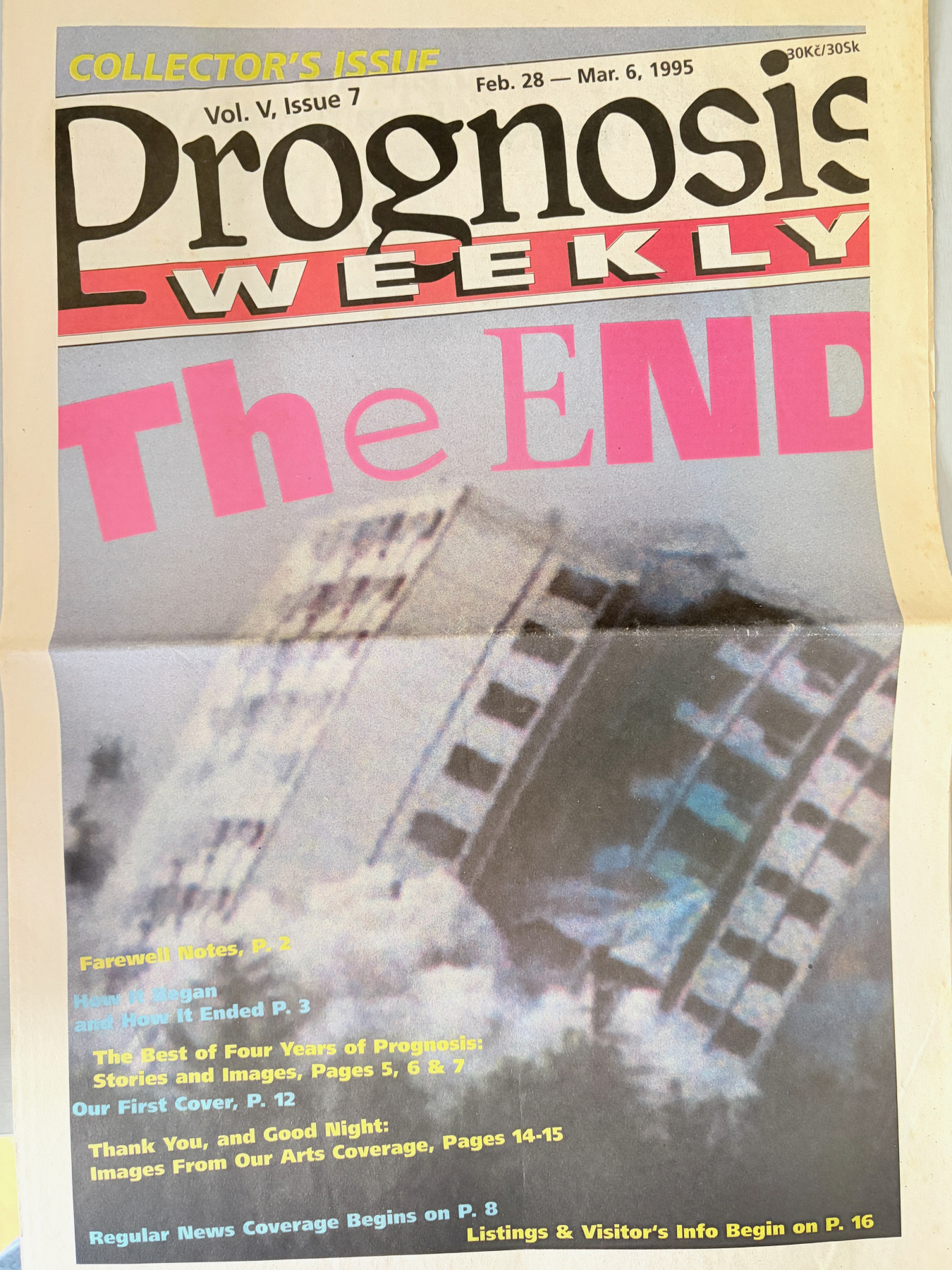
Prognosis lasted four years, closing in March 1995. I’m not privy to all the reasons for its demise, though like many publications of the time it struggled with chronic funding problems. The pressure to produce quality issues while also navigating the inevitable scandals and constant staffing and logistical challenges also took its toll. You can find a terrific long-form overview of all of this, including the paper’s legendary spat with the Post, by former staffer Jacques Poitras here.
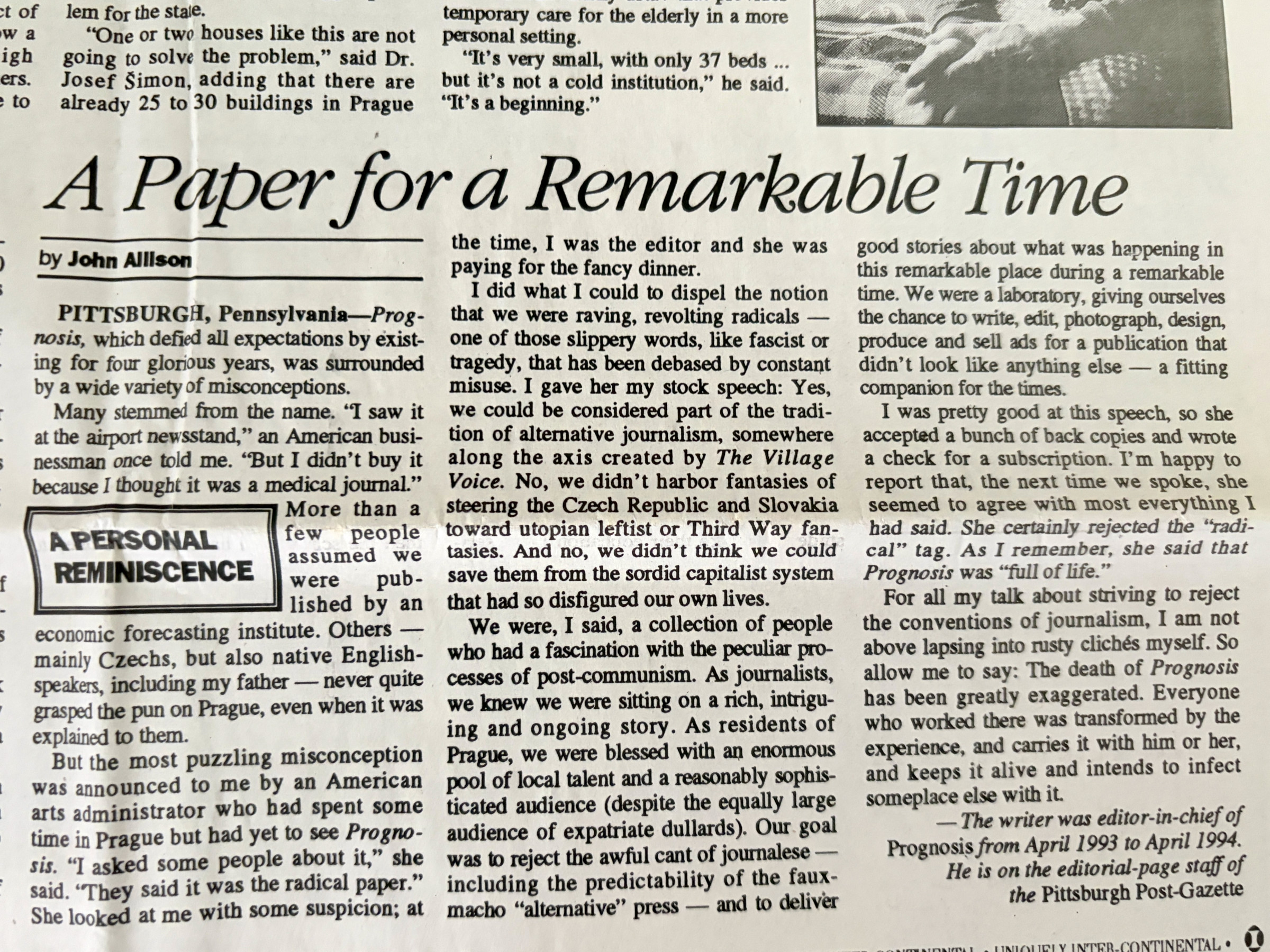
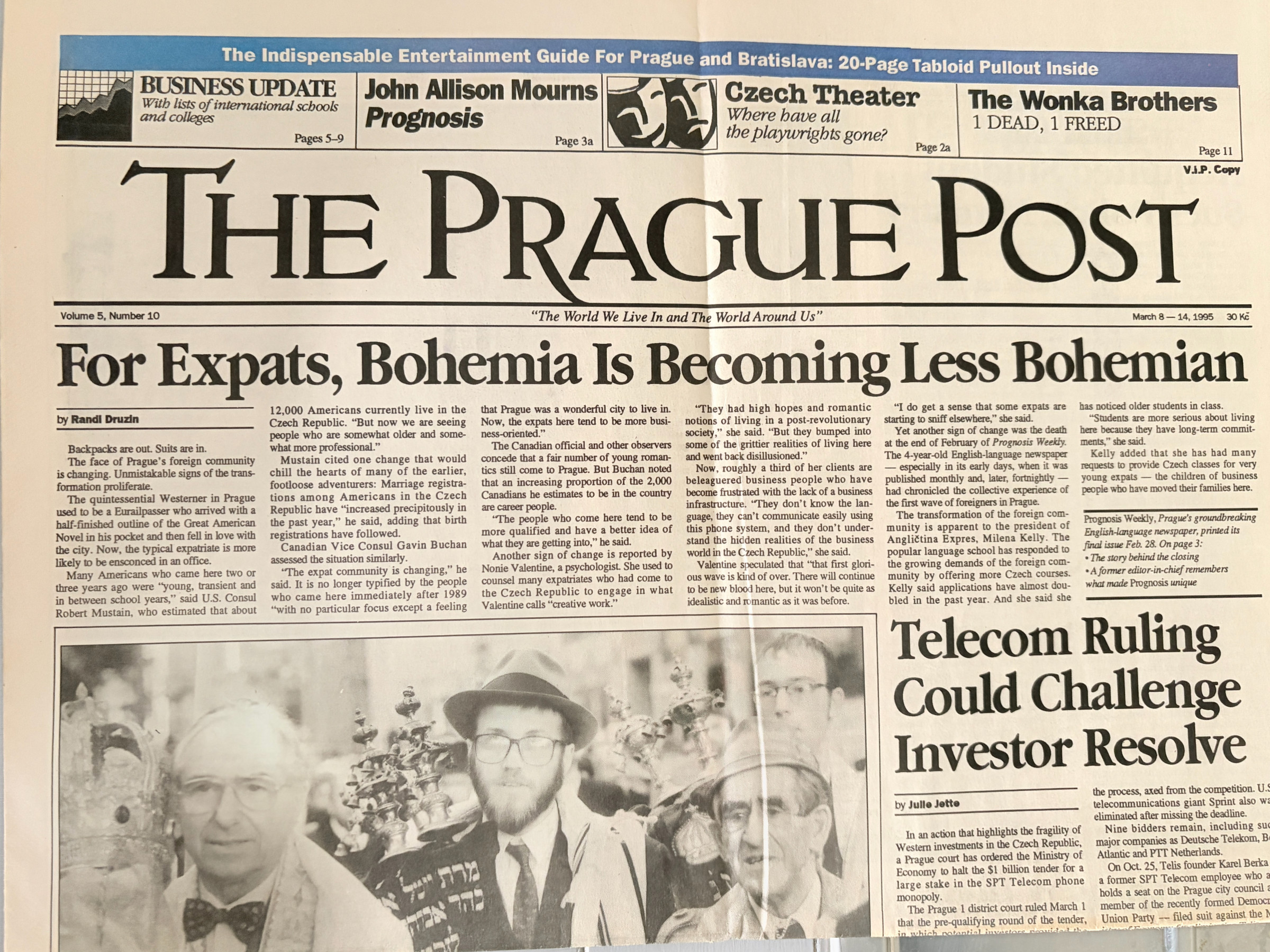
Writing shortly after the paper closed (see photo, below), former editor-in-chief John Allison suggested that the publication’s name—a pun on the word Prague—confused some readers, while others may have been put off by the mistaken notion the paper was somehow “radical.” The reality, he said, was quite different: “We were [merely] a collection of people who had a fascination with the peculiar processes of post-communism. As journalists, we knew we were sitting on a rich, intriguing, and ongoing story.” I wish it were still around.
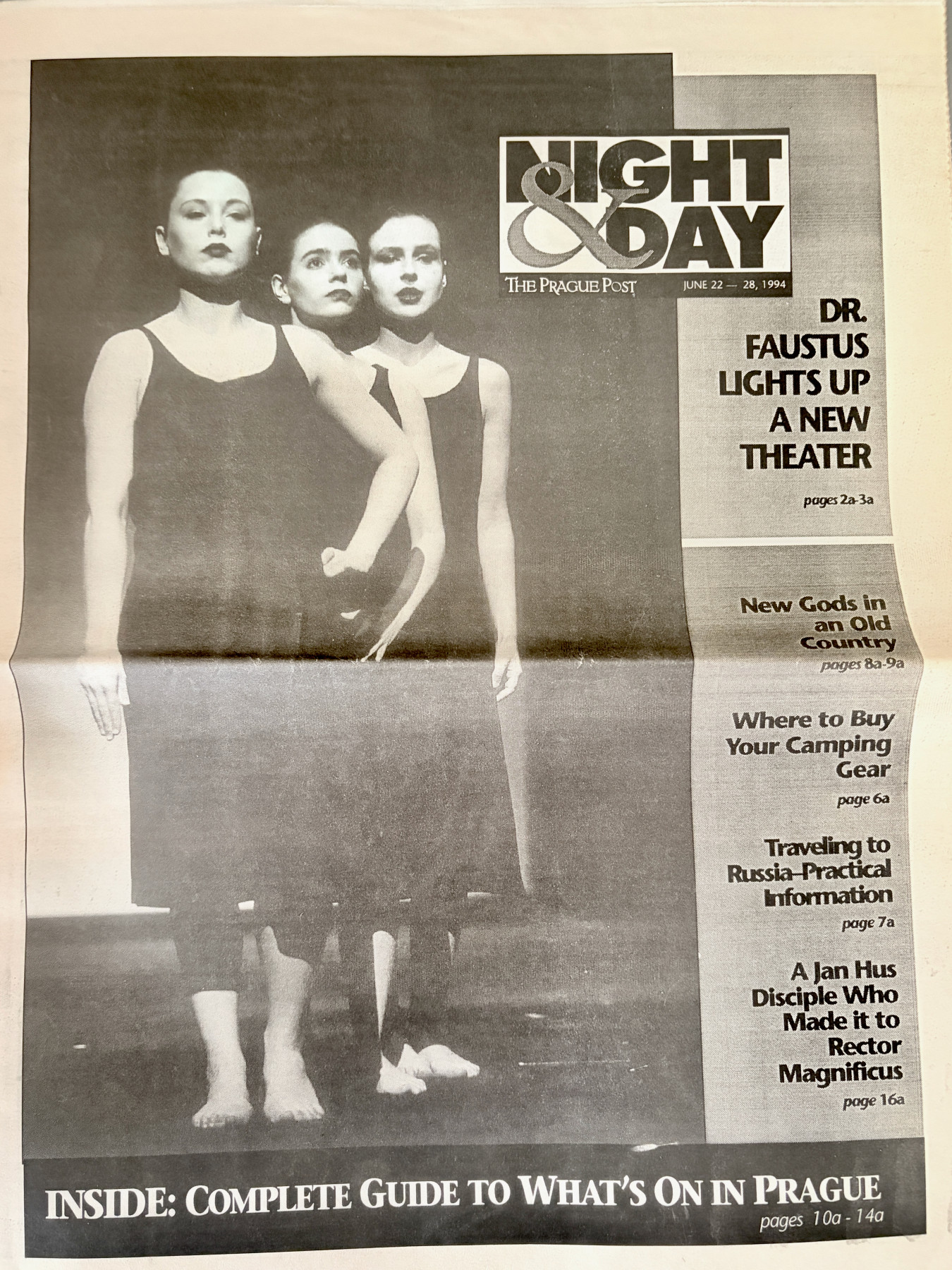
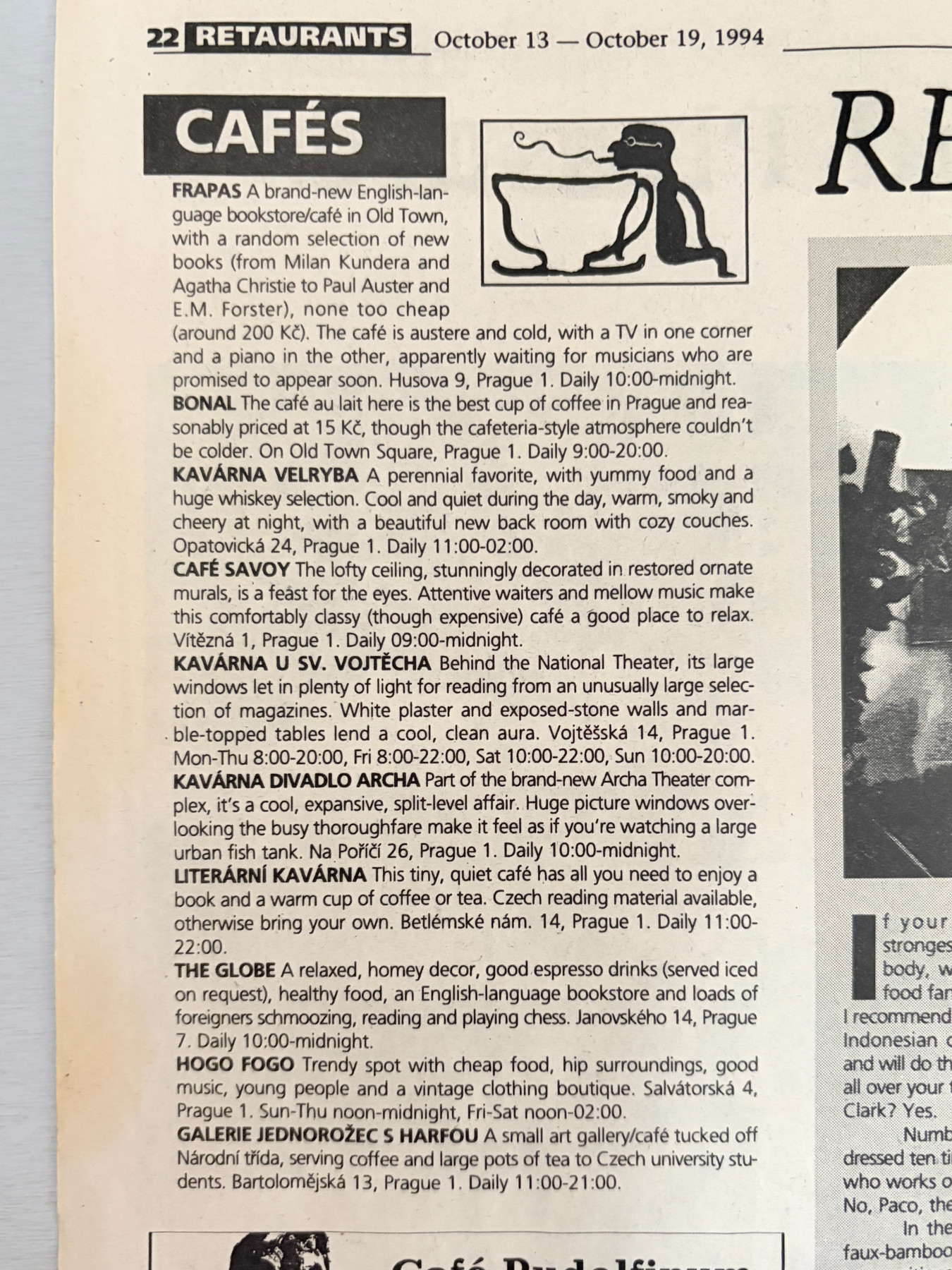
The Prague Post (print: 1991-2013)
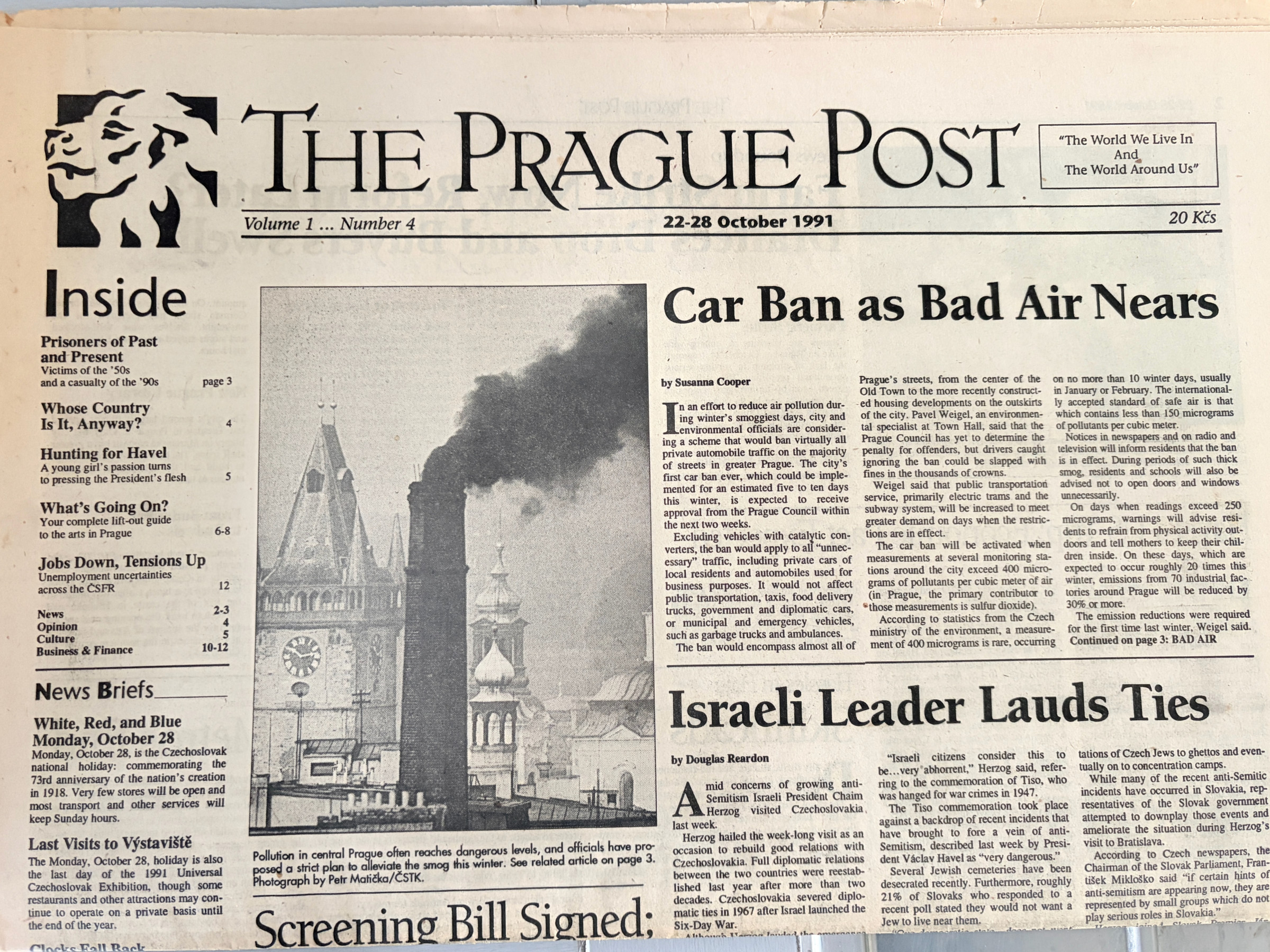
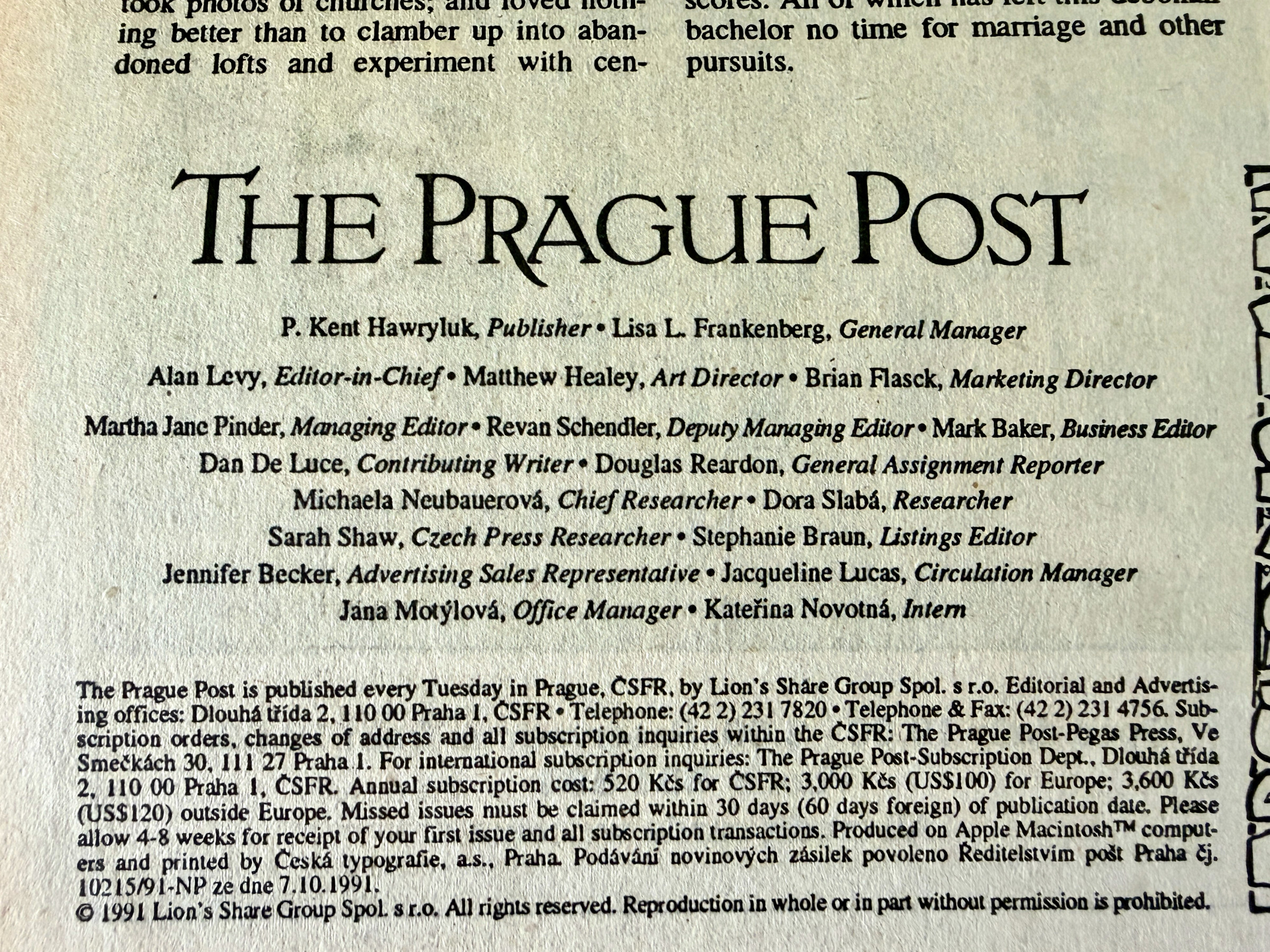
The Prague Post, probably the best-known publication to come out of Prague in the ’90s, followed Prognosis to the newsstands by seven months. In fact, the Post can trace its origins directly to Prognosis. Two of the Post’s founders, Lisa Leshne (Frankenberg) and P. Kent Hawryluk, originally worked for Prognosis before leaving to start their own paper. Without getting too far into the weeds, their departures inevitably led to hard feelings and an unfortunate rift in the expat community ("edgy" Prognosis versus "establishment" Prague Post) that in some ways continues to this day.
In contrast to Prognosis, the Post began as a weekly and adopted a much-safer, more-traditional newspaper format: a two-part broadsheet with clearly delineated sections devoted to news, business, and culture. Instead of a twentysomething editor, the Post brought in the nearly sixty-year-old American journalist Alan Levy as editor-in-chief. Levy had earlier witnessed the 1968 Warsaw Pact invasion of Czechoslovakia and later wrote a well-known account of that catastrophe: So Many Heroes. His appointment gave the Post instant gravitas among a generation of Czechs who had lived through the invasion.
Like Prognosis, the Post also established a template of sorts for future publications to follow—in this case, a commitment to serious business news coverage and a keen focus on building a strong base of advertising revenue and distribution through city newsstands (never Prognosis's strong suit). That said, the Post was by no means immune to the petty scandals, incessant staff churn, and inevitable financial troubles that beset nearly every publication of the time. Over its 22-year existence, the paper changed offices at least four times, including—ironically—a year in the same building on Prague’s Politických vězňů street that also housed the Communist Party of Bohemia and Moravia (KSČM), the successor party to the former regime. That unfortunate location confused some readers, including the ideologically blinkered former Finance Minister (later Prime Minister) Václav Klaus, who once told me to my face, "Everyone knows The Prague Post is a left-wing newspaper."
Twenty-two years, however, is quite a run—proof that the paper must have gotten at least a few things right. The Post was often dismissed as the “boring” paper, but as I leaf through the old copies I keep in my office, I’m struck by how many of the stories still hold up. Doubtless this was at least partly due to the early addition of highly experienced British journalist Martin Huckerby as the paper's managing-editor.
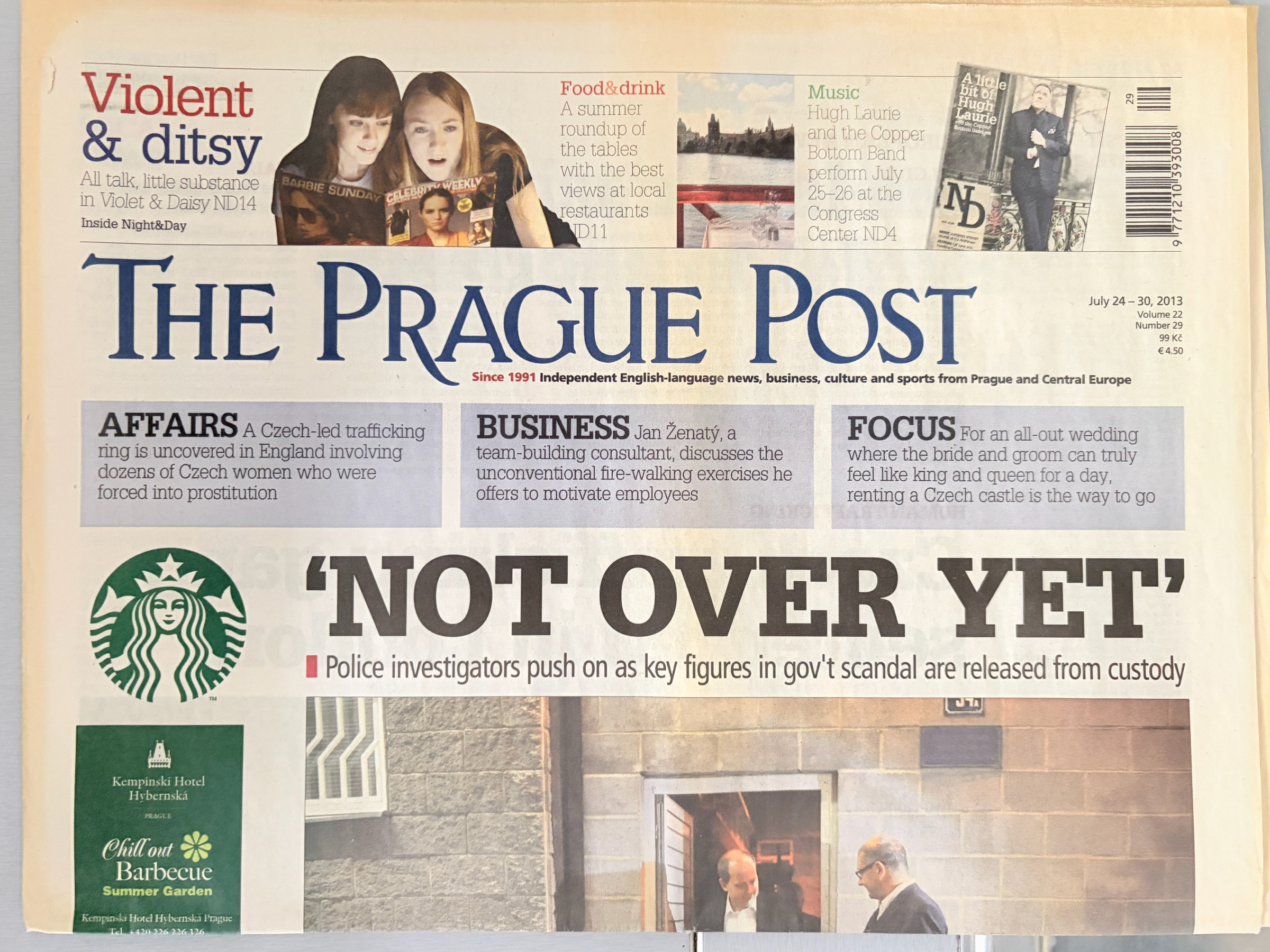
The paper ceased publication without warning in the summer of 2013—ultimately succumbing to tax arrears and unresolved court cases, according to an article by Jeffree Benet in Think Magazine. For readers, it simply vanished from newsstand shelves (though it continued online for a couple of years afterward). Ironically (and poetically), the headline on that final print issue read “Not Over Yet” (see photo)—a reference not to the paper itself but to some long-forgotten scandal in the Czech government. Perhaps the Post’s most enduring legacy is its staff, many of whom went on to highly distinguished careers in journalism in the United States, Canada, the UK, and elsewhere.
Prager Zeitung (1991–2016)
Although this German-language weekly doesn’t fit neatly into this anglophone round-up, I always had a soft spot for the Prager Zeitung, which held on valiantly in a city where English dominated the expat publishing scene. Before moving to Prague, I had lived for several years in Vienna, and whenever I spotted a copy of the PZ on a newsstand, I would pick it up to practice my German.
The Prager Zeitung was founded in 1991 with support from the German Foreign Office to serve German speakers in the Czech Republic and to help revive the German-language press tradition that had been so strong in Prague before World War II. The paper ceased publication in 2016, making it possibly the longest-running survivor among the foreign-language publications that sprang up in Prague in the 1990s. Its website still lives on as a digital archive of past stories, with occasional updates. (As an aside, incredibly, neither Prognosis nor the The Prague Post has yet managed to digitize its archives.)
The Bohemia Daily Standard (1994)
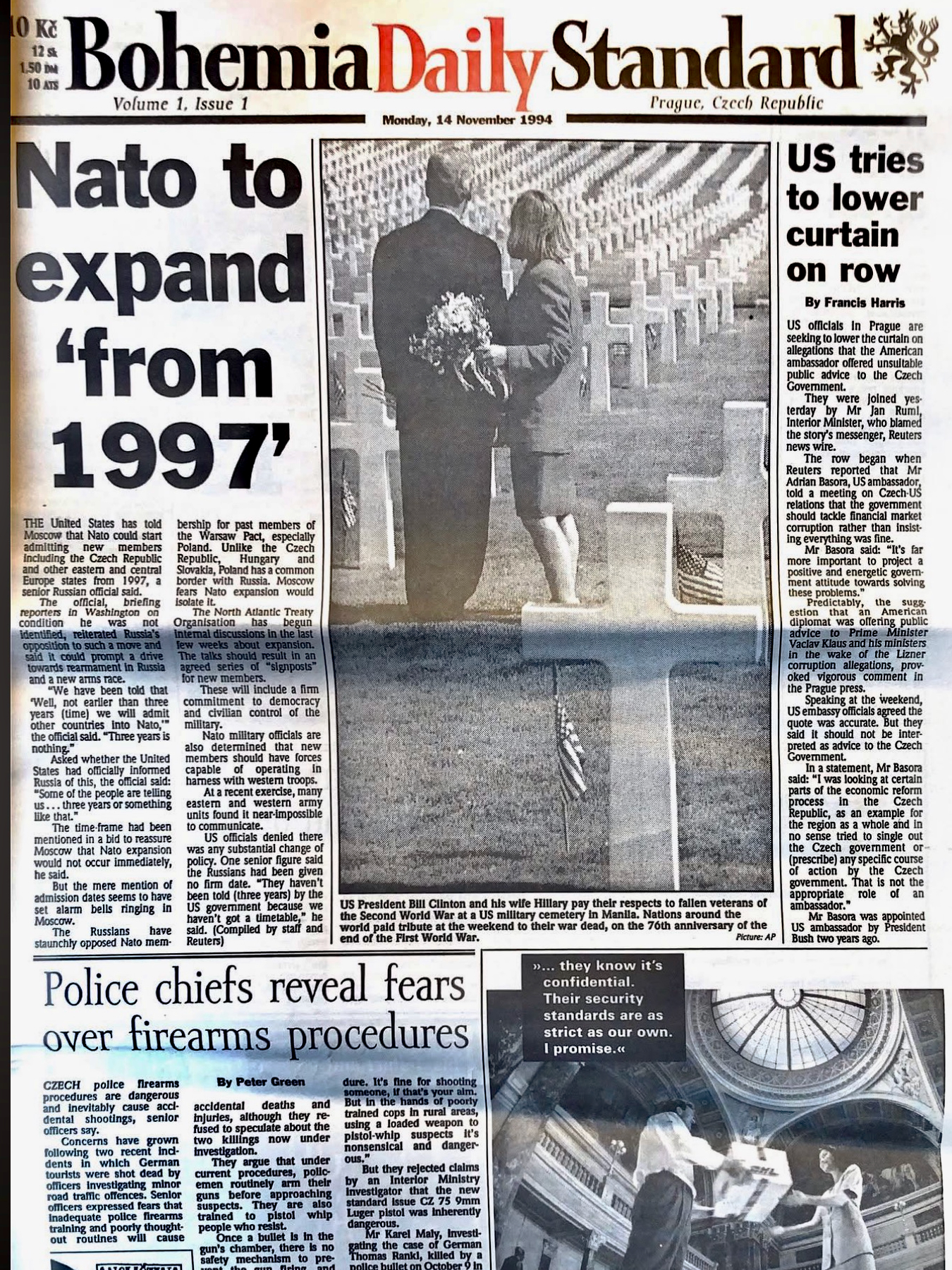
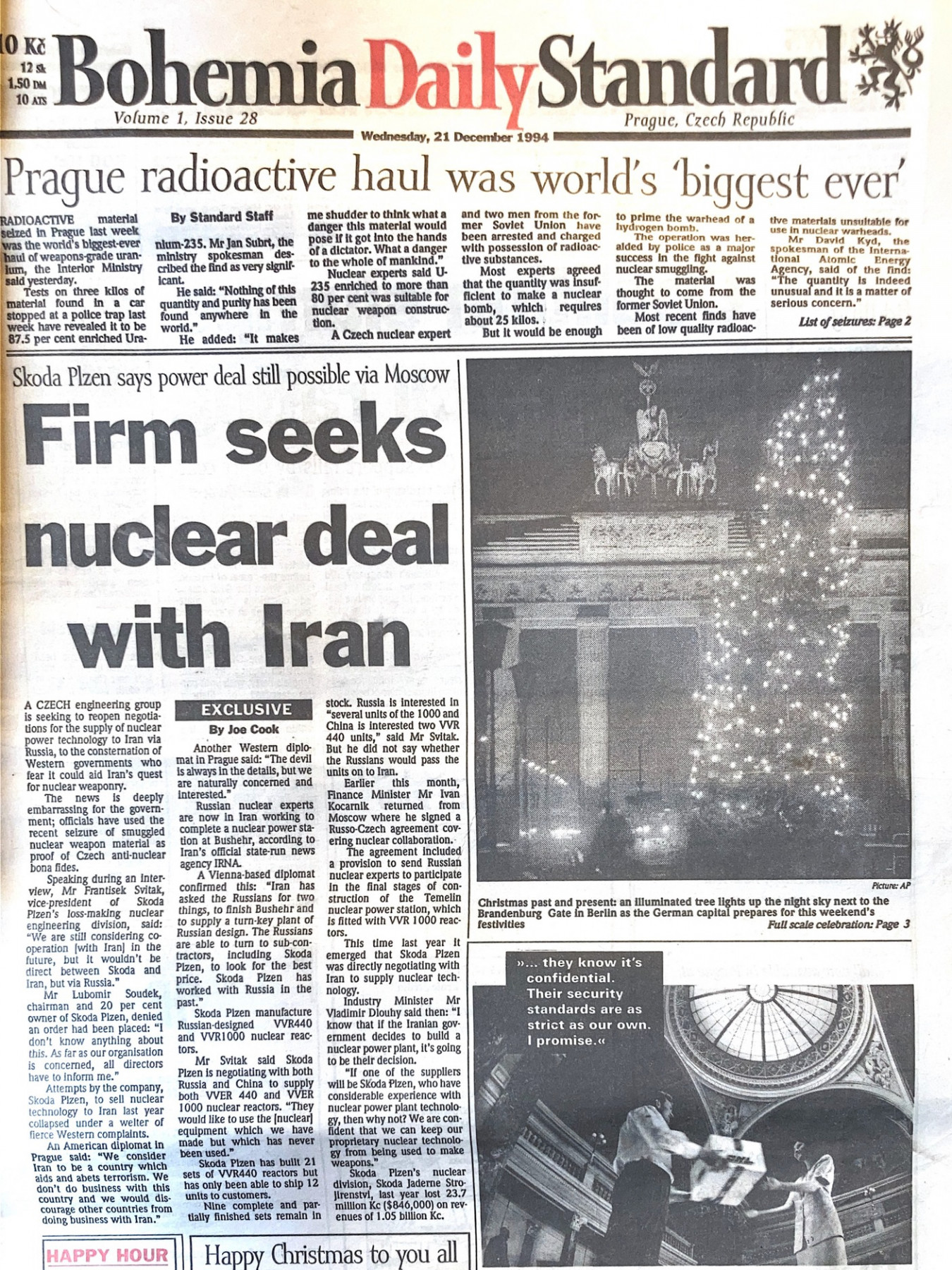
This short-lived, eight-page paper was born of hubris: the belief that the world’s sudden, intense interest in Czech news could support a daily newspaper—not just a weekly or monthly. The Standard was the brainchild of Erik Best (of Fleet Sheet fame), who brought together several talented journalists, including Francis Harris of The Daily Telegraph, as well as Peter Green and Joe Cook. The paper received some early publicity from Jane Perlez, writing in The New York Times, but it shut down after only six weeks due to weak circulation and poor prospects. Best told Think Magazine in June 1996, “We would not have done it if we hadn’t thought that we could make some money.” He added, “We obviously misidentified the market, thinking there were more people who wanted in-depth daily news.”
Donald Taylor, an editor and page designer, later wrote in the “Prague Expats in the 90s” Facebook group that “although the financial pressures proved too strong, it was great fun and in various ways changed my life. I must be one of the few people in the world to possess all 28 issues.”
NEWS MAGAZINES AND JOURNALS
In the ’90s, Prague served as the editorial headquarters for a handful of high-quality, serious-minded news journals that set their sights beyond the city’s medieval walls toward the broader Central and Eastern European landscape that had opened up after the fall of communism. The choice of Prague as a regional base made a certain sense. The city already had a sizable expatriate community of potential readers, and its location placed it near the center of this newly accessible expanse. That said, Central Europe was (and still is) a notoriously fragmented cultural space, and no single city—whether Prague, Budapest, Warsaw, or Vienna—could convincingly claim the role of regional capital. For that reason, publications based here always ran the risk of being perceived elsewhere as overly Czech-centric, a reputation they worked hard to counter through their editorial mix and reporting.
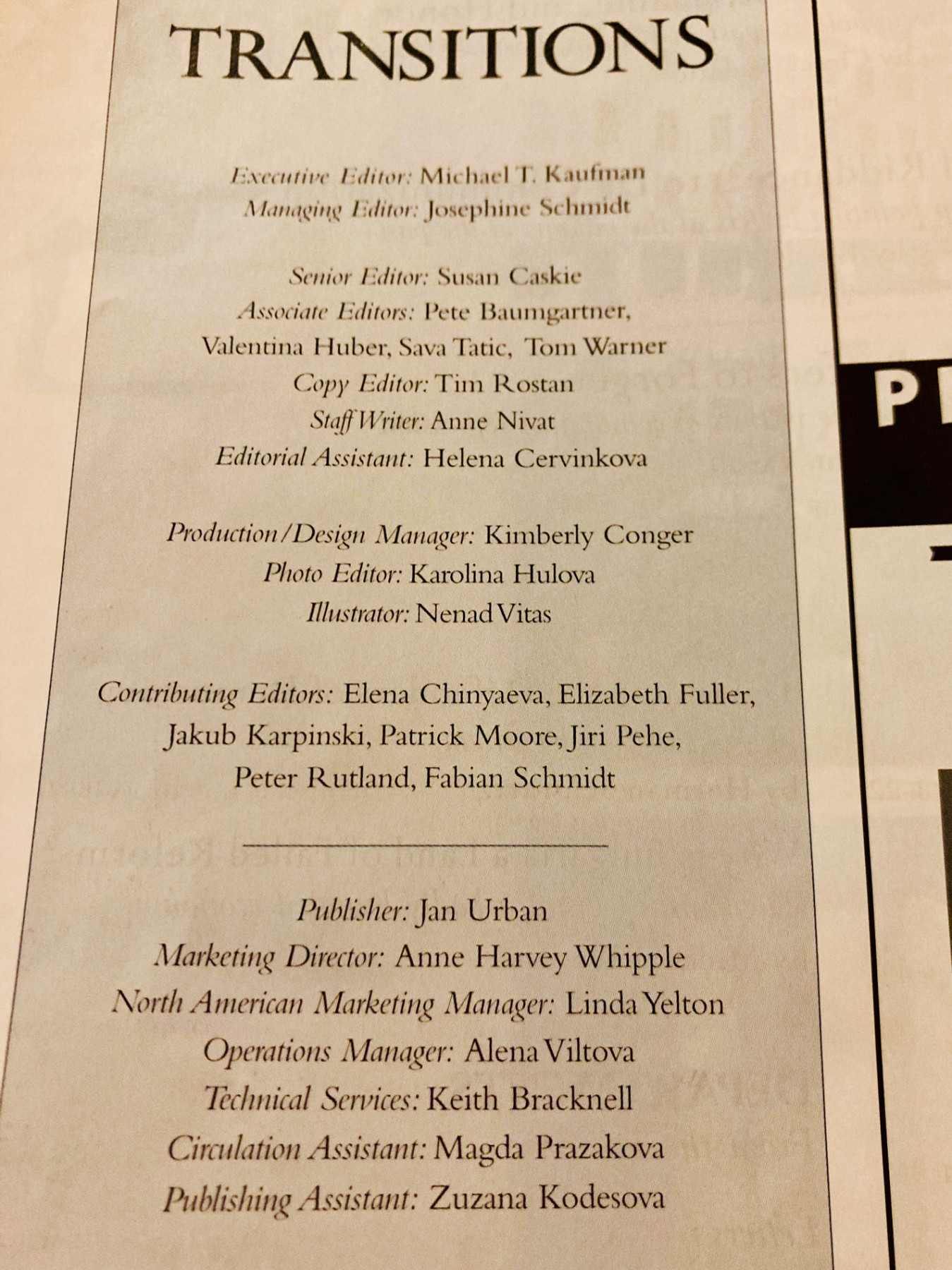
Transitions (print: 1994–1999)
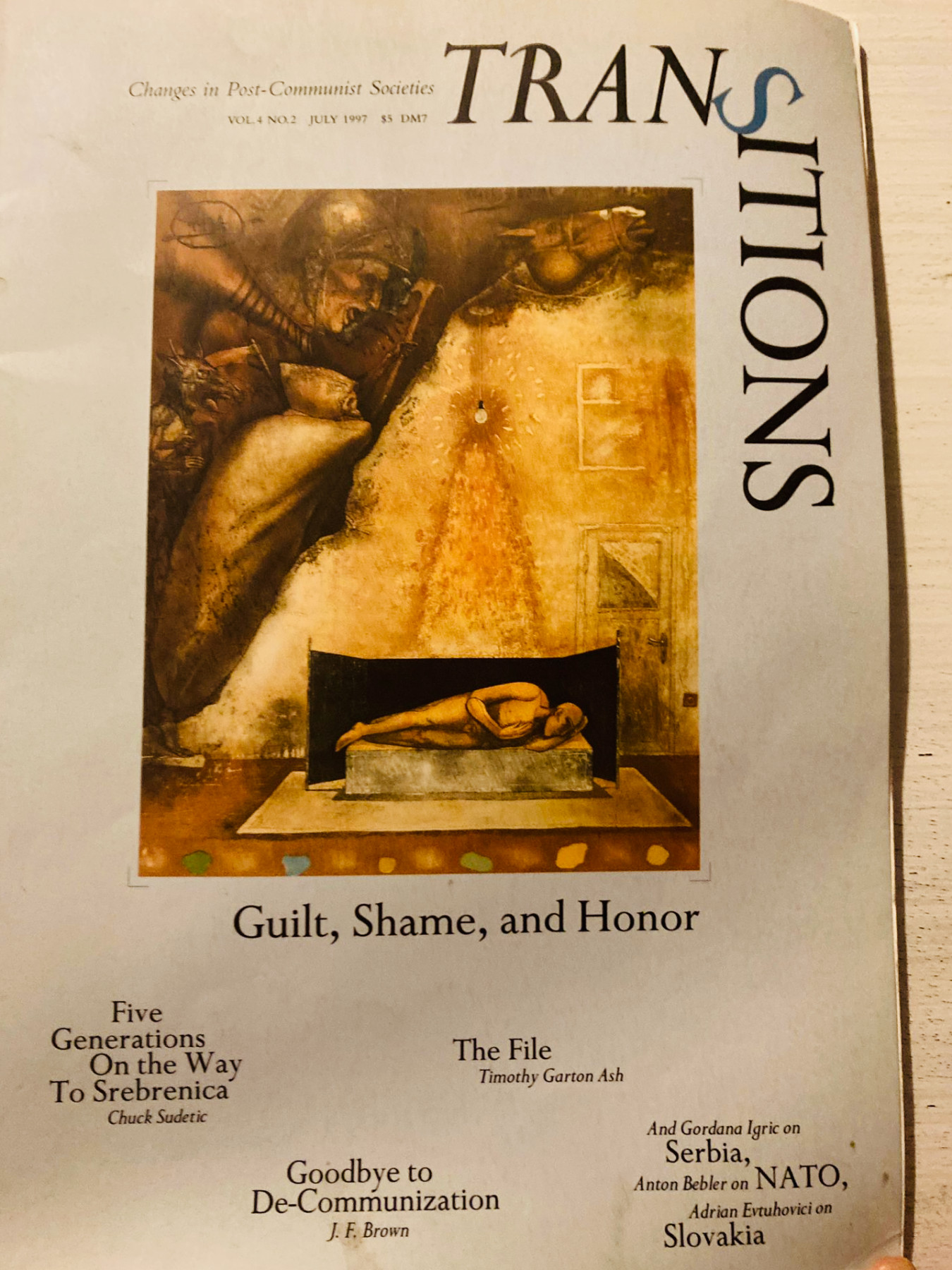
Transitions was perhaps the most ambitious of these new magazines to wager that political interest in the Czech Republic—and more broadly in Central and Eastern Europe—would remain strong long after the lights of the Velvet Revolution had dimmed. And the organization behind it, George Soros’s Open Society Institute (OSI), initially had very deep pockets. OSI assembled a crack team of writers and editors, some recruited from The Prague Post, to work under the direction of respected New York Times reporter Michael T. Kaufman.
A monthly magazine, Transitions offered real salaries and career prospects at a time when most Prague scribes were still scraping by and laboring more for love than money. That said, the publication foundered more than once over its long lifetime (the digital version has continued since 1999 as TOL). Several staffers eventually moved over to the relative security of Prague-based Radio Free Europe/Radio Liberty, and the struggles of journalists who remained at TOL in trying to get paid—by no means a problem unique to Transitions—became the stuff of local legend.
To its credit, Transitions continues to publish to this day, showcasing the work of courageous journalists across Central and Eastern Europe and the former Soviet Union.
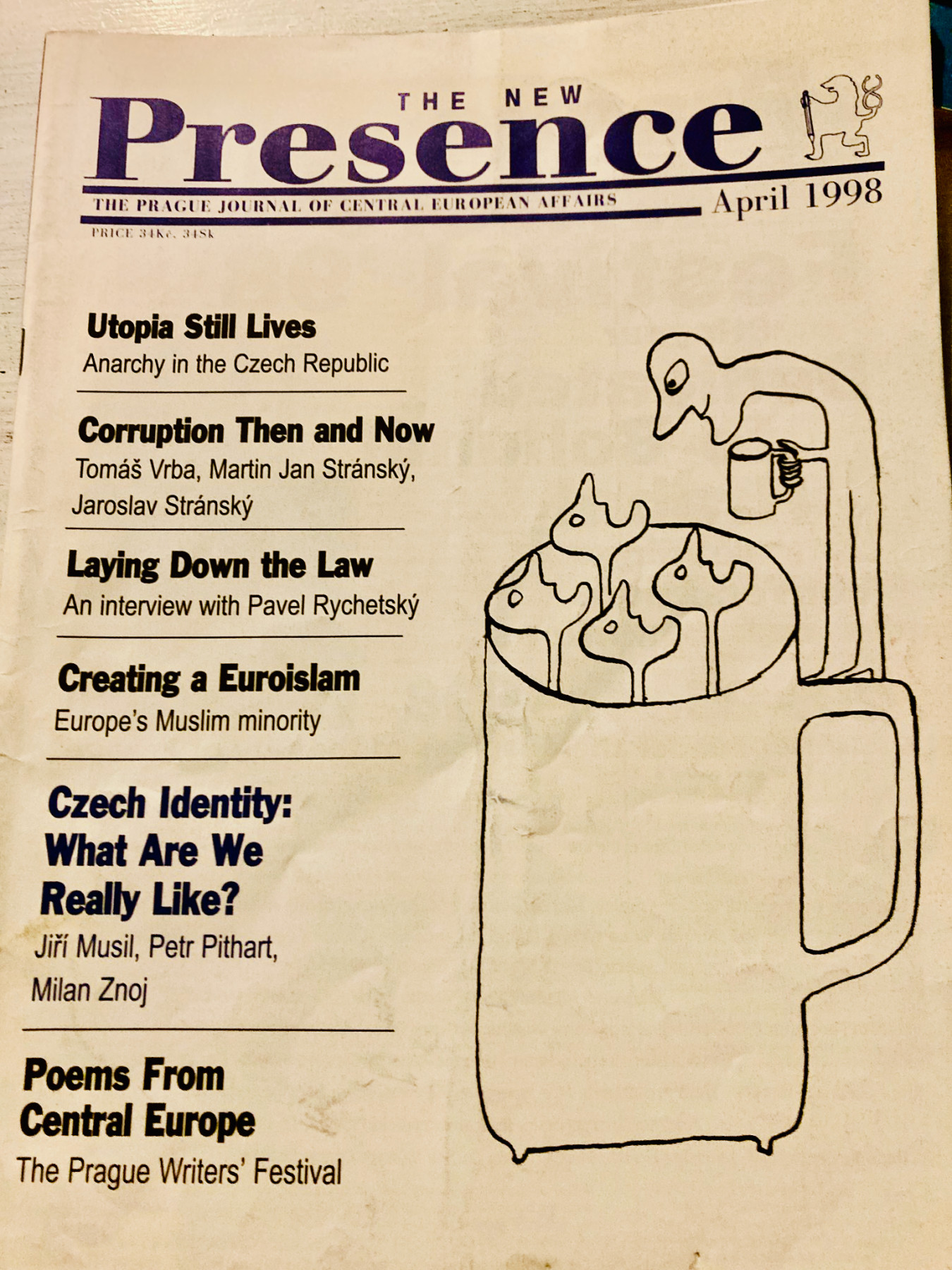
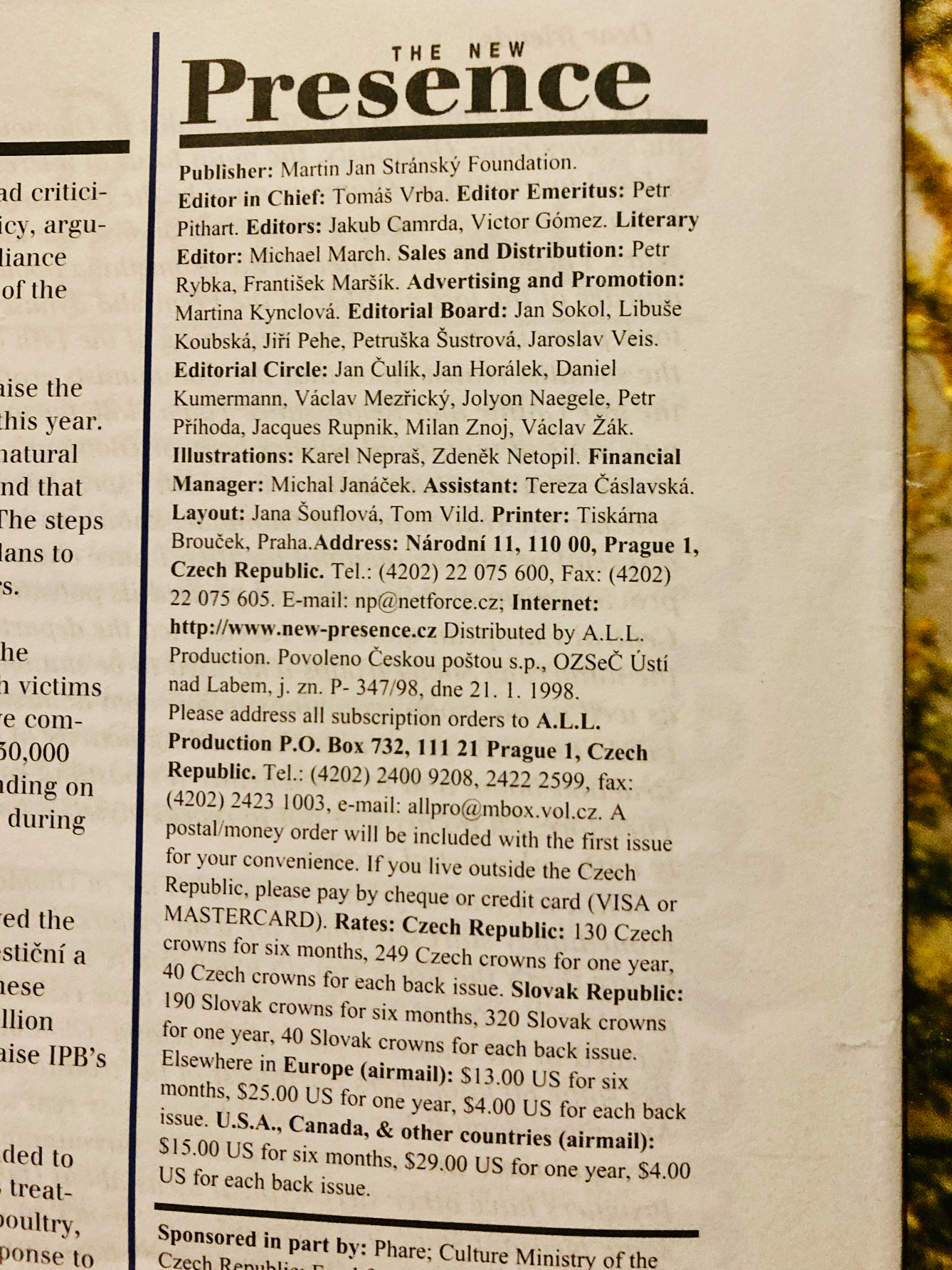
The New Presence (1996-2000s)
The New Presence had loftier ambitions than most of its peer English-language publications in Prague in the mid-1990s. The brainchild of Czech-American publisher Martin Jan Stránský, the monthly was positioned as a highbrow intellectual journal and as the international counterpart to the then-recently revived Czech magazine Nová Přítomnost.
The New Presence traced its roots to the renowned interwar publication Přítomnost, founded by the Czech journalist Ferdinand Peroutka, and saw its mission as building a bridge between the emerging Czech and international intellectual communities. The magazine later downsized to a quarterly sometime in the 2000s before ceasing publication altogether. It still lives on in digital form in partnership with Transitions Online, as a weekly English-language bulletin.
(Click here to jump to Part 2, where I look at all the expat business and economic publications that tumbled down the pike in the 1990s.))
Did you like the story and want to add your own experiences? Or maybe help me to correct something I didn’t get right? Write me at bakermark@fastmail.fm.
*I’m also highly indebted to Think Magazine, which over the years chronicled the rise and fall of the expat publishing world. Find a sample link here and here.